

COLOWE Orders Are Full, And The Factory Is Open Day And Night
1, The global twin-screw extruder market welcomes a structural growth window
According to the "2025-2031 Global Twin Screw Extruder Industry Research and Trend Analysis Report", the global revenue scale of twin screw extruders is expected to reach approximately 11.11 billion yuan in 2024, and is expected to approach 12.92 billion yuan in 2031, with a compound annual growth rate of 2.2%. More noteworthy is that the growth rate of the sub market for co rotating twin-screw extruders is significantly higher than the industry average, and it is expected that the global output value will reach $1848 million by 2031. The overall market for plastic extruders also maintains a strong momentum. According to the market analysis report released by Mordor Intelligence in 2026, the global plastic extruder market is expected to grow from $8.42 billion in 2026 to $11.33 billion in 2031, with a CAGR of 6.12%, with the twin-screw extruder sub category leading with a growth rate of 6.21%.
Behind market expansion is the dual drive of policy and demand. On August 12, 2026, the European Union's "Packaging and Packaging Waste Regulation" (PPWR, Regulation 2025/40) officially ended its transition period and is universally applicable in all 27 member states. It requires that by 2030, the recycled content in all plastic packaging should not be less than 30%. In the United States, as of 2026, extended producer responsibility (EPR) legislation has been extended to 12 states, and California's SB 54 bill requires a 65% reduction in disposable plastic waste by 2032. These policies directly stimulate the demand for co rotating twin-screw extruders capable of handling high impurities, high moisture, and mixed waste plastics, and also accelerate the search for reliable plastic extruder suppliers for international customers who pursue environmental protection and hope to enter the new material market with high cost-effectiveness.
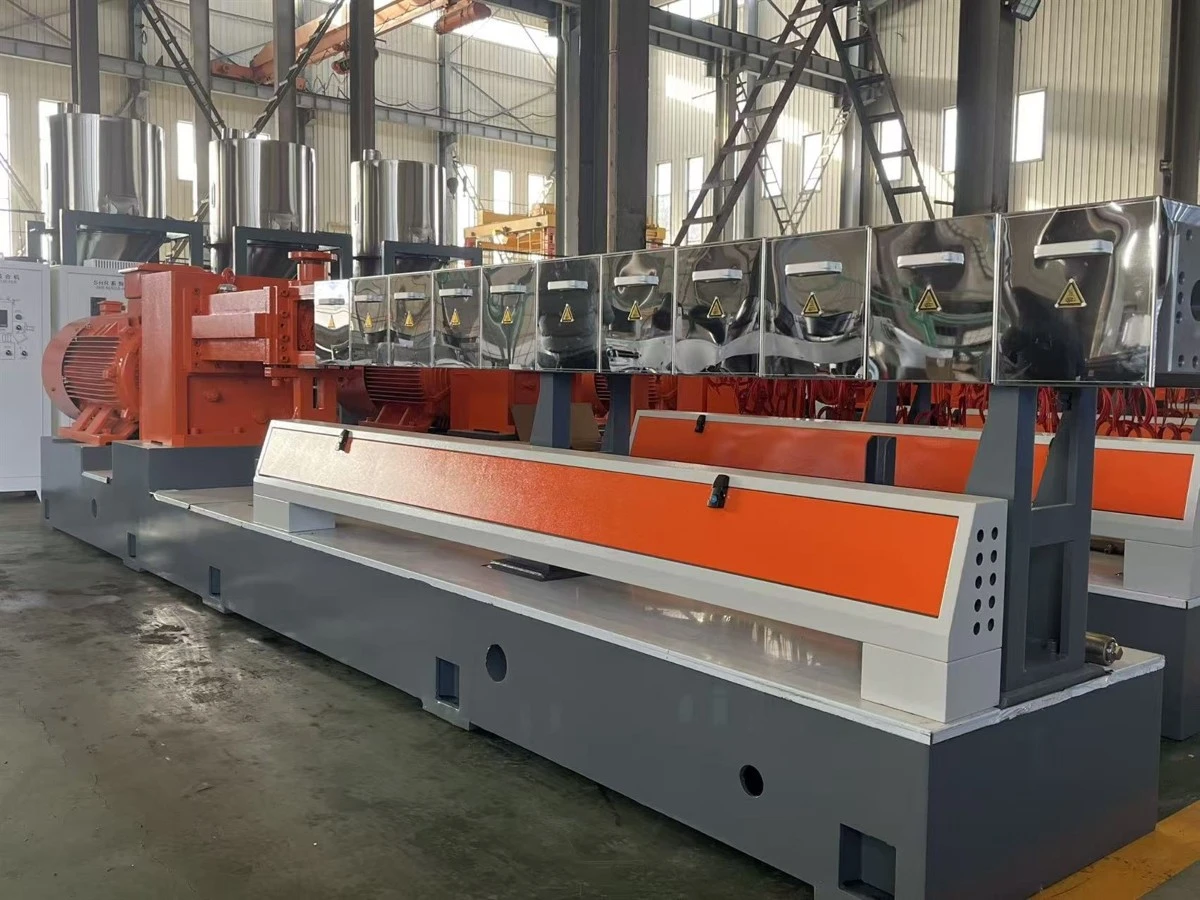
2, Where does the technical confidence of COLOWE's cost-effective extruder come from?
'High cost-effectiveness' has never been synonymous with cheap alternatives in the product logic of COLOWE. Taking the COLOWE 65D co rotating twin-screw extruder as an example, this model has a length to diameter ratio of 65:1, equipped with a high torque gearbox, a specific torque of 11.3 N · m/cm ³, and a maximum screw speed of 900rpm. All gearboxes adopt carburizing quenching and gear grinding process, and the cylinder liner is made of bimetallic centrifugal casting, with wear resistance three times higher than that of nitrogen nitride steel. The screw components are made of powder metallurgy steel imported from Europe, and have a service life of up to 5 to 8 years under abrasion conditions such as PC recycling and granulation.
For customers who are new to plastic extruders, the terms aspect ratio and specific torque may be unfamiliar - in short, the longer the aspect ratio, the more uniform the material stays in the barrel, and the better the dispersion and mixing effect; The higher the specific torque, the greater the shear force that can be output by the same motor power, making it suitable for high filling or high viscosity systems. The specific energy consumption of the COLOWE co rotating twin-screw extruder has been measured to be stable at 0.24 kWh/kg, while the average for similar specifications is 0.28 to 0.32 kWh/kg, saving about 20% energy. This means that a production line with an annual output of 5000 tons of modified plastics can reduce electricity expenses by about 120000 yuan per year, while reducing indirect carbon emissions by about 96 tons of CO ₂ .
3, From PC feedback to new material trial production: COLOWE's international practice
In 2026, an international customer who was first involved in plastic recycling directly injected PC recycled pellets produced by two 65D co rotating twin-screw extruders from Kelongwell into electronic device casings, with performance comparable to new materials. Operating data shows that the single line production capacity remains stable at 580 to 620 kg/h, with a power consumption of only 0.23 kWh per ton, saving about 15% energy compared to similar solutions; The black spots of PC return particles are controlled at ≤ 3/200g, and the tensile strength retention rate is as high as 96%, meeting the requirements of high-end electronic and electrical injection molding.
Earlier, the COLOWE twin-screw extruder completed a difficult trial in the field of nylon recycling and successfully exported to overseas markets. It used PA66 recycling as raw material and successfully achieved high-value recycling of nylon recycling through technological advantages such as high torque, high speed, and strong mixing. A person in charge of a modified plastic production enterprise commented, "COLOWE's co rotating twin-screw extrusion granulation line not only successfully completed the first batch of PP material trial machines, but also performed steadily in subsequent capacity improvement and formula expansion tests. The modular screw combination makes formula switching efficient and flexible. "
4, Quick questions, quick answers
Q1: For the first attempt at plastic modification or new material trial production, should we choose a cost-effective extruder or a high-end configuration model?
A: COLOWE's cost-effective co rotating twin-screw extruder has not compromised on core parameters - modular screw structure, combined cylinder design, and high torque gearbox are all standard. For first-time customers, COLOWE provides a complete solution from process diagnosis to equipment customization, helping customers complete new material trial production and formula verification with a lower investment threshold, and expand production after the process matures.
Q2: How does the COLOWE plastic extruder adapt to the high impurity and high moisture characteristics of environmentally friendly recycled materials?
A: The COLOWE co rotating twin-screw extruder adopts a large aspect ratio design, and the 14 section cylinder can accurately layout functional areas such as exhaust, vacuum, and side feeding. Combined with the deep devolatilization technology of dual vacuum chambers in series, it effectively removes trace moisture and residual additives from the melt. The screw combination adopts a "high dispersion+low shear" configuration, which not only achieves efficient melting and mixing, but also avoids molecular chain breakage caused by excessive shear.
Q3: In the face of EU PPWR and other environmental regulations, can COLOWE's equipment help customers meet standards?
A: Okay. PPWR requires that the recycled content in plastic packaging should not be less than 30% by 2030. Kelongwell's rPET bottle chip non drying and thickening solution can increase the IV value from 0.55 dL/g to 0.78 dL/g without crystallization drying, saving 35% energy compared to traditional routes. The equipment can increase the retention rate of tensile strength of recycled PP from 72% to 89% in the processing of recycled materials, helping customers' products meet food grade or high-end application standards.

5, Why do global environmental modification factories choose COLOWE?
The answer lies in the balance between technical data, environmental compliance, and full cycle costs. In the third quarter of 2026, the production line delivered by Kelongwell covers various application scenarios such as rPET thickening, PLA/PBAT biodegradation modification, and PE/PP high filling regeneration granulation. From 55mm laboratory level to 75mm mass production level, the product matrix of COLOWE's co rotating twin-screw extruder covers the complete demand chain from new material trial production to large-scale production. The bright lights in the factory day and night are the most honest recognition of the market for the COLOWE twin-screw extruder.
No Information


