

How To Select Kneading Block (KB) Offset Angles For Twin-Screw Extruders: Comparison Of 30°, 45°, 60°, 90° On Mixing Performance & Energy Dissipation
How to Select Kneading Block (KB) Offset Angles for Twin-Screw Extruders: Comparison of 30°, 45°, 60°, 90° on Mixing Performance & Energy Dissipation
Publish Date: June 24, 2026
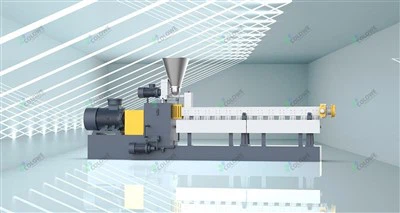
Kneading blocks (shortened as KB) are core modular components that define the final quality of modified plastic pellets in co-rotating twin-screw compounding lines. Whether customers produce glass fiber reinforced composites, high-filler masterbatch or polymer alloy blends, the offset angle of kneading blocks directly determines filler dispersion efficiency, melt uniformity and even the risk of material thermal degradation.
Many production technicians struggle to pick suitable KB angles among the four mainstream specifications: 30°, 45°, 60°, 90°. This technical guide clarifies the fundamental working logic of offset angles, compares their conveying capacity, shear intensity and heat generation, and lists matching application scenarios for each model to support customized screw layout design.
1. Core Mechanism: What Does Kneading Block Offset Angle Control?
The offset angle of kneading blocks balances two key forces inside the barrel: forward conveying thrust and shear resistance applied to molten polymer.
• Small offset angle: The geometry is close to standard conveying screw elements. It delivers strong forward pushing force, shortens material residence time, and generates mild shear with low heat buildup.
• Large offset angle: The forward driving component decreases sharply while flow resistance rises significantly. Materials are retained for longer residence time under intense shear. At 90°, the kneading block loses all axial conveying ability, and melts can only pass through relying on continuous pressure from upstream material flow.


2. Function & Energy Dissipation Comparison of Four Standard Kneading Blocks
2.1 30° Kneading Block
Core Function: Prioritize axial conveying with gentle distributive mixing.
Energy Dissipation: Extremely low. Fast material flow reduces friction and shear stress, minimizing self-generated heat.
Typical Application: Installed at the front melting zone. It supplies mild shear to soften solid pellets without excessive flow resistance that causes blockage. This angle is the safest option for highly heat-sensitive polymers prone to scorching under extra heat.
2.2 45° Kneading Block
Core Function: Balanced conveying and moderate shear mixing. It maintains stable forward transport while providing uniform homogenization.
Energy Dissipation: Medium level. Creates stronger mixing effect than 30° blocks without triggering sudden overheating of the barrel.
Typical Application: The standard primary mixing element for general-purpose plastics. It serves as the main melting section for most unmodified resins, suitable for preliminary homogenization where extreme high shear is unnecessary.
2.3 60° Kneading Block
Core Function: Dominated by dispersive shear mixing; axial conveying capacity drops obviously. Materials experience powerful stretching and breaking action.
Energy Dissipation: High. Extended residence time converts much mechanical energy into frictional heat, leading to obvious melt temperature rise.
Typical Application: Ideal for hard-to-blend formulations, including alloying polymers with large viscosity differences and mineral filler dispersion. It efficiently breaks agglomerates of calcium carbonate, talc powder and titanium dioxide to achieve homogeneous filler distribution.
2.4 90° Kneading Block
Core Function: Pure dispersive & distributive mixing with zero axial conveying capacity. Melts are fully rolled and subjected to maximum radial shear force.
Energy Dissipation: Extremely high (peak heat generation). High pressure and intense shear create massive frictional heat. Overlong 90° segments easily trigger local molecular degradation, discoloration or scorching.
Typical Application: Used for pressure building and extreme homogenization at the end of mixing sections. It acts as a flow barrier to force complete melting and uniform blending, widely adopted for final dispersion of glass fiber and heavy mineral fillers.

3. Intuitive Performance Ranking of All Four Angles
1. Axial Conveying Capacity (Material Flow Speed):
30° > 45° > 60° > 90° (Zero conveying capacity)
2. Shear & Dispersion Strength (Agglomerate Breaking Ability):
90° > 60° > 45° > 30°
3. Energy Dissipation (Heat Generation & Degradation Risk):
90° > 60° > 45° > 30°
Final Summary
Choose 30° or 45° kneading blocks if you prioritize fast throughput and low thermal degradation risk for heat-sensitive materials. Select 60° or 90° kneading blocks when full filler dispersion and thorough homogenization are required.
Customized screw layout relies on matching different KB angles according to material viscosity, thermal stability and filler loading. Reasonable combination of kneading blocks is the key to stable, high-quality twin-screw compounding and pelletizing production.


