

Extruder Vent Spillage: Root Causes & Practical Troubleshooting Solutions
Vent spillage (also known as vent overflow) at vacuum vent ports is a prevalent operational issue during twin-screw extrusion and plastic pelletizing processes. The vacuum vent is designed to extract moisture and volatile components from molten polymer; however, unexpected melt overflow contaminates equipment surfaces and may trigger unplanned production shutdowns when severe.
I. Working Principle of Extruder Vent Section
The screw configuration corresponding to the vacuum vent is specially engineered as a devolatilization zone with deep screw flights, where polymer does not fully fill the screw channel. The unfilled channel reserves ample free space for vapors and moisture to escape outwards smoothly.
Spillage occurs once pressure balance in this zone collapses: excessive polymer fill or abnormal built-up pressure inside the barrel forces molten resin to surge out via the only open outlet-the vacuum vent port.

II. Four Core Root Causes of Vent Spillage
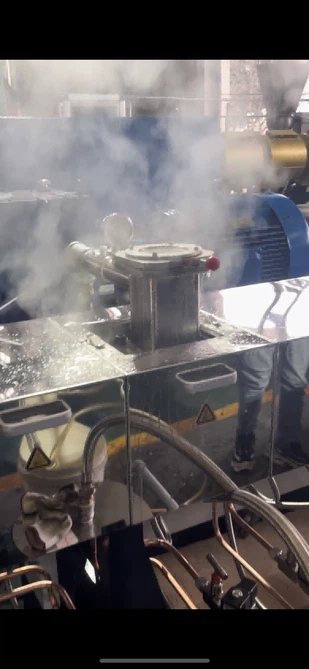
1. Improper Screw Element Layout
Forward conveying kneading blocks or reverse screw segments are commonly arranged upstream of the vent to build localized pressure for full volatile release. If the downstream conveying element right below the vent features insufficient pitch or poor delivery capacity, incoming molten stock accumulates rapidly within the vent zone with inadequate forward transportation, eventually overflowing upward from the vent opening.
2. Unbalanced Processing Parameters
• Over-feeding: Material input exceeds the maximum conveying limit of the screw, leading to overfilling of the vent section channels.
• Low barrel temperature: Undersized heating on the barrel ahead of or at vent section restricts complete polymer melting, raising melt viscosity and flow resistance to cause material stacking and blockage.
• Excessive head backpressure: Clogged screen packs, low die temperature or restrictive mold geometry triggers backward melt backflow, which fills up the devolatilization segment reversely.


3. Intrinsic Raw Material Properties
• High moisture & volatile content: Undried feedstock generates massive instantaneous vapor inside the extruder after heating. Rapid bubble expansion and rupture inside the barrel drag molten resin out from the vent, analogous to boiling liquid spilling over the pot rim.
• Low melt strength or high wall-adhesion: Runny low-viscosity polymer or highly adhesive melt fails to maintain stable flow and easily creeps upward to overflow the vent.
4. Overly High Vacuum Level
Extreme vacuum suction is another common trigger for spillage. Excess vacuum pressure dramatically inflates existing bubbles inside low-viscosity melt, with expanded bubbles carrying molten polymer outward and sucking stock out of the vent port.

III. Tiered Troubleshooting Solutions for Vent Overflow
We split corrective actions into two phases: quick process fine-tuning without machine disassembly for emergency mitigation, plus permanent mechanical modification for long-term prevention.
Phase 1: On-site Quick Process Adjustment (Emergency Fix)
1. Reduce feed rate while moderately raising screw rotating speed: Free up spare space within vent-section screw channels and lower polymer filling ratio.
01
2. Cut down vacuum intensity: Lower vacuum from extreme levels (e.g., from -0.08MPa down to -0.06MPa), most cases eliminate spillage while keeping qualified devolatilization efficiency.
02
3. Adjust barrel temperature by material status: Raise pre-vent heating temperature for incompletely melted solid feed to improve plasticization and reduce viscosity; drop vent-section temperature for overly fluid resin to thicken melt and boost structural strength.
03
4. Clean clogged screen and die assembly: Replace blocked filter screens or preheat die flange properly to relieve excessive head backpressure and reverse backflow.
04
Phase 2: Permanent Hardware & Screw Optimization (Fundamental Remedy)
If repeated spillage persists after full process tuning, upgrade screw layout and barrel accessories fundamentally:
1. Install high-pitch, multi-start deep-flight conveying elements directly below vent ports, with a minimum delivery capacity twice the actual feed throughput.
2. Adjust spacing of upstream restriction components: Maintain a clearance of 0.5~1×screw outer diameter between reverse kneading blocks and vent opening as buffer space.
3. Add anti-spillage scraper baffles at vent port: Custom fitted scraper inserts push creeping melt back into screw channels to avoid upward overflow.
4. Resize vent opening geometry: Modify narrow original vents into flared or stepped expansion ports to slow vapor flow speed and cut entrainment of molten particles.
IV. Final Operational Tip for New Material Trials
Prior to formal production with new formulations, test raw material moisture content, volatile proportion and inherent melt viscosity thoroughly. Follow the core operation principle: build moderate upstream restriction, strengthen downstream conveying, regulate feeding volume and guide steady material flow to prevent recurring vent spillage.


