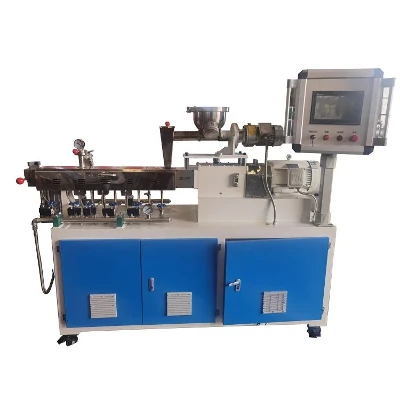
How To Choose A Cost-effective Screen Changing System For Your Twin-screw Extruder
Global Market Institute (GMI) predicts that the global extruder market size will increase to $19.1 billion by 2034, with co rotating twin screw extruders expected to achieve a compound annual growth rate of 5.8% due to their excellent mixing performance and ability to handle complex formulations.
For international customers who pursue environmental protection, high cost-effectiveness, and try to produce new materials, choosing the appropriate screen changing system is not only related to production efficiency, but also the key to achieving efficient extrusion and sustainable production.

1. Market Trends and Core Challenges
The plastic granulation industry is undergoing profound changes. According to the in-depth research and analysis report on the competitive landscape and investment planning of China's plastic particle industry from 2025 to 2030, increasing the utilization rate of recycled plastics to over 30% has become a global trend.
This trend has driven the demand for plastic extruders that can handle diverse raw materials, especially those that are compatible with recycled and biobased materials.
The global extruder industry is transitioning towards energy efficiency and sustainability. Manufacturers are facing a dual pressure: to meet increasingly stringent environmental regulations while maintaining production cost competitiveness.
For international customers who are new to plastic granulation, this means that they must be more cautious in equipment selection, ensuring that the selected system meets current needs and has the flexibility for future upgrades.
2. Fundamentals and Selection Principles of Network Switching System
The screen changer is essentially a switching device used to filter foreign particles and impurities in plasticized materials. In the plastic extrusion production line, it is responsible for ensuring the purity and consistency of the final product.
The screen changer can be divided into three categories: manual, hydraulic automatic, and mesh belt fully automatic. The manual type has a small volume and low cost, but requires shutdown to replace the filter screen; Hydraulic automatic screen changing is fast and has strong sealing performance; The mesh belt fully automatic type can achieve continuous mesh changing.
When choosing a mesh changing system, it is necessary to consider the compatibility with the co rotating twin screw extruder. The type and model of extruder, production capacity and filtration requirements, and flow pressure and temperature are all key factors.
The output of an efficient extruder determines the amount of melt that needs to be processed per unit time, which directly affects the filtration area and efficiency of the screen changer.
3. Matching technical parameters of extruder
The output, pressure, and temperature parameters of the extruder directly affect the selection of the screen changing system. The continuity of the plastic granulation production line requires the screen changer to be able to work stably in high-pressure and high-temperature environments, ensuring uninterrupted production.
The temperature stability of the melt has specific requirements for the material and sealing performance of the screen changer to ensure that there is no leakage or damage at high temperatures. Usually, high-quality screen changers can withstand temperatures up to 300 ℃ and pressures of 25-30MPa.
For processing recycled materials or raw materials containing impurities, it is more appropriate to choose a system with a larger filtration area and higher screen replacement frequency. The viscosity, composition, and impurity content of materials can affect the selection of screen changers.
It is worth mentioning that the diameter of the filter screen of the extruder should usually not be lower than the diameter of the screw to ensure that the melt can pass through the filter screen smoothly and achieve the desired filtration effect.
4. Special considerations for twin screw extruder
Compared with single screw equipment, co rotating twin screw extruders have significant advantages in mixing performance and flexibility, which also puts special requirements on their screen changing system.
Twin screw systems are typically used to handle more complex formulations and a wider variety of raw materials, which means that screen changers need to address a wider range of material characteristics. In some twin screw extrusion production, due to material factors (such as ultra-low viscosity materials), it is difficult to establish sufficient mesh pressure at the extruder outlet, and it may be necessary to use it in combination with a melt pump.
For international customers who pursue high cost-effectiveness, when choosing a mesh changing system that matches the twin screw plastic granulator, modular design of the system should be considered to facilitate future adjustments and upgrades according to production needs.
Automation and intelligence are another important trend. With the integration of Industry 4.0 technology, intelligent screen changers achieve precise screen changing through servo motors, pressure sensing, and automated control systems, greatly improving production efficiency and stability.

5. Cost benefit and long-term value analysis
When choosing a network switching system, the initial investment is only a part of the total cost. Long term operating costs, maintenance expenses, and production efficiency are the key factors determining overall investment returns.
According to the selection principles of plastic extruder screen changers, there may be significant price differences among screen changers with different prices, structures, and driving methods. When making a choice, it is necessary to comprehensively consider price factors and maintenance costs to ensure economic rationality.
For customers who are trying to produce new materials, production flexibility and changeover efficiency are particularly important. Some advanced systems, through modular design, can shorten the production time of elastomers from 4 hours to 15 minutes, increasing production capacity by up to 20%.
The efficient screen replacement system ensures the stability of product quality and the continuity of production by continuously replacing the filter screen without stopping the machine, thereby saving costs and increasing efficiency. This continuous production capacity is crucial for meeting large-scale orders from international customers.
6. Customer FAQ
Question: As an international customer who is new to plastic granulation, how should I start?
For customers who are new to this field, it is recommended to start by clarifying production needs: determining the type of raw materials you plan to handle, target production volume, product specifications, and budget range. Visiting the operating plastic granulation production line and understanding the performance of different screen changing systems in actual production will help you make more informed decisions.
Question: How to evaluate the efficiency and reliability of the network replacement system?
Efficiency evaluation should focus on several key indicators: screen replacement time, pressure fluctuation range, filtration accuracy, and continuous operation time. Reliability can be judged by material quality, sealing performance, maintenance cycle, and manufacturer's technical support capabilities. High quality screen changers should be able to operate stably at pressures of 25-30 MPa and temperatures of 300 ℃.
Question: What are the special requirements for the network replacement system in pursuit of environmentally friendly production goals?
Environmentally friendly production requires a system that can efficiently process recycled materials and biobased materials, which often contain more impurities. Therefore, it is necessary to choose a screen changing system with stronger filtering ability and the ability to handle high impurity content. Meanwhile, the energy and material consumption of the system itself should also be minimized as much as possible.
Question: How should the screen changer and melt pump be coordinated in a twin screw extrusion system?
In some applications of twin screw plastic granulators, especially when handling ultra-low viscosity materials, it may be difficult to establish sufficient mesh pressure at the extruder outlet. At this point, a combination of "melt pump+screen changer" can be used, where the material is first pressurized by the melt pump and then filtered through the screen changer before entering downstream equipment.
With the expected market size of plastic granulators in China reaching 28 billion yuan by 2025, global manufacturers are facing a clear choice: whether to satisfy current production efficiency or invest in systems that can adapt to future changes.
A suitable and efficient screen changing system is hardly noticed during the smooth operation of a co rotating twin screw extruder, but it silently filters every gram of impurities, ensuring the continuity of the production line, and ultimately converting ordinary plastic raw materials into high-value product particles, invisibly shaping the competitiveness and sustainable development capabilities of the enterprise.