

How Twin Screw Extruders Work: Principles, Components & Applications
The twin-screw extruder stands as one of the most versatile and efficient machines in modern manufacturing. These systems are capable of achieving precise mixing, melting, and molding, from plastic compounding to food and pharmaceutical processing, which is often difficult for single-screw designs to match. Understanding its working principle aids engineers, production managers, and buyers in optimizing process flows and selecting the appropriate equipment based on their needs.

Core working principle
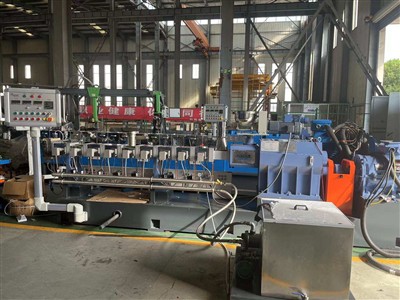
The twin-screw extruder utilizes two parallel screws rotating inside a heated barrel to convey, mix, melt, and pressurize materials. The screws mesh with each other, creating a self-cleaning effect, thereby improving material processing efficiency and reducing material buildup.
The process flow continues: raw materials enter through a hopper, move along the screw under controlled heat and shear forces, and are finally extruded from the die in the desired form (such as granules, sheets, or profiles).
Operators mainly classify twin-screw systems based on the direction of rotation:
- Co-rotating (same direction): Ideal for high-intensity mixing and compounding tasks.
- Counter-rotation (opposite direction): It has better effects in conveying and accumulating pressure, and is commonly used for heat-sensitive materials.
The screw speed, configuration, barrel temperature, and feed rate can achieve fine control over residence time, shear force, and output quality.
Multiple integrated components ensure smooth system operation:
- Hopper and feeding system: Raw materials (particles, powders, or additives) enter through this. Gravity or volumetric feeders ensure consistency of input, which is crucial for quality assurance.
- Barrel: A cylindrical shell encloses the screw. The segmented barrel is equipped with independent heating and cooling zones, ensuring precise temperature control and preventing material degradation or incomplete melting.
- Screw: The core of the machine. The modular design allows users to customize the configuration according to their needs, including conveying elements (for transportation), kneading blocks (for intensive mixing), and mixing sections. This flexibility can cater to various requirements, ranging from simple melting to complex reactive extrusion.
- Drive system: A high-torque motor and gearbox drive the screw at a controlled speed, achieving a balance between output and energy efficiency.
- Vent and devolatilization port: Remove water, volatiles, or gases to enhance product purity.
- Molds and downstream equipment: Form the melt and assist in cutting, cooling, or granulation.
The meshing action provides positive displacement, making this process more stable than single screw extrusion, especially when processing materials with diverse properties or high viscosity.

Step-by-step process

1. Feeding: Material enters the feed cylinder through the hopper. The side feeder can add fillers or additives downstream.
2. Conveying and compression: The screw is responsible for conveying and compressing the material. Friction and heat from the barrel begin to soften the material.
3. Melting and mixing: In the dedicated area, shear forces and kneading elements fully melt and homogenize the material. Additives are evenly dispersed here.
4. Devolatilization: The vacuum exhaust port is used to remove unwanted gases or moisture.
5. Metering and Pressurization: The final section is used to establish pressure, ensuring the melt passes through the die uniformly.
6. Mold forming and cooling: The material takes its final shape before being cooled and cut downstream.
This continuous flow approach supports high throughput while maintaining strict quality control.
The twin-screw system excels in the following aspects:
- The mixing and dispersion effects of additives, fillers, or fibers are better.
- Better handle powder, high viscosity or heat-sensitive materials.
- It features a self-cleaning function, which can reduce downtime during material replacement.
- Higher production, flexibility, and process stability.
- It can complete reactive extrusion or devolatilization in one step.
These advantages manifest in many applications as reduced energy consumption per kilogram, reduced waste, and stable product quality.

Manufacturers rely on twin-screw extruders in the following aspects:
- Plastics and Polymers: Compounding, Masterbatch Production, Recycling, and Engineering Plastics Modification.
- Food processing: snacks, cereals, pet food, and texturized protein.
- Pharmaceutical field: Hot melt extrusion technology for drug delivery systems.
- Rubber and elastomers: mixing and molding compounds.
- Special materials: bioplastics, composite materials, and advanced materials.
Their modular design makes them ideal for laboratory-scale development and complete production lines.

With the increasing demand for high-performance materials and sustainable processes in the industry, twin-screw extruders can provide the required control and efficiency. Proper screw design, regular maintenance, and operator training can maximize their potential.
If you need tailored solutions, reliable equipment, or technical support in the extrusion process, please contact our team. We assist manufacturers in selecting, configuring, and optimizing twin-screw systems to achieve their specific production goals.
Contact us immediately for consultation or to learn about our range of extrusion equipment


