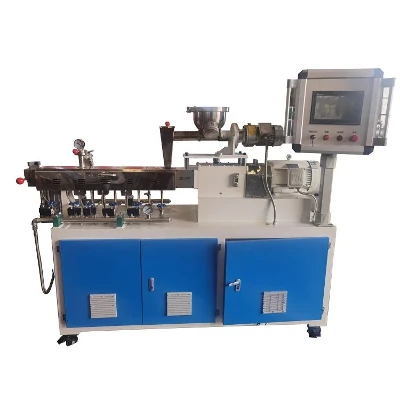
The Golden Rule For Unlocking The Quality And Efficiency Of Plastic Granulation: The Art And Science Of Parameter Adjustment
On the production line, a twin screw extruder is processing a batch of recycled plastics, and an engineer is carefully adjusting the parameters on the control panel - the global market size is continuously expanding at a compound annual growth rate of 5.5%, but experts who can accurately control product quality and maximize efficiency are still scarce.
How can I determine the quality of extruded plastic particles
How to adjust equipment parameters to ensure both quality and efficiency
This is the most common problem encountered by global plastic granulation practitioners, especially international customers who are new to extrusion technology or trying to make new materials.

1. Quality benchmark, the core dimension for judging the quality of plastic extruded products
Judging the quality of plastic pellets is not solely based on visual observation. Professional quality assessment is a scientific system that requires objective testing from multiple dimensions. This is not only the end point of the production process, but also the starting point of process optimization.
According to the standards of the Testing Center of the Northern Inspection Institute, the quality assessment of plastic extruded materials includes four core dimensions:
Physical performance indicators are the foundation, including thickness deviation measurement (with an accuracy of ± 0.05mm), density measurement, surface roughness (Ra value usually requires ≤ 1.6 μ m), and accurate measurement of transmittance and haze values.
The mechanical properties directly determine the application range of materials, and key testing items include tensile strength (generally required to be ≥ 25MPa), bending modulus, notch impact strength, and Shore hardness (commonly measured by a D-type hardness tester).
Thermal parameters reflect the thermal stability of materials, mainly including Vicat softening point (measured under a load of 50N), hot deformation temperature (performance under a load of 1.8MPa), linear expansion coefficient (usually measured in the temperature range of -30~150 ℃), and melt flow rate (standard condition is 190 ℃/5kg).
The environmental tolerance verifies the long-term reliability of the material, which is evaluated through a series of rigorous tests such as UV aging test, wet heat cycle test (such as 40 ℃/95% RH conditions), and low-temperature embrittlement temperature (commonly -40 ℃ impact test).
A study by the German Research Council further suggests that pressure fluctuations and melting degree during extrusion are directly related to the quality of the final product. This means that process control is equally important as terminal detection.
2. parameter fine-tuning, mastering the art of regulating co rotating twin screw extruders
The geometric design and process parameter settings of the screw are decisive factors in extrusion quality. This process integrates the dual wisdom of mechanical engineering and materials science.
According to the theory of extruder screw optimization design, key geometric parameters include screw diameter, aspect ratio (L/D), and thread pitch angle. These parameters directly affect the conveying efficiency, melting process, and energy conversion of materials.
The regulation of process parameters is equally crucial. Taking the co rotating twin screw extruder of Nanjing Kelongwell Chemical Machinery Co., Ltd. as an example, the optimized parameter settings usually include:
The temperature distribution needs to be precisely controlled in sections along the barrel to form a reasonable gradient. The temperature in the feeding section is usually low to prevent premature melting of the material; In the melting and mixing stages, the temperature gradually increases to ensure that the material is fully melted and uniformly mixed. The temperature control of the measuring section is particularly critical, as it directly affects the stability and final quality of the melt.
The screw speed not only affects the output, but also determines the shear effect and residence time of the material. A higher rotational speed can increase production, but it may lead to shear overheating or insufficient mixing; A lower rotational speed is beneficial for thorough mixing, but it can reduce production efficiency. Finding the optimal balance point is the key to achieving maximum quality and efficiency.
The feeding speed needs to be coordinated with the screw speed to maintain a stable filling rate of the material in the barrel. Mismatched feeding can lead to "hunger" or "overeating" phenomena, which in turn cause fluctuations in melt pressure and temperature, directly affecting extrusion stability.
The effective operation of a vacuum exhaust system is crucial for removing moisture, volatiles, and air, especially when dealing with recycled materials or certain polymers that are prone to volatile substances. Appropriate vacuum degree can significantly improve the compactness and appearance quality of products.
3. Efficiency leap, how to achieve production optimization with efficient extruders
Efficient extruders have achieved the unity of quality and efficiency through technological innovation, which is no longer a difficult choice between "fish and bear's paw". Market data confirms the growing demand for efficient equipment - the global market size of co rotating twin screw extruders has reached approximately 7.66 billion yuan in 2024 and is expected to continue to grow.
Choosing a length to diameter ratio (L/D) that matches the material characteristics is a professional choice. Research from Beijing University of Chemical Technology shows that twin screw extruders with ultra large aspect ratios (>100) have significant advantages in improving shear, dispersion, and mixing capabilities.
For most common plastics, co rotating twin screw extruders with aspect ratios between 40-48 can provide excellent mixing quality and production efficiency.
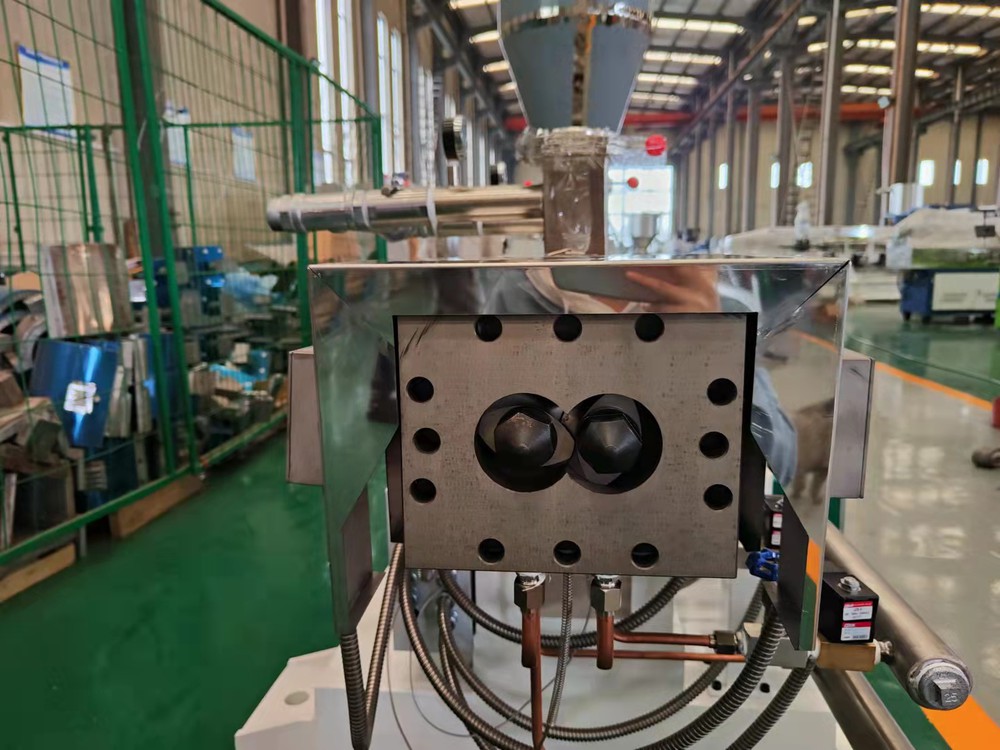
Optimizing screw combination is the core of efficient extrusion. The modular design of modern co rotating twin screw extruders allows for customized screw combinations based on material characteristics and process requirements.
The combination of different functional modules such as threaded components, kneading blocks, and anti threading components can accurately control the shear history, residence time distribution, and mixing effect of materials.
The adoption of an intelligent control system is a hallmark of an efficient extruder. The advanced equipment of Nanjing Kelongwell Chemical Machinery Co., Ltd. integrates IoT technology, which can monitor and automatically adjust key process parameters in real time.
This intelligence not only improves production stability, but also reduces unplanned downtime through predictive maintenance.
Implementing energy-saving design directly reduces operating costs. The efficient drive system, optimized heating and cooling design, and waste heat recovery technology have reduced the energy consumption of modern co rotating twin screw extruders by 5-15% compared to traditional equipment.
4. Practical Guide: Advanced Plastic Granulation Strategies for International Customers
Mastering principles and practical skills is the key to transforming theoretical knowledge into production benefits. Especially for international customers who pursue environmental protection and high cost-effectiveness, this strategy is more instructive.
For customers who are new to plastic extrusion technology, it is recommended to start by understanding the basic parameters. Understanding the interaction between temperature, pressure, and screw speed is the first step in mastering the extrusion process.
It is recommended to use the "single variable adjustment method" in the initial stage, which fixes other parameters, adjusts only one parameter and observes its impact on product quality, gradually establishing a visual understanding of the process.
Customers attempting to produce new materials need to pay special attention to the matching of material characteristics and equipment settings. Different polymers have different melting characteristics, thermal stability, and shear sensitivity.
When starting new material development, it is recommended to start with small batch experiments, gradually optimize process parameters, record the effects of each adjustment, and form a "process formula library" for specific materials.
For customers who pursue environmental protection, there are two key points to pay special attention to when dealing with recycled plastics. Recycled materials typically contain more impurities and volatiles, so stronger filtration systems and more efficient exhaust settings may be required.
The melt strength of recycled materials may be low, and temperature distribution and screw speed need to be adjusted to balance melt quality and production efficiency.
Focusing on cutting-edge technologies in the industry is the driving force for continuous improvement. According to a report by Global Market Institute (GMI), the extruder industry is moving towards greater energy efficiency, intelligence, and flexibility.
Especially the intelligent extrusion system integrating Industry 4.0 technology can achieve more stable quality and higher production efficiency through real-time data analysis and adaptive control.
The true high-efficiency extrusion is not a mechanical combination of equipment parameters, but a profound understanding and balance of material characteristics, equipment potential, and process goals, "wrote an engineer from Nanjing Kelongwell Chemical Machinery Co., Ltd. in an electronic log
When the screen displays that all indicators of this batch of recycled plastic particles meet the high-quality standards and the energy consumption has decreased by 8% compared to expectations, he knows that this is the best proof of maximizing quality and efficiency.