

Three-screw Extruders Have These Advantages Over Twin-screw!
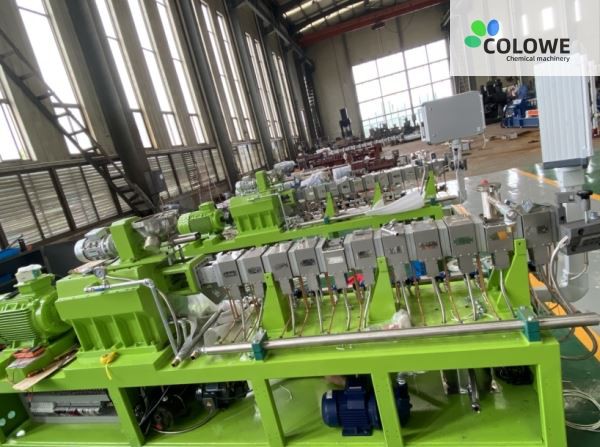
The three-screw extruder designed and manufactured by Nanjing Kelongweier Chemical Machinery Co., Ltd. has a flexible and diverse geometric arrangement. Many meshing areas form multiple changes in the flow direction and flow rate of the material, and the distribution of particle points in space. A rather beneficial effect has been formed, attracting much attention with its excellent mixing characteristics, small aspect ratio, and high capacity ratio.
The structure of the three-screw extruder is characterized in that the three screws are arranged in a line and rotate in the same direction, which is equivalent to the production capacity of two pairs of twin-screw three-screw extruders.
Three screw extruder advantages:
1. The three screws with sufficient melting and evenly distributed in-line arrangement increase the rolling range, improve the effect of rolling, and have a good actual effect of plasticizing. Because of the existence of the two meshing areas, the rolling range becomes Multipliers make the dispersion more even.
2. High production capacity Taking the production of talc powder high-filling masterbatch as an example, without high stirring, the 3-Φ52 machine can produce a filling masterbatch with a high concentration of 80% at one time, and the production capacity is 350 kg/hour , and 2-Φ52 (same type of twin-screw machine) can only produce 40% concentration of filling masterbatch without relying on high mixing or repeated processing, 60 kg/hour.
3. Energy saving Taking the 3-Φ52 machine as an example, the main motor of 75kw, 500 rpm, produces 50% concentration of carbon black masterbatch, 180kg/hr, the main motor current is 90 amperes, and the specific power is only 0.2-0.25kw.

4. The products are of high quality. One is that the twin-screw extruder produces 50% concentration of conductive carbon black masterbatch, which requires internal mixing, while the three-screw extruder does not require an internal mixer, and the material can be directly fed into the three-screw extruder to produce 50%. % concentration of carbon black masterbatch, bite the masterbatch will be deflated, cracked but not broken, indicating that the manufactured masterbatch has good toughness. why? It is because of its sufficient melting and uniform dispersion of components. It is used to blow 0.005mm film, and the test results are particularly well-proportioned. If relying on high stirring, the three-screw extruder can produce a higher concentration of carbon black masterbatch, and the particle toughness is good. The second is the 85% calcium carbonate filled PE or PP masterbatch produced by the twin-screw machine, which will be broken when pinched with a finger, while the masterbatch of the same preparation produced by the three-screw machine cannot be pinched with the fingers, and the centrifugal The dehydrator is dehydrated and dried without breaking it. The third is to produce PP flame retardant cable material. After banburying, the material is made by a 2-Φ65 twin-screw extruder with an aspect ratio of 40. The strength is 13Mpa and the elongation rate is 185%. However, using a 3-Φ65 three-screw machine without internal mixing, the strength of the material produced is 14Mpa and the elongation is 237%. In addition, the three-screw machine can process aluminum powder or masterbatch with an antimony trioxide filling of 70%, but the twin-screw machine cannot.