

Does Higher Screw Speed Always Mean Higher Output in Extrusion Production?
Does Higher Screw Speed Always Mean Higher Output in Extrusion Production?
Release Date: April 22, 2026

Production supervisors and factory managers often ask one common question on the extrusion workshop floor: Can we run the screw faster to boost hourly output?
It seems logical at first glance. Many operators believe a higher rotating speed will transport materials quicker and raise total production volume. However, this idea does not work well for polymer compounding, especially when processing biodegradable resins and high-filler formulations. Chasing extreme screw speed blindly will fail to deliver expected yield, and even cause severe quality issues for your final products.
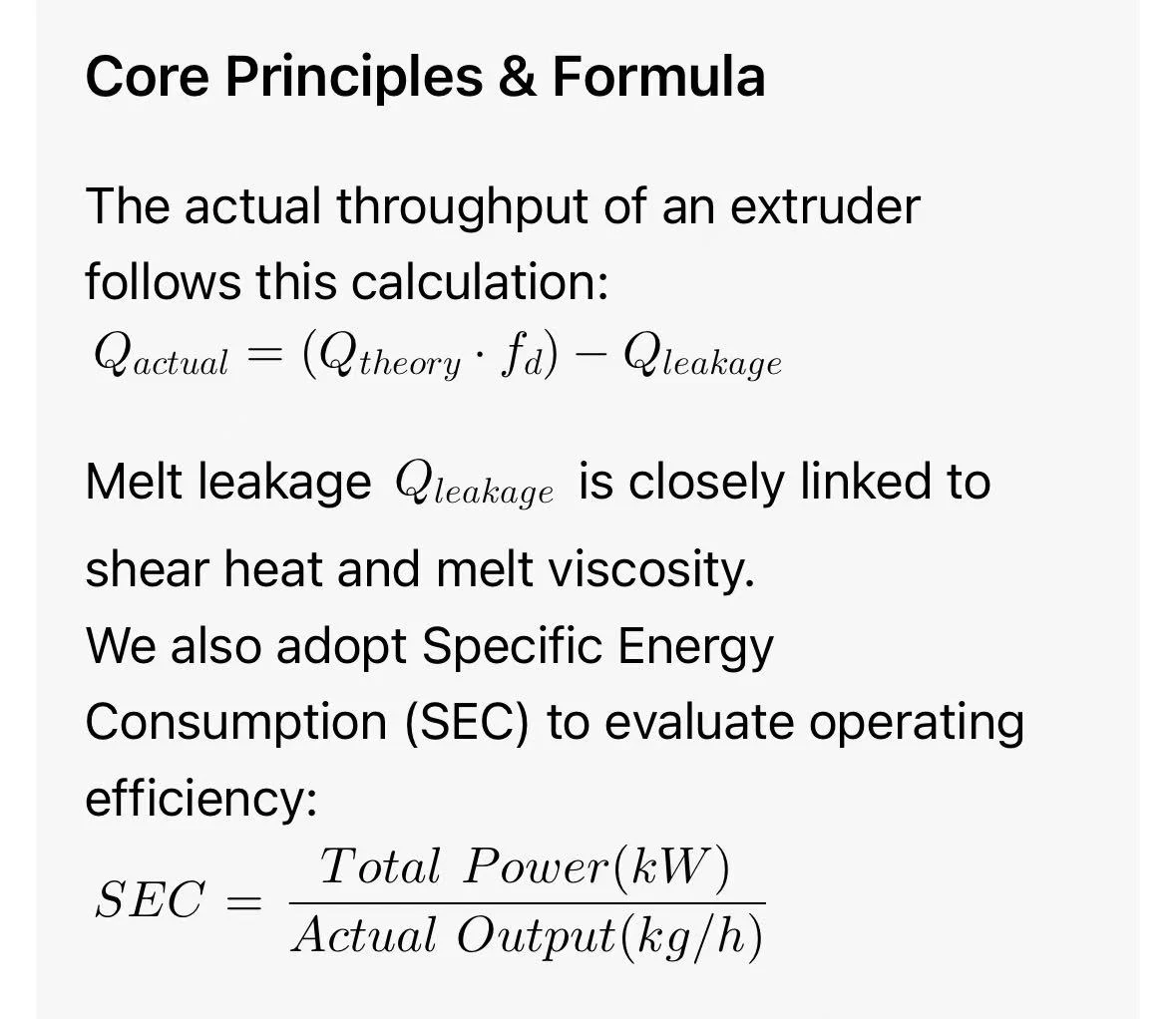
1. Is Output Proportional to Screw Speed in Theory?
Theoretically, production volume rises along with screw rotation speed. In real operation though, raising the speed from 300 rpm to 600 rpm rarely doubles the output.
Two key factors hold back production: feed limitation and melt backflow.
When the screw runs too fast, raw materials stay in the feed zone for only a very short time. If the feeding system cannot keep up, or the bulk density of materials is low, the screw will run underfilled or even idle. In this case, higher speed only leads to extra power consumption and accelerated equipment wear, with no improvement on throughput at all.
2. Watch Out for Excessive Shear Heat at High Speed
Excessive shear heat is a major headache for process technicians. The faster the screw spins, the stronger shear force the materials receive.
• Uncontrolled temperature: Massive heat generated by strong shear builds up rapidly. Even with maximum cooling on the barrel, the core temperature of molten material will spiral out of control.
• Material degradation: Heat-sensitive materials such as PLA and PBAT are easily damaged under intense shear. Overheating will break their molecular chains and ruin material properties.
• Vicious cycle: Rising melt temperature reduces viscosity, which in turn increases melt backflow. Output stops growing, and vent overflow will occur, disrupting the entire production line.
3. Specific Energy Consumption (SEC): The Key Indicator for Profitability
Hourly output is not the only standard to judge a production line. Specific energy consumption, calculated as kilowatt-hour per kilogram of product, matters more for long-term benefits.
Quite often, a 10% increase in output may cost over 30% more electricity. Meanwhile, high speed greatly shortens the service life of screws and barrels.
Besides, equipment wear does not increase linearly with speed. Doubling the screw speed can multiply wear and tear, bringing high costs for later parts replacement. This hidden loss is always overlooked by those who only pursue higher production speed.
4. Performance Threshold of Finished Products
You may notice obvious performance defects after speeding up the screw:
• Poor dispersion: Glass fiber and other fillers fail to fully combine with base resin due to shortened residence time. The mechanical strength of finished products will drop sharply.
• Strong unpleasant odor: Extra shear heat creates large amounts of volatile organic compounds (VOCs). The unwanted smell will remain on final goods and affect product quality.
5. Practical Tips to Find the Optimal Operating Point
Experienced process technicians never pursue high speed blindly. They always strike a perfect balance among screw speed, output and product quality.
• Prioritize stable feeding first. Make sure the screw is fully filled with materials before raising rotation speed.
• Focus on melt pressure stability rather than just pressure readings.
• Customize parameters for different materials. For heat-sensitive resins, reduce screw speed properly. A slight drop in output is worthwhile to maintain stable color and product performance.
Extrusion production is a long-term operation, not a short sprint. Any high output that comes at the cost of poor quality will only create waste products in the end.

No Information


