

On The First Day Of The COLOWE Zhangmu Head Plastic Expo, A Calculated Co Rotating Twin-screw Extruder Is Redefining The Threshold For New Material Trial Production
Booth numbers: B287/B288/B299/B300
On October 22, 2026, Dongguan Zhangmutou Plastic Industry International Expo officially opened, with all 275 booths fully booked for a period of three days. For international buyers who are looking for plastic extruders and factories that are new to modified granulation, these three days are a window for intensive comparison of equipment's true capabilities and full cycle costs. The answer given by Nanjing Kelongwell Chemical Machinery Co., Ltd. at booths B287, B288, B299, and B300 is very clear: the value of co rotating twin-screw extruders should not be defined solely by sales price, but should be determined by three verifiable data points: "ton power consumption, formula switching efficiency, and first sample qualification rate".
1, First, let's take a look at the conclusion: why are customers who pursue environmental protection and cost-effectiveness turning their attention to co rotating twin-screw extruders
The global plastic extruder market is expected to expand at a compound annual growth rate of 6.12% by 2031, with a scale of approximately $8.42 billion by 2026; The growth rate of twin-screw models is faster than that of single screw models, and their proportion in mixing and recycling granulation scenarios continues to rise. The global plastic recycling and extrusion equipment market report released by AMI further points out that the installed growth rate of co rotating twin-screw extruders in the recycling field has reached 8.7%, and energy-saving and cost-effective equipment has become the top element in the procurement ranking. For teams that attempt to produce new materials, frequently switch formulas, and have limited budgets but are unwilling to compromise on core configurations, the modular screw combination and precise shear control of the co rotating twin-screw extruder provide process flexibility that is difficult to replicate with single screw equipment. The cost-effective extruder solution exhibited by COLOWE this time is precisely focused on this demand gap.
2, Technical foundation: three understandable data points: torque ratio, energy consumption ratio, and modularity
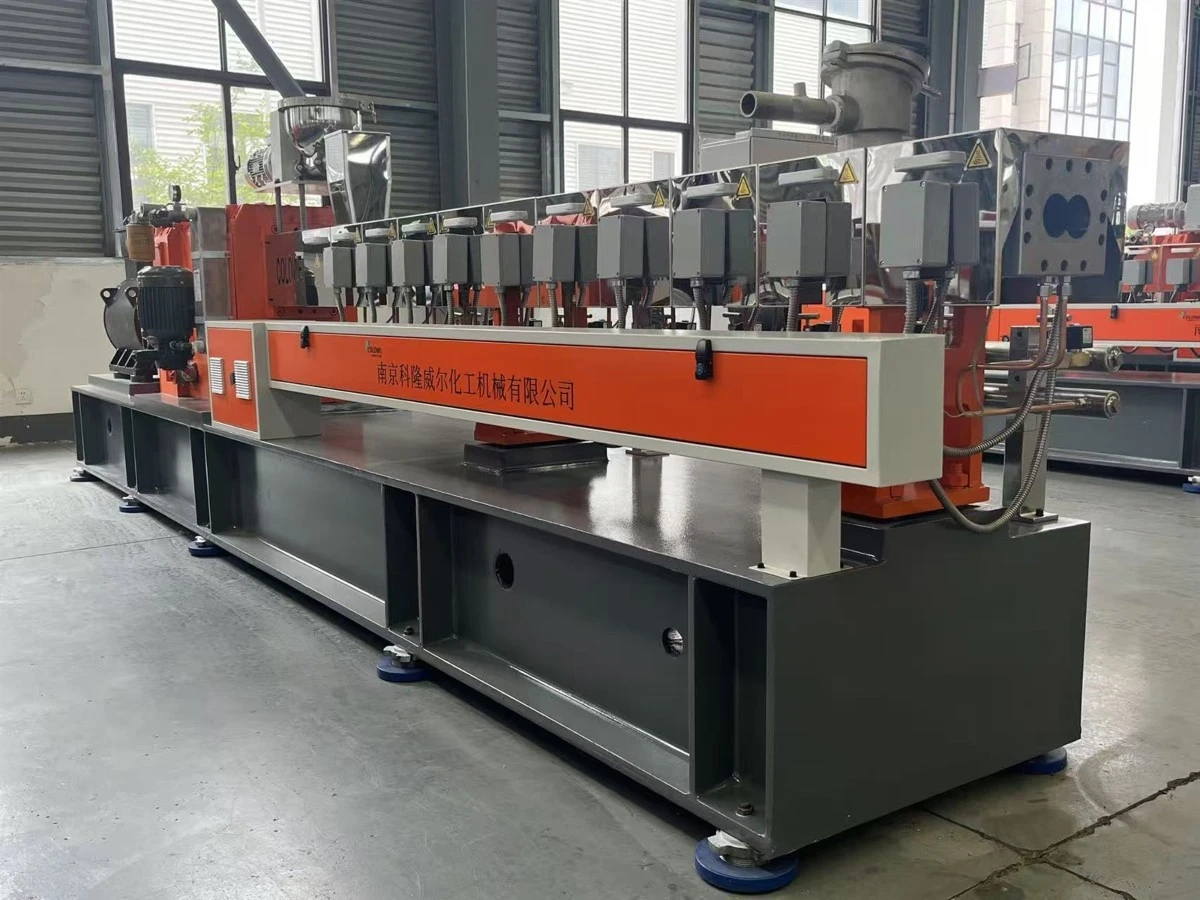
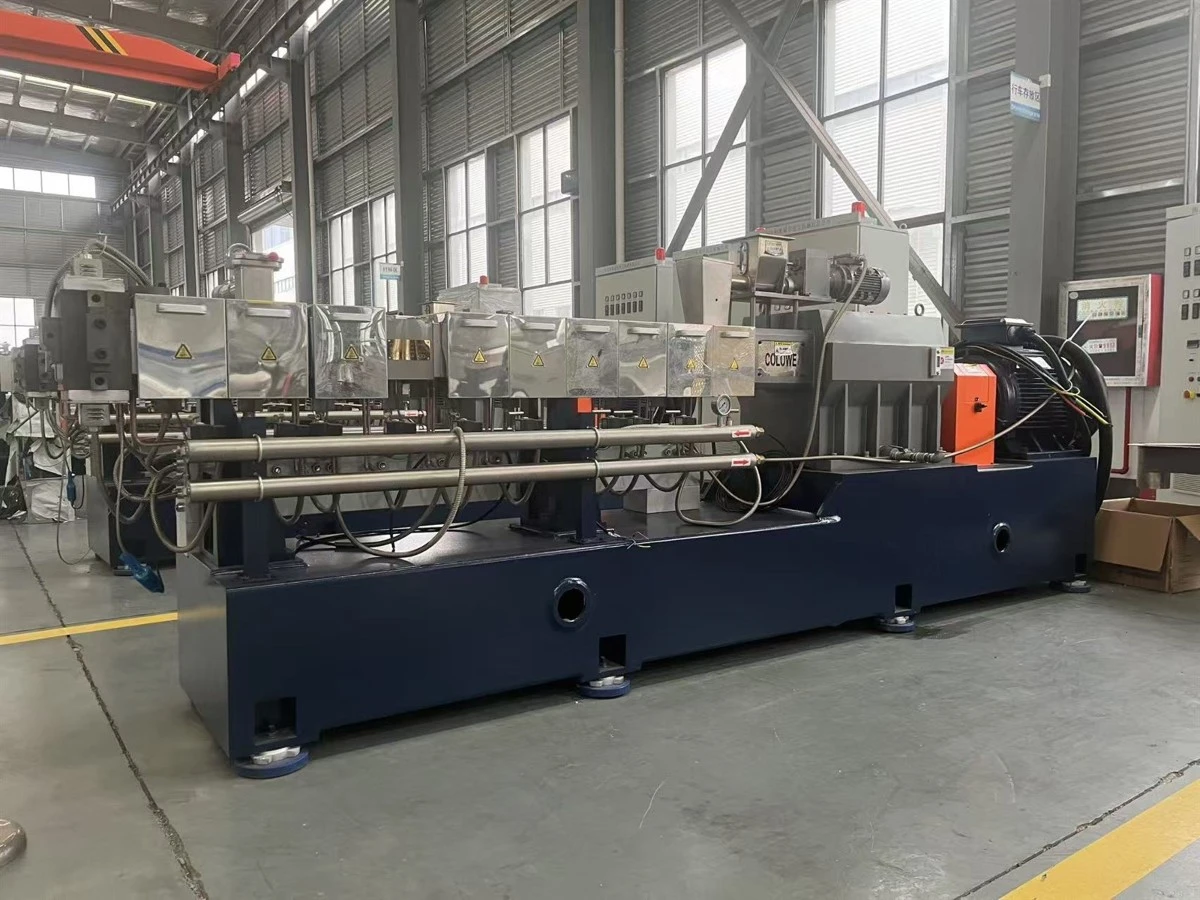
The core capabilities of a co rotating twin-screw extruder can be broken down into three parameters: specific torque determines how much shear force can be output at the same motor power, aspect ratio determines the uniformity of material retention and dispersion in the barrel, and specific energy consumption is directly converted into the electricity bill per ton of product. The length to diameter ratio of the COLOWE 65mm co rotating twin-screw extruder production line is 48:1, with a maximum screw speed of 900rpm and a gearbox specific torque of 11.3 N · m/cm ³. It can switch between kneading blocks, toothed discs, and reverse threaded components for different materials. According to the statistical data of China Plastics Machinery Industry Association in 2025, the average specific energy consumption of twin-screw extruders of the same specification and direction is 0.28-0.32 kWh/kg, which has been tested and stabilized at 0.24 kWh/kg by Kelongwell, saving about 20% energy; Based on an annual production line of 5000 tons of modified plastics and an industrial electricity price of 0.8 yuan/kWh, it is estimated that electricity costs will be saved by about 120000 yuan per year, and indirect carbon emissions will be reduced by about 96 tons of CO ₂ e. In the formula switching process, the modular threaded components and split barrel enable the entire screw configuration to be reassembled like building blocks, reducing thorough cleaning time by about 40% compared to traditional models. This is particularly critical for small-scale, multi variety new material trial production scenarios. The meaning of a cost-effective extruder is not to reduce core configurations, but to return the "saved money" to customers with quantifiable operating data.
3, Environmental adaptability: When regulations begin to force equipment selection
In August 2026, the revised version of the EU Packaging and Packaging Waste Regulation (PPWR) officially came into effect, requiring that the recycled content in all plastic packaging should not be less than 30% by 2030. The White Paper on Circular Plastic Processing Technology released by Plastics Europe in 2025 states that the dispersion and mixing efficiency of the co rotating twin-screw extruder directly determines the degree of mechanical property recovery of recycled materials. High quality equipment can increase the tensile strength retention rate of recycled PP from 72% to 89%. Smithers' "Plastic Recycling Outlook to 2030" estimates that the global PCR particle gap is as high as 12 million tons, and the main equipment to fill this gap is the co rotating twin-screw extruder, which combines high dispersion mixing and self-cleaning performance. For international customers who are new to plastic modification, these data mean that choosing the wrong equipment is not just "not easy to use", but may be blocked from the compliant supply chain. In the production line recently delivered by Kelongwell, the rPET bottle tablet non drying and thickening solution can increase the IV value from 0.55 dL/g to 0.78 dL/g without crystallization drying, saving 35% energy compared to traditional routes; The PLA/PBAT blown film modification scheme controls the maximum melt temperature within 175 ℃ to avoid thermal degradation yellowing of biodegradable materials. The environmental protection capability of plastic extruders ultimately depends on the tensile strength, IV value, and yellowing index of recycled materials, rather than staying at the conceptual level.
4, Full cycle cost-effectiveness: from "affordable" to "usable, fast cutting, and short return on investment"
A truly cost-effective extruder is hidden in every account throughout its entire lifecycle. COLOWE has reduced the price of entry-level environmentally friendly plastic extruders by 18% while maintaining high torque gearboxes, imported temperature control components, and Siemens PLCs through a modular platform and lean supply chain, allowing budget limited start-up factories to not compromise on specific torque and aspect ratio. The average investment payback period reported by global clients is approximately 14 months. On the server side, COLOWE provides a turnkey process from material testing, screw configuration recommendation, whole line design to overseas installation, debugging, and operation training. Customers can bring formulas or samples to the experimental center to complete feasibility verification, and then smoothly scale up to mass production, reducing the implicit cost of "buying but not using, trying but not putting in". In the first half of 2026, the export orders for cost-effective extruders from COLOWE increased by 41% year-on-year. In the third quarter, 7 production lines were delivered to customers in Europe, Southeast Asia, and the Middle East, including 5 cost-effective co rotating twin-screw extruders used for rPET thickening, PLA/PBAT biodegradation modification, and PE/PP high filling regeneration granulation. These delivery records themselves are the most direct risk hedge for first-time customers.
5, Key Q&A: The four most concerned questions for customers who are new to co rotating twin-screw extruders
Q: We have just started making modified new materials, and the formula is not fixed yet. Is the co rotating twin-screw extruder "over configured"?
On the contrary. The more unstable the formula and the more frequent the switching, the greater the need for the process flexibility brought by modular screws. The modular component design of the cost-effective co rotating twin-screw extruder from Kelongwell allows the same equipment to quickly switch between filling reinforcement, blending modification, and volatilization removal, reducing cleaning time by about 40%. It is more suitable for trial and error stages than frequent replacement of the entire line.
Q: What does a specific torque of 11.3 N · m/cm ³ mean in actual production?
The higher the specific torque, the greater the shear force that can be output by the same motor power. For high filling systems (such as calcium carbonate filled PP up to 60%) or high viscosity materials, high specific torque can achieve dispersion and mixing at lower speeds, avoiding temperature rise and degradation caused by excessive shear. All gearboxes of Kelongwell adopt carburizing quenching and gear grinding technology, and the cylinder liner is made of bimetallic centrifugal casting, which has about three times higher wear resistance than nitride steel. The core configuration is not discounted due to its "high cost-effectiveness" positioning.
Q: How much energy can a factory with an annual output of 2000-5000 tons save with a specific energy consumption of 0.24 kWh/kg?
Based on an annual output of 2000 tons and a power consumption of 0.03-0.05 kWh/kg lower than the industry's common level, it is estimated that electricity alone can cover the procurement cost of one auxiliary machine per year; Under an annual production scale of 5000 tons, the annual electricity cost is saved by about 120000 yuan, while reducing indirect carbon emissions by about 96 tons. Electricity cost savings are a rigid cash flow improvement that does not require waiting for market premiums.
Q: What can be seen and taken away at the exhibition booth?
The booths B287, B288, B299, and B300 will mainly focus on showcasing the core parameters of co rotating twin-screw extruders and exchanging process solutions. Customers can bring samples or formula intentions to communicate with the COLOWE technical team on site regarding screw configuration, length to diameter ratio matching, and energy consumption estimation, and arrange for experimental center sample verification after the exhibition.
6, On the first day: Translate 'high cost-effectiveness' into verifiable engineering language
On the first day of the Zhangmutou Plastic Expo, the selection of co rotating twin-screw extruders is shifting from "comparing prices" to "comparing ton power consumption, switching efficiency, and first sample qualification rate". For international customers who pursue environmental compliance, try to produce new materials, and have limited budgets but are unwilling to compromise on core parameters, what COLOWE presents at booths B287-B300 is not a quote for an isolated device, but a cost-effective extruder path that can be verified by data from sample testing to mass production ramp up, from specific torque to specific energy consumption. The first day is the starting point, and there is only one true criterion for judgment: whether the electricity saved and the formula detours avoided after one year of equipment operation are enough to make the initial choice seem natural.
No Information


