

How To Choose The Right Torque Level For Your Twin-screw Extruder: A Practical Guide For First-time Pelletizers
1. The three-layer division of torque levels: not the distinction between high and low, but the distinction between "load-bearing boundaries"
The torque level of a twin-screw extruder is determined by the specific torque (the torque that can be sustained per unit center distance volume, Nm/cm ³), which is directly determined by the gearbox structure, main bearing capacity, and drive system design. The classification logic commonly used in the industry is clear and stern: basic torque levels of 6-9, serving low load scenarios such as unfilled polyolefins and initial color masterbatch mixing; High torque type 9-13, covering the mainstream demand for engineering plastic modification, fiberglass reinforcement, and high filling masterbatch granulation; Ultra high torque type 13-18, designed for high-speed and high filling conditions in special engineering plastics, reactive extrusion, and high viscosity systems.
The gap revealed by the data is more worthy of attention than the grading itself. For every 1 Nm/cm ³ increase in torque level, the shear rate can be reduced by 15% to 20% under the same output, which means less molecular chain damage and more stable mechanical indicators such as impact strength. Taking the 65 model as an example, the production capacity of high torque configuration can reach 600-1000 kg/h, while the difference between ordinary models is significant at the same caliber. But the other side is equally true: the global demand growth rate for high torque series (specific torque ≥ 11 Nm/cm ³) is expected to reach 11% to 13% by 2026, and the market is shifting towards high torque, but this does not mean that every formula needs to enter the ultra-high torque range. For first-time granulation customers, understanding that 'sufficient with margin' is more commercially valuable than chasing parameter limits.
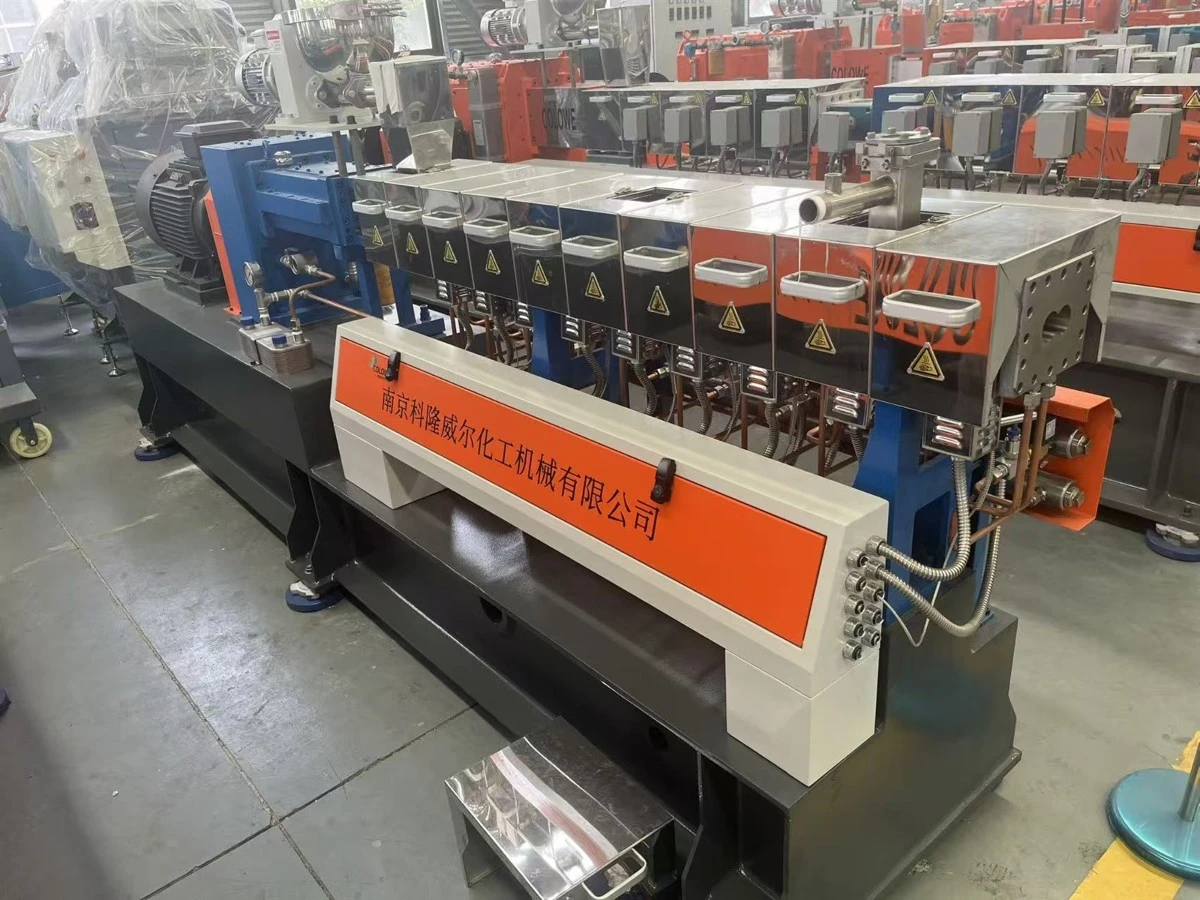
2. Derive torque from formula: Three selection paths to avoid the trap of "good parameters, difficult production line"
COLOWE has formed a pragmatic logic in the selection of a large number of exports: thermal sensitive materials are first controlled for shear, high filling materials are first considered for torque and wear resistance, and recycled materials are first treated for exhaust and plasticization stability.
The first path is reserved for heat sensitive new materials such as PLA, PBAT, and starch based materials. The processing window for this type of material is narrow, and local overheating or excessive shearing can quickly lead to degradation. The reasonable configuration of a cost-effective co rotating twin-screw extruder in this scenario is not to stack high torque, but to combine a medium aspect ratio (32:1~44:1) with multi-point independent temperature control (accuracy up to ± 1 ℃) and a screw combination mainly consisting of conveying components and flexible kneading blocks to minimize the "thermal history". The high torque gearbox equipped by Kelongwell can achieve a specific torque of 11 Nm/cm ³, coupled with a 48:1 aspect ratio combination screw, which outputs stronger shear and mixing at relatively low speeds, ensuring uniform dispersion of fillers and additives while avoiding temperature degradation caused by excessive shear; When processing wood plastic composite materials, the temperature fluctuation of the materials can be controlled within ± 2 ℃.
The second path corresponds to high filling and reinforcement systems such as calcium carbonate, talc powder, fiberglass, and halogen-free flame retardants. The torque transmission capacity and wear resistance of the cylinder are rigid here, and having no margin means frequent shutdowns and replacement of parts. COLOWE adopts bimetallic alloy cylinder body and wear-resistant threaded components, which can increase production capacity by 15% to 20% compared to conventional configurations under standard testing conditions, and prolong wear life by more than 30%. For the classic challenge of maintaining the length of fiberglass in co rotating twin-screw extrusion granulation, a reasonable 40:1~48:1 aspect ratio and dispersed/distributed mixing section configuration can better preserve the useful length of fibers than simply increasing the speed.
The third path is reserved for PCR, industrial scraps, and composite film waste. These materials carry moisture, ink, and low molecular weight volatiles, and the bottleneck is often not in the rotational speed, but in the plasticization stability and exhaust thoroughness. The COLOWE plastic extruder can be equipped with multi-stage vacuum exhaust, side feeding, and hydraulic screen changing to meet the continuous operation requirements of high impurity regeneration granulation.
3. Full lifecycle ledger: why "just right torque" is the most cost-effective option
The most easily overlooked factor for first-time buyers is that the selection of torque levels simultaneously locks in the electricity curve and maintenance rhythm for the next five to eight years. The industry average specific energy consumption of twin-screw extruders of the same specifications and direction in 2025 is about 0.28-0.32 kWh/kg, while the measured energy consumption by Kelongwell can be stabilized at 0.24 kWh/kg, with an energy-saving rate of about 20%. A modified plastic production line with an annual output of 5000 tons, calculated based on industrial electricity prices, has an annual electricity cost difference of about 120000 yuan, corresponding to an indirect carbon reduction of about 96 tons of CO ₂ e. In the evaluation framework of cost-effective extruders, this account is far more significant than the difference in purchase unit price.
Modular design further dilutes the "trial and error cost". The modular threaded components and split barrel enable formula switching without the need to replace the entire machine, reducing thorough cleaning time by about 40% compared to traditional models. For international customers who are trying new materials for the first time and have frequent formula iterations, the ability of a set of equipment to cover multiple material paths is itself a risk hedge. In the first half of 2026, the export orders of high cost-effective extruders from COLOWE increased by 41% year-on-year, which indirectly confirms the acceptance of this logic in emerging markets.
4. Key Q&A: The Four Most Frequently Asked Questions for Initial Selection
Q1: Is higher torque better?
No, Ultra high torque may result in unnecessary excessive shear and investment redundancy in thermal sensitive materials and low filling systems. The benchmark for selection is the torque required for the most demanding working conditions in the formula, plus a reasonable margin, rather than benchmarking the highest number on the exhibition.
Q2: What level does 11 Nm/cm ³ belong to? Is it enough?
Located in the high torque range, it is sufficient to cover engineering plastic modification, fiberglass reinforcement, high filling masterbatch, and the vast majority of recycled granulation scenarios. For customers who start with environmental modification and new material experimentation, this is a pragmatic level of "no debt, no surplus".
Q3: How to determine the aspect ratio for initial granulation?
Thermal sensitive new materials are given priority at a ratio of 32:1 to 44:1, while high filling and reinforcement systems are given priority at a ratio of 40:1 to 48:1. Regenerated mixed materials require sufficient space in the exhaust section. The aspect ratio is not a fixed answer, it dynamically moves with the "dispersion difficulty" and "exhaust burden" in the formula.
Q4: How to determine if a device is truly "cost-effective"?
Look at three indicators: measured specific energy consumption at the same torque level, design life of wear-resistant parts, and time cost of modular switching formula. The purchase price is only the numerator, the output and downtime losses throughout the entire lifecycle are the denominators.

At the top of the pyramid, there is only one sentence: the choice of torque level should be determined by the most difficult 20% of operating conditions in the formula, rather than by budget limits or parameter lists. For international customers who pursue environmental compliance, control initial investment, and retain room for formula iteration, a co rotating twin-screw extruder with torque matching, adjustable aspect ratio, and high modularity is much closer to the real investment return than an equipment that is "fully loaded with torque but mostly idle". The continuous delivery data and export growth rate of Nanjing Kelongwell Chemical Machinery Co., Ltd. in this range provide a verifiable reference for this pragmatic path.


