

Specialization Of Plastic Granulation And The Future Of Extrusion Equipment: Three Deterministic Trends For Choosing Twin Screw Extruders in The Future
Plastic granulation is transitioning from the extensive stage of 'having machines to discharge' to a specialized cycle with specific energy consumption, one-time start-up success rate, and environmental compliance as the hard standards. For international customers who pursue environmental protection, high cost-effectiveness, try to produce new materials, and are new to extrusion equipment, the choice of twin-screw extruder in the future is no longer a check on the brand list, but a bet on "production certainty". The three keywords of co rotating twin-screw extruder, cost-effective extruder, and plastic extruder are intersecting on the same decision table.

1, The market signal is clear: the competitive dimension of squeezing out equipment has changed
The global market size of twin-screw extruders is expected to reach 1.393 billion US dollars by 2025, and is expected to increase to 1.844 billion US dollars by 2032, with a compound annual growth rate of 4.09%. The growth rate is not aggressive, but the structure is undergoing significant displacement: the penetration rate of high-efficiency and energy-saving models has rapidly increased from 35% in 2024 to 48% in 2026, and China's new energy consumption quota standards have raised the energy efficiency threshold of extruders by 22% at once. This means that if a plastic extruder only talks about output and not about unit output electricity consumption, it will be almost impossible to enter the final selection list in the procurement evaluation after 2026. The share of co rotating twin-screw extruders in blending modification and granulation scenarios continues to expand, not because of the three words "twin-screw", but because it integrates mixing efficiency, self-cleaning, and specific energy consumption control into the same screw geometry.
2, Why co rotating twin-screw is a cost-effective 'molecular level answer'
High cost-effectiveness extruders are often misunderstood as "low price". The true logic of cost-effectiveness occurs in the matching layer between screw configuration and material rheological properties: the high torque and low-speed design of co rotating twin-screw naturally has energy consumption advantages, while high torque models transmit greater torque at the same screw diameter, further reducing energy consumption per unit output. The actual measurement data of the KLWE series co rotating twin-screw extruder from Kelongwell provides a verifiable reference: the industry average specific energy consumption of the same specification co rotating twin-screw is 0.28-0.32 kWh/kg, and Kelongwell stabilizes at 0.24 kWh/kg, saving about 20% energy; Based on an annual production of 5000 tons of modified plastics, the annual electricity cost savings are about 120000 yuan, and the indirect carbon reduction is about 96 tons. The "White Paper on Energy Efficiency of Plastic Processing Equipment" released by the Joint Research Center of the European Commission in 2025 also points out that the optimized design of co rotating twin-screw plastic extruders can reduce unit power consumption by 18% to 25% compared to traditional single screw equipment. The significance of this set of data is not to compare two devices, but to inform first-time users that the primary indicator of a cost-effective extruder is "how much electricity is spent per kilogram of qualified particles", rather than the numbers on the quotation.
3, Environmental compliance is forcing equipment selection to take a step forward
The revised version of the EU PPWR requires that the recycled content of all plastic packaging should not be less than 30% by 2030, and China's "14th Five Year Plan" for circular economy specifies a target of 35% for the recycling rate of waste plastics. The most direct consequence of policy pressure transmitted to the granulation process is that if a plastic extruder is only good at eating new and clean materials, it will quickly lose its elasticity on the order side. Among the 7 twin-screw extruder production lines recently delivered by Kelongwell to Europe, Southeast Asia, and the Middle East, 5 are cost-effective co rotating twin-screw extruders used for rPET thickening, PLA/PBAT biodegradation modification, and PE/PP high filling regeneration granulation; In the first half of 2026, its cost-effective extruder export orders increased by 41% year-on-year. This indicates that environmental adaptability is no longer a "bonus point", but a threshold for the entry of co rotating twin-screw extruders into the international supply chain. The value of modular design is also evident here: by replacing screw components and cylinder functional sections, the same platform can switch between new materials, recycled materials, and biodegradable materials, rather than having customers purchase a separate line for each material.
4, The real risk for first-time contacts is not in the equipment price, but in the inability to run
For international customers who are trying to produce new materials for the first time, the biggest hidden cost is never the purchase price, but the trial and error of materials, downtime debugging, and batch scrapping. Among the 31 cost-effective twin-screw extruder production lines delivered by COLOWE in the first half of 2026, 22 are the customer's first plastic extruder production lines, of which 19 produce qualified particles within 7 days of arrival at the factory, with a one-time start-up success rate of 93%. The experimental and mass-produced co rotating twin-screw extruders use the same geometric parameters of screw components, and the amplification process does not require re exploring the process window, directly reducing the cost of trial and error materials and time. For first-time buyers who are budget sensitive and dare not compromise on quality, this "replicable amplification path" can better define the true meaning of a cost-effective extruder than any single unit quotation.
5, Key Q&A: Leave selection doubts on data
Q1: When making rPET or PLA/PBAT modifications for the first time, what size should be the starting point for co rotating twin-screw extruders?
It is recommended to start with an experimental co rotating twin-screw extruder with a length to diameter ratio of 32:1-44:1 and a processing capacity of 5-20 kg/h. The modular cylinder and screw component configuration should be prioritized, and it can be directly scaled up to mass production models without the need to change the process logic.
Q2: Does a high cost performance extruder mean that the core components are "downshifted"?
No. The cost reduction path of the COLOWE cost-effective extruder is to standardize the mass production of gearboxes, unify the pitch of the cylinder, and reduce non essential customization options, rather than reducing specific torque or wear resistance levels; The gearbox has a 5-year warranty and a designed bearing life of 100000 hours, which is consistent with the core parameters of mainstream European brands.
Q3: Can the specific energy consumption of plastic extruders still be maintained when dealing with high impurity recycled materials or high filling systems?
COLOWE has strengthened the configuration of dispersed threaded components, dual channel screen changers, and pressure closed-loop feedback in the recycled material production line. The specific energy consumption of the co rotating twin-screw extruder can still be controlled within the range of 0.24-0.28 kWh/kg; The high filling system adopts a "low shear, high dispersion" screw combination combined with lateral forced feeding to avoid powder carbonization and abnormal screw wear caused by excessive shear.
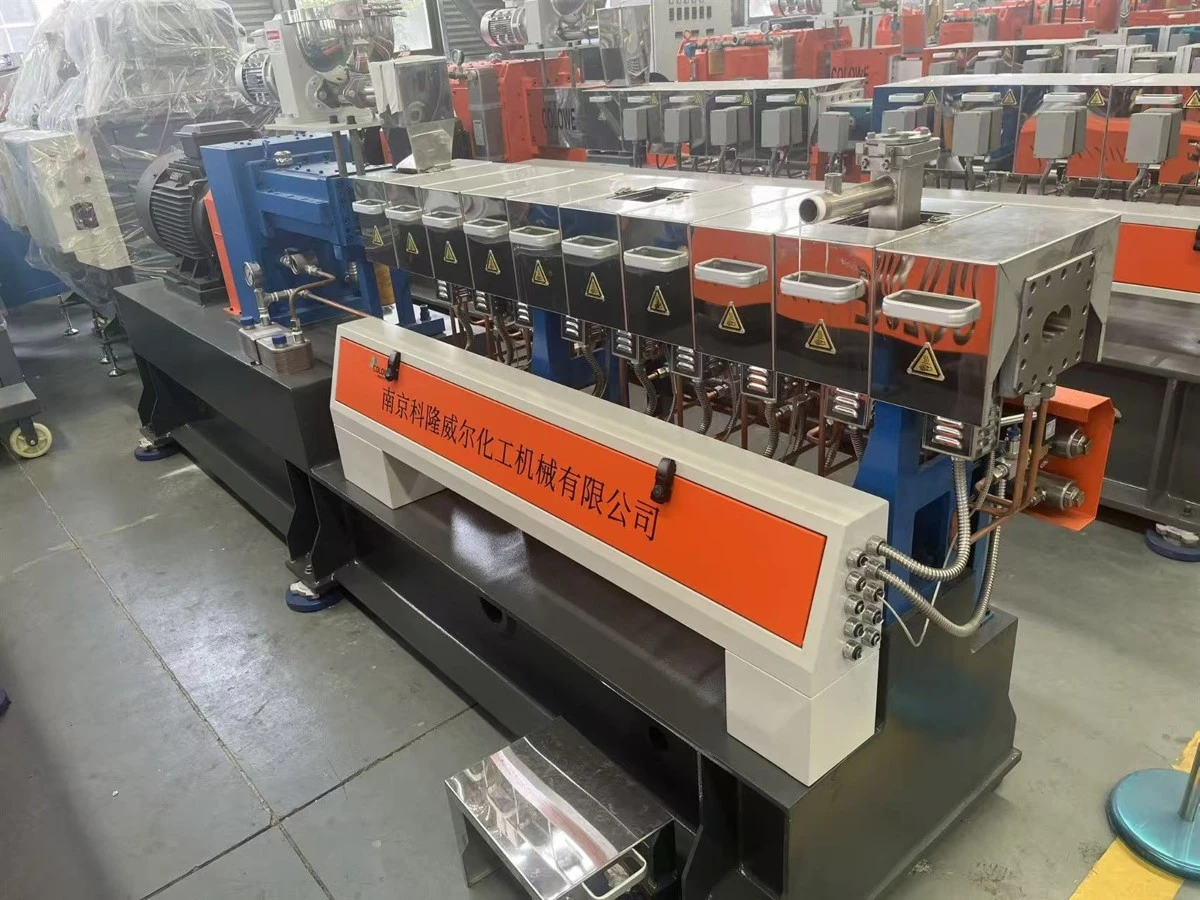
When the industry shifts from "buying a machine" to "buying a replicable set of production certainty", the trend of choosing twin-screw extruders becomes clear: co directional twin-screw extruders provide a bottom structure of mixing efficiency and specific energy consumption, while high cost-effective extruders anchor their value on unit output power consumption and one-time startup success rate. A truly environmentally compliant plastic extruder must leave room for switching between recycled materials, biodegradable materials, and new material formulations in the design stage. COLOWE's practice is to compress these three trends into the engineering parameters of the same equipment, so that people who choose plastic extruders for the first time do not have to repeatedly try and make mistakes to pay tuition fees.
No Information


