

Detailed Explanation For Strip Breakage Of Twin-screw Extruder
Introduction: Broken strip, not just a fault on the production line
With the global trend of pursuing circular economy and sustainable development, more and more international customers begin to devote themselves to the R&D of green plastic pelletizing and new materials. However, in practice, the strip breakage of twin screw extruder often becomes a problem between stable production and efficient production. This not only results in material waste and reduced capacity, but more likely means a bias in the understanding of material characteristics or equipment selection. This paper will deeply analyze the root of the broken strip problem, and provide you with a set of systematic, refined and in-depth solutions from the scientific selection of high-efficiency extruder and accurate matching of material characteristics.
1, Precise diagnosis: analysis of six root causes of broken bars
Broken strip phenomenon has single appearance but complex genesis. Only accurate diagnosis can solve the problem. The main causes can be divided into the following six aspects:
Impurity intervention and carbonization aggravation
Hard particles form fatal defects in the strip, whether they are mixed with impurities in the external environment or carbonized by improper processes (e.g. local overheating, strong shearing). This is particularly true when the proportion of recycled material increases.
Poor plastification of materials
When the extrusion temperature is low or the shear strength of the screw is insufficient, the material cannot reach a uniform melting state, which will produce incomplete plasticized "bumps", and it is very easy to break under the traction. The low melting point additives in the formulation may also lead to uneven plastification under certain conditions.
Mismatching of physical properties of raw materials
During blending modification, if the melt flow rate (MFR) between different components is too different, or the molecular weight (viscosity) of resin between batches fluctuates significantly, it will lead to the unmatched mobility and the tendency of phase separation, thus destroying the continuity of the strip.
Poor exhaust (steam)
This is a critical but often overlooked point. If the water vapor produced by the material affected with damp and the small molecule gas produced by the auxiliary decomposition cannot be effectively discharged through the natural exhaust and vacuum exhaust system, it will be trapped in the melt. These pores become the starting point of fracture during cooling forming.
Elastic fracture of melt
When the shear stress borne by the melt exceeds the critical value, the elastic turbulent phenomenon of melt fracture will occur, which is manifested by shark skin, bamboo grain or even irregular fracture on the extrusion surface. This is closely related to the mouth die design, processing temperature and the viscoelasticity of the material itself.
Mismatch between cooling and traction
For materials with extremely fast cooling crystallization speed, such as PBT and PET, if the cooling water temperature is too low and the cooling is too high, the strip will become hard and brittle rapidly, and the tension with the tractor cannot be flexibly matched, resulting in mechanical breaking.
2, Solution (I): Selection Wisdom of Extruder Oriented to Efficient and Stable Production
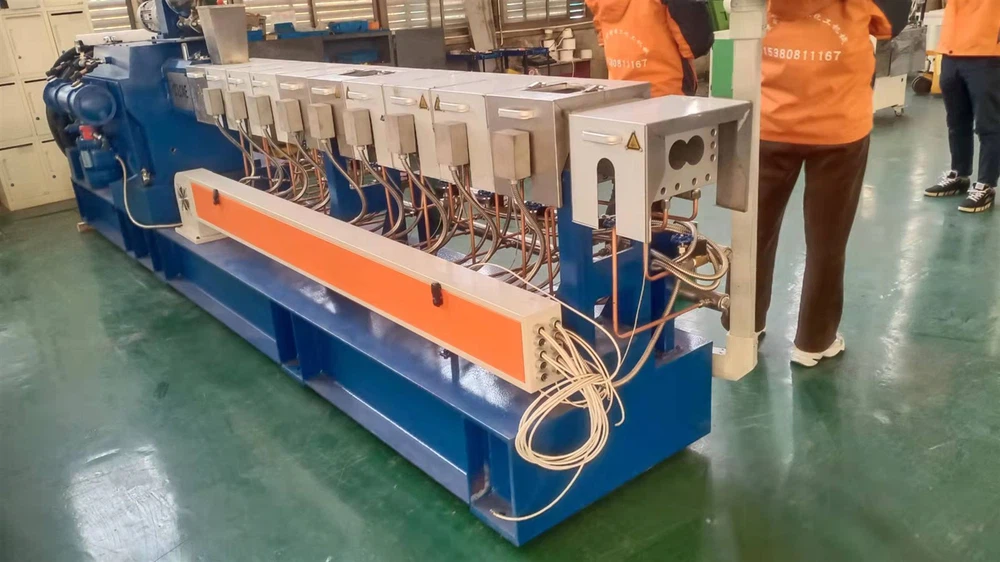
To do a good job, one must first sharpen his tools. An advanced design of the same direction twin screw extruder can avoid many design defects that lead to broken bars from the source.
Core selection: advantages of co-acting twin screw extruder
Compared with the opposite direction twin screw extruder, the same direction twin screw extruder has become the first choice for modification, blending and high-quality granulation due to its excellent self-cleaning performance, excellent distribution and mixing capacity and more flexible screw configuration. Scratch between screw elements can effectively reduce material retention and degradation, and fundamentally reduce the risk of impurities generated by carbonization.
Technical frontier: conical co-axial twin screw extruder
For customers pursuing high cost performance, energy conservation and environmental protection, the tapered co-axial twin screw extruder represents an important technical direction. It combines the advantages of strong conveying capacity of tapered screw and efficient mixing of co-axial screw. It is unique in that:
·Figure 8 motion path: the material moves along the figure 8 in the conical space, prolonging the effective plasticizing time and promoting the plasticizing uniformity.
·Progressive compression: the diameter of the screw gradually decreases from the feeding section to the metering section, realizing gentle and progressive compression of the material, reducing local overheating and strong shear stress, especially suitable for materials sensitive to heat and shear.
·Energy consumption advantage: according to industry data, the optimized conical design can reduce energy consumption by 30% - 50% compared with traditional equipment, which directly responds to the dual demands of customers on environmental protection and cost.
Key parameters: length-diameter ratio and modular design
·Length to diameter ratio (L/D): the length to diameter ratio is a key indicator to measure the processing capacity of plastic extruder. For processes that require adequate venting, devolatilization, or complex modifications, the higher aspect ratio (e.g., 48:1 or greater) provides sufficient space for the process section setup to ensure complete removal of moisture and volatiles.
·Modular Barrel and Screw: The state-of-the-art high-efficiency extruder shall be of modular design, allowing the customer to freely combine the barrel vent location and screw elements according to the specific material formulation (e.g. glass fiber addition, strong dispersion required) to create the most appropriate temperature, shear and pressure fields.

3, Solution (II): Process Adaptation Philosophy Based on Material Characteristics
No matter how good the equipment is, it is also necessary to "show sympathy" with the materials. From the viewpoint of the ASM International Handbook, the analysis of plastic processing failures must begin with a deep understanding of the material itself.
Know your material: Rheological properties are the key
The melt strength, viscoelasticity, MFR and thermal stability of a material together determine its "processing window". For example:
·High melt strength material (such as HDPE of certain grades): it can bear large tractive force, but it is sensitive to mouth die pressure, so attention shall be paid to melt rupture.
·Low melt strength/brittle materials (e.g. high content PCR material, some engineering plastics): Extremely easy to break, need to reduce resistance by increasing processing temperature, optimizing mouth die flow path, and ensure gentle and uniform plastification.
Process optimization: a dynamically balanced system
·Temperature strategy: avoid "one-shot" temperature settings. The feeding section shall prevent bridging, the melt section shall provide sufficient and uniform heat, and the homogenizing section and head temperature shall be accurately controlled to adjust the melt strength.
·Screw speed and feeding ratio: this is the core to control the shearing and retention time. Excessively high rotational speeds can result in shear overheating or melt rupture, while excessively low feed can result in insufficient melt pressure and uneven plastification.
·Ultimate application of vacuum systems: For hygroscopic materials (e.g. PA, PET) or recycled materials, a robust and stable multi-stage vacuum system is the lifeline. It effectively extracts moisture and volatile matter, preventing hollows and breaks caused by gas expansion.
4, Practical Q&A: key answers from the production line
Q1: We use a high proportion of post-consumer recycled plastics (PCR) to produce regenerated particles, and how do we break the situation frequently?
A: PCR feed has complex composition, variable mobility and may contain impurities. Recommendations:
·Equipment end: select the same direction twin screw extruder with high torque and strong self-cleaning capacity, and strongly recommend the efficient melt filtration system (such as automatic screen changer) and enhanced multi-stage vacuum degasser.
·Process end: Properly increase the temperature of melting section and give more sufficient homogenizing time; The operation strategy of "high torque, medium speed" is adopted to avoid excessive shear degradation while ensuring the output.
Q2: What is the particularity of the broken strip problem in the production of glass fiber reinforced materials?
A: Glass fibres have a significant impact on melt rheology. Broken bars are often caused by a combination of rapid increase in material rigidity and improper cooling.
·Ensure that the fiberglass is introduced in a suitable downstream position (after the melt has been fully formed) to reduce wear to the screw and premature failure to melt uniformity.
·Special attention shall be paid to the cooling link: properly increase the water temperature of the cooling water tank (such as using warm water) to prevent the strip surface from quenching to form a "hard shell" while the interior is still soft and broken under the traction force.
Q3: As a newcomer to twin screw pelleting for the first time, how to systematically debug to reduce strip breakage?
A: Follow the debugging logic of "process first, equipment later":
Material preparation: ensure that the raw materials are dry, evenly mixed and sieved if necessary.
Basic process setting: refer to the recommended temperature of the resin supplier and set the temperature curve based on the principle of "low to high". Use lower screw speed and feed rate for initial operation.
Observation and adjustment: Observe the appearance of extrusion strip. If the surface is rough and has bumps, it may be necessary to rise the temperature or adjust the screw combination to increase shearing; Check the vacuum system immediately and increase the vacuum degree if the strip is foaming and has voids.
Fine matching: on the basis of continuous and stable strip, gradually optimize the output (improve the rotating speed) and performance (adjust the formula).
Conclusion: Smart Pelleting towards Zero Strips
It is a systematic project to solve the broken strip problem of twin screw extruder through equipment selection and profound understanding of material and fine process regulation. It requires practitioners to upgrade from traditional troubleshooting thinking to preventive design thinking based on rheology and process control.
For international customers who are committed to environment-friendly pelletizing and R&D of new materials, investing in a high-efficiency extruder with scientific design and strong flexibility (such as the advanced conical co-axial twin screw extruder) is far more than purchasing one equipment, but also a "adaptive insurance" for uncertain raw materials in the future. It allows you to deal with various challenges from pure new materials to complex recycled materials, transform the trouble of broken bars into the joy of stable output, and finally realize the double harvest of economic value and environmental responsibility on the road of sustainable development.


