

What Is The Limit Of Aspect Ratio? ——Deep Reflections On The Granulation Efficiency Of Plastic Extruders
Choosing the right 'length to diameter ratio' means choosing the right profit track
Under the dual drive of globalization and the "dual carbon" goal, the plastic granulation industry is undergoing unprecedented changes. On the one hand, international customers' demand for high-performance plastic extruders has shifted from "usable" to "high-efficiency"; On the other hand, the rise of recycled materials, new material modification, and bio based materials has put forward almost stringent requirements for the adaptability of equipment.
In this game of efficiency and quality, there is a core parameter that is often overlooked by first-time contacts but determines the fate of the entire production line - the length to diameter ratio (L/D) of the co rotating twin screw extruder.
What exactly is it? Why do some materials require a very short "temper" while others must go through a long "marathon"? Today, we will not talk about mystical theories, but start from the underlying logic of efficient extruders, combined with the latest industry white paper data from around the world, to unveil the mystery of aspect ratio for you.
1. Length to diameter ratio: not just numbers, but also the "long march" of materials
Length to Diameter Ratio (L/D) refers to the ratio of the effective working length of a screw to its diameter. This is not only a geometric parameter of the plastic extruder, but also a time scale of the material's heat and shear history inside the barrel.
As Professor Wang Jian's research group at Beijing University of Chemical Technology pointed out in the journal Polymer Engineering and Science, "The aspect ratio is a very important factor that affects product quality and the rheological properties of materials during extrusion
Understanding the impact of different length to diameter ratio ranges is the golden key to unlocking the door to profitability for those who pursue environmental protection, high cost-effectiveness, and are trying new material production. Next, we will adopt a pyramid structure and peel off its core secrets layer by layer.

1.1 Level 1: Extremely short aspect ratio range (L/D ≤ 20) - "emergency channel" for thermosensitive materials
·Core logic: Fast in and fast out to avoid degradation.
For PVC, some biobased materials, and recycled materials with high moisture content, time is the enemy. Excessive aspect ratio can cause materials to stay in the barrel for too long, leading to thermal decomposition and ultimately resulting in yellowing and decreased performance of the product.
·Data support: According to a study conducted by the Egyptian Agricultural Research Center on the influence of die geometry, for residue materials (similar to recycled materials), a shorter aspect ratio (such as around 1.67 for the die) combined with specific pressure control can effectively reduce energy consumption to 153.10 kW · h/ton, while ensuring particle durability (PDI) of over 90.35%.
·Equipment matching: For this type of application, Nanjing Kelongwell Chemical Machinery Co., Ltd. recommends configuring a specialized thermosensitive material screw configuration to ensure gentle plasticization of co rotating twin screw extruders under low shear conditions.
1.2 Level 2: Standard aspect ratio range (L/D 28:1-36:1) - General modified "golden waterway"
·Core logic: Strong universality, king of cost-effectiveness.
This is currently the most common range of plastic extruders on the market, and it is also the preferred choice for most filling masterbatch, ordinary color masterbatch, and reinforcement modification.
·Technical Deep Dive: Within this range, the material has sufficient time to complete melting, mixing, and venting. A doctoral study at Lanzhou University of Technology found through response surface analysis that the optimal microstructure (sensory evaluation) of the extruded product is achieved when the screw aspect ratio is 25.5:1 and the molten area aspect ratio reaches 12:1.
·Application scenarios:
·Calcium carbonate filled masterbatch: Sufficient mixing stroke is required to ensure that the powder is coated with resin, but too long can result in energy waste.
·Universal polyolefin modification: simple reinforcement of materials such as PP and PE.
1.3 Level 3: Large aspect ratio range (L/D 40:1-60:1) - "Deep sea tunnel" with high filling and stripping
·Core logic: Multi stage exhaust, deep compatibility.
When you start trying difficult formulas such as recycling and modifying engineering plastics (PA, PC, PET), or systems containing large amounts of oil and solvents (such as TPE oil filled), the standard aspect ratio becomes inadequate.
·Key Q&A:
·Q: Why is it necessary to choose a large aspect ratio when making high filling flame-retardant materials?
·Answer: Because it requires the arrangement of multiple side feeding ports. The large aspect ratio allows for multiple exhaust ports and additive injection ports to be opened on the barrel of a co rotating twin screw extruder. The first section transports resin, the second section adds fiberglass, and the third section performs vacuum exhaust. Only when the L/D is above 40, can we ensure that these auxiliary processes have sufficient physical space and reaction time.
Think deeply: For customers who are trying to make new materials, a large aspect ratio provides a "tolerance" for process adjustments. You don't have to sacrifice the mixing quality of materials to meet the deadline.
1.4 level 4: Ultra large aspect ratio range (L/D 80:1-150:1) - "Superconducting orbitals" in molecular engineering
·Core logic: disentanglement and reactive extrusion.
This is the Mount Everest of current efficient extruder technology and the engine of future material revolution.
·Current affairs hotspots and authoritative external links:
With the surge in global demand for high-performance fibers and biodegradable materials, ultra large aspect ratio technology is moving from the laboratory to industrialization. In a cover paper published in Industrial and Engineering Chemistry Research in 2023, Professor Wang Jian's team from Beijing University of Chemical Technology successfully used a co rotating twin screw extruder with a length to diameter ratio of up to 150:1 for dry jet wet spinning of primary polyacrylonitrile (PAN) fibers.
·Amazing data: Research has found that when the aspect ratio increases from 64 to 150, the tensile strength and modulus of the primary fibers increase by 42.1% and 67.2%, respectively, and the crystallinity of the fibers increases by 45.5%.
·Inspiration for granulation: What does this mean? This means that for ultra-high molecular weight polyethylene (UHMWPE), fully biodegradable film materials, and certain liquid crystal polymers, only through extremely large aspect ratios (such as the specific field models being explored by Nanjing Kolmwell Chemical Machinery Co., Ltd.) can the "disentanglement" of molecular chains be truly achieved, and the potential properties of the materials be "squeezed" out.
2. Key Q&A: Face the customer's deepest doubts directly
To help you make better decisions, we have compiled a list of the most frequently asked questions by international clients:
2.1 Q: I am only doing ordinary PP recycling granulation. Is it necessary to buy a plastic extruder with a large aspect ratio?
A: It depends on your business positioning. If your goal is only low-cost, low-quality backfill, standard or short aspect ratio is indeed more cost-effective. But if your client is an international enterprise that requires particles with higher packing density, lower volatile matter, and more consistent melt index, then choose a co rotating twin screw extruder with a medium length to diameter ratio (36:1-40:1), which can effectively turn "waste" into "new" through effective vacuum exhaust and gentle shearing, thus escaping the red sea of price wars.
2.2 Q: How can Nanjing Kelongwell solve the problem of excessive aspect ratio (>100) that can easily cause screw bending and wear?
A: The question you raised is very professional. The traditional high-efficiency extruder adopts a cantilever beam structure, and increasing the aspect ratio does indeed bring risks of screw sweeping and abnormal noise. But modern co rotating twin screw extruder designs, such as the high torque model from Nanjing Kelongwell Chemical Machinery Co., Ltd., break through limitations by:
1. New supporting components: Drawing on cutting-edge technologies at home and abroad, a special spline connection and supporting structure are adopted in the screw core shaft, effectively suppressing deflection deformation.
2. High torque transmission box: equipped with imported bearing sets and military grade gears, ensuring stable operation at low speed and high torque or high speed and high torque.
3. Material upgrade: Powder metallurgy high-speed steel screw components are used to improve toughness while ensuring hardness, and to resist bending stress caused by oversized L/D.
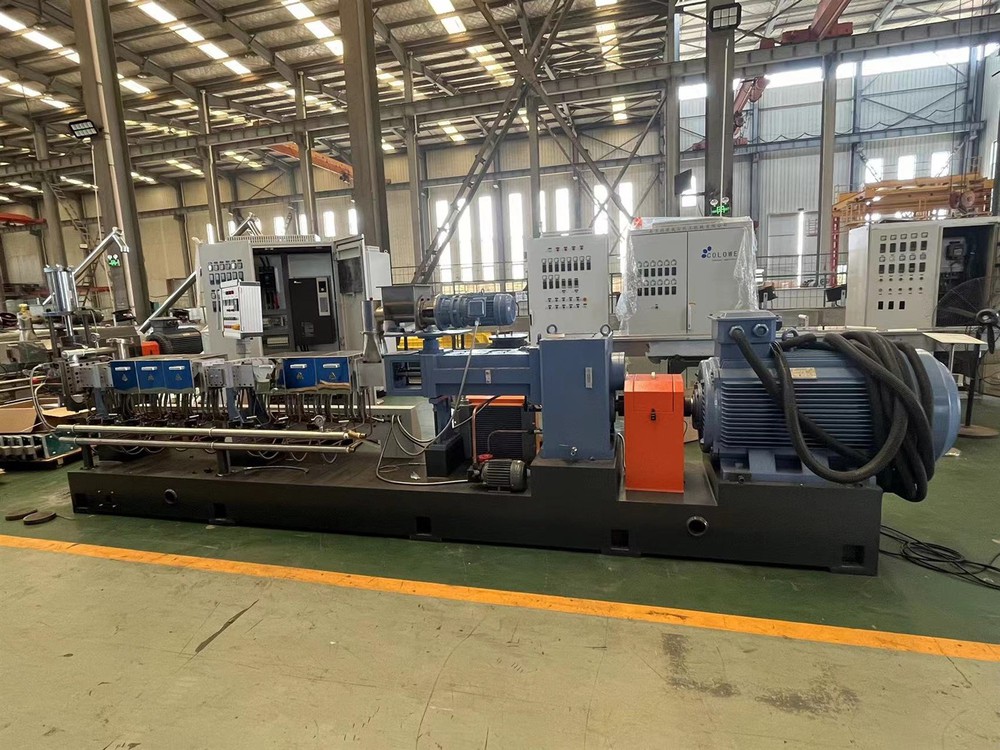
3. The Decision at the Top of the Pyramid: The Business Logic Behind the Length to Diameter Ratio
Standing at the top of the pyramid and looking down, the choice of aspect ratio is actually an accurate calculation of "time" and "space".
In the range of short aspect ratio (L/D ≤ 28), the residence time of materials is usually less than 1 minute, and the mixing intensity is mainly dispersed mixing, which is most suitable for heat sensitive and high water content materials. Its investment return logic focuses on winning by quantity and low power consumption. In the range of medium length to diameter ratio (L/D 32-52), the material residence time is about 1-2 minutes, which combines the balance of dispersion and distribution mixing. It is widely used in the fields of general modification, filling, and recycling, achieving a good balance between functionality and cost. For the ultra long aspect ratio (L/D 80+) range, the material residence time can reach more than 3 minutes, and the mixing strength can reach molecular level entanglement or even trigger chemical reactions. It is designed specifically for high-end scenarios such as high molecular weight, high viscosity, and reactive extrusion, and its investment return logic is based on high added value and technical barriers.
Conclusion:
Today, as the plastic industry moves towards a high-quality cycle, aspect ratio is no longer a cold number in equipment manuals, but rather the depth of your dialogue with materials. Whether you are a recycler pursuing the ultimate cost-effectiveness or an explorer trying to define the future with new materials, Nanjing Kelongwell Chemical Machinery Co., Ltd.'s co rotating twin screw extruder series can provide you with precise matching solutions for aspect ratios.
We not only need to produce qualified particles, but also to unleash the maximum potential of each polymer chain with minimal energy consumption and the highest efficiency. Because by choosing the right aspect ratio, you have chosen the shortest path to the future.


