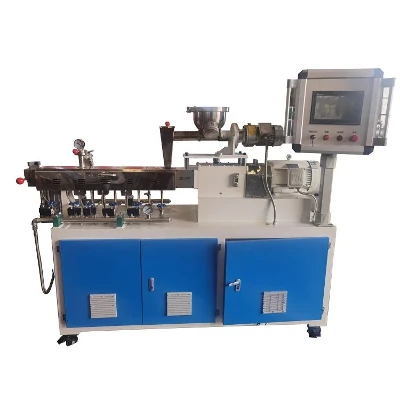
Reshaping The Future Of Granulation: How To Systematically Solve The Problems Of Strip Breakage, Material Leakage, And Blackening - A Guide To Selection And Process Depth Optimization Based On The Same Direction Double Screw Extruder
Introduction: The "invisible killer" at the granulation site and the way to break through the situation
In 2025, when the plastic circular economy is thriving, the global plastic pellet market is expanding at an unprecedented pace. However, while pursuing efficient extruder production capacity, the three major "hidden killers" of breakage, bleeding, and blackening still plague countless modification factories and recycled material workshops. Especially with innovative companies such as UBQ Materials transforming household waste into plastic alternatives, the complexity of raw materials poses even more stringent challenges to equipment.
Why does your production line always shut down to clean up carbides? Why can't the same formula achieve the design peak in production? The answer often lies not in the raw materials themselves, but in the selection logic of the co rotating twin screw extruder and the matching degree of the process window.
This article will cite the "Market Research Report on China's Plastic Particle Industry from 2025 to 2031" and the latest trends at K 2025 (Dusseldorf International Plastics and Rubber Exhibition), combined with the technical practice of Nanjing Kelongwell Chemical Machinery Co., Ltd. in the field of plastic extruders, to construct a complete solution framework from phenomenon to essence for you.

1. Root cause of the problem: Physical underlying logic of the three major faults
To solve the problem, it is necessary to first understand the fluid mechanics and thermodynamic principles behind the fault.
1.1 Broken bar: characterization of the imbalance between melt strength and pressure
Broken bars are the most intuitive "red light" in production. It is not just a breakage of the material strip, but also a manifestation of pressure fluctuations and insufficient strength of the melt at the die.
·Core reasons: Unstable back pressure caused by clogged filter screens, "phase separation" caused by significant differences in MFR (melt flow rate) of raw materials, or gas residue caused by insufficient vacuum exhaust, resulting in stress concentration points under traction.
·Data support: According to research on modified plastic companies, breakage caused by raw material impurities or poor plasticization accounts for more than 40% of the total number of failures, which is often directly related to the "gentle" or "intense" arrangement of screw shearing elements.
1.2 Material emission: The game between conveying capacity and exhaust efficiency
Raw materials are divided into raw materials and clinker.
·Raw material discharge: commonly found in the feeding area or natural exhaust outlet. The reason is that the conveying capacity of the screw combination does not match the plasticizing capacity, and the material is "squeezed" out of the exhaust port by subsequent materials before it is completely melted.
·Clinker emission (vacuum port emission): This is the most difficult problem in high-end modification (such as engineering plastic reinforcement). When the temperature in the vacuum section is too high, causing a sudden drop in the viscosity of the melt, or when the position of the reverse threaded component is improperly designed, resulting in low pressure in that area, the strong vacuum suction force will directly suck the melt into the vacuum pipeline.
·Industry pain points: Many general-purpose plastic extruders often experience frequent "churning" of the vacuum port when dealing with high filling (such as 65% or more talc powder) or high flame retardant formulations due to insufficient free volume design.
1.3 Blackening/Black Spot: The "Timer" of Hot History
Blackening (black spots, yellowing) is a hard flaw that affects product grade and is also a key concern for international customers during factory inspections.
·Charcoal burning and shearing: Excessive shearing heating leads to excessively high local melting temperatures, especially for flame retardants (such as bromine and red phosphorus) or heat sensitive materials that stay in dead corners for too long, resulting in carbonization.
·Hidden pollution: It's not just a matter of raw materials. According to the research in "Application of Engineering Plastics", the carbonization accumulated in the gap between the screw and the barrel after wear, as well as the oligomers condensed and dripped from the vacuum port, are the main sources of black spots.
·Current situation background: With the increasingly stringent requirements of the European Union for food contact grade recycled plastics (rHDPE, rPP), the new regulations in 2025 have raised the control standards for black spots (<200 μ m) by 30%, which puts geometric requirements on the self-cleaning performance of equipment.
2. Key to breaking through: How to choose the right "high-efficiency extruder"?
In the face of the above problems, simple process adjustments often treat the symptoms rather than the root cause. Choosing a co rotating twin screw extruder is essentially choosing a combination of "screw geometry+torque density+thermal control accuracy". For customers who pursue high cost-effectiveness and try new materials such as biodegradable plastics PLA/PBAT, the following dimensions are crucial.
2.1 High torque: not only power, but also a "gentle" guarantee
·Principle Explanation: Higher torque means that high output can be achieved even at low screw speeds. This not only reduces the risk of local overheating caused by high-speed friction of materials, but also provides a wider "process window" for heat sensitive materials such as wood plastic and flame retardant materials.
·Industry Trend: The TEX-44 Alpha III, launched by JSW in 2013, led the industry with a 36% increase in torque. On this day in 2025, the new generation parallel twin screw extruder developed by Nanjing Kelongwell Chemical Machinery Co., Ltd. achieved torque output under high filling conditions by optimizing the load distribution of the gearbox, effectively solving the problem of broken bars caused by unstable pressure in fiberglass reinforced materials.
2.2 Screw Combination: The "Lego Philosophy" of Modular Design
No single screw can solve all problems. The core of an efficient extruder lies in the flexible combination of its modular screw components.
·Solution for material leakage:
·A reverse conveying component or toothed disc must be installed in front of the vacuum port to establish a "melt seal" and prevent material leakage from the vacuum port.
·For customers who are trying to granulate recycled materials for the first time, due to the high impurities and large viscosity fluctuations in the recycled materials, Nanjing Kelongwell recommends using a combination of large lead conveying elements and kneading block gradient colors to ensure good dispersion under low shear and avoid pressure fluctuations and breakage caused by frequent filter clogging.
·Solution for blackening:
·Using self-cleaning threaded components, the "scraping" effect is achieved through the extremely small gap between the screw edge and the barrel wall (only 0.1mm-0.2mm), eliminating dead corners of material retention and physically preventing material carbonization.
2.3 aspect ratio (L/D): Space reserved for special processes
·Data interpretation: The aspect ratio of mainstream twin screw extruders has evolved from the early 28:1-32:1 to the current 36:1-52:1.
·Decision suggestion: If your goal is to try making new materials, such as biodegradable plastics (which require longer residence time to complete the reaction) or high filling masterbatch (which requires multi-stage side feeding and exhaust), it is recommended to choose equipment with L/D ≥ 40:1. This not only provides sufficient length for natural exhaust and vacuum pumping, but also effectively reduces the shear strength of a single section, achieving "low-temperature mixing".
Practical Q&A: What should be the first step when a problem occurs?
To help you locate faults more accurately, we have set up the following key questions and answers:
Q1: Glass fiber reinforced nylon (PA+GF) frequently breaks during production, but the temperature is normal during inspection. Why?
A: This situation is often a "false plasticization".
a. Check the filter: Fine glass shards in the fiberglass can clog the filter, causing the back pressure to surge and drop instantly, resulting in broken bars. It is recommended to use a 40/60/40 mesh stainless steel laminated filter and observe the microwave action of the host current.
b. Check the water temperature: Nylon belongs to crystalline plastics. If the water temperature is too low, the material strip will suddenly become hard and brittle when cooled, and break under traction and stretching. Try raising the water temperature to 40-50 ℃ to maintain the "flexibility" of the material strip before entering the granulator.
Q2: The vacuum port always emits material, and reducing the feeding amount is useless. What should I do?
A: This is a typical screw combination that does not match the vacuum position.
a. Emergency handling: Fine tune and reduce the pumping volume of the vacuum pump (if there is a frequency conversion), and appropriately lower the temperature setting of this section of the barrel (by 5-10 ℃) to increase the viscosity of the melt.
b. Fundamental solution: Check the screw configuration after stopping the machine. Confirm if there is a reverse threaded component below the vacuum port. If so, check if it is worn or positioned too far forward. Technical engineers at Nanjing Kelongwell usually design deep groove threads here, effectively reducing the filling degree of the groove and completely solving the problem of material leakage.
Q3: There are black spots on the surface of the particles that cannot be erased, but they quickly reappear after shutting down for cleaning?
A: This is the continuous carbonization caused by the "dead corner of equipment structure".
a. Check the exhaust port: Natural exhaust ports and vacuum ports that have not been cleaned for a long time usually accumulate a layer of high-temperature aged resin on the inner wall, which forms black spots once it falls into the melt. Suggest establishing a standard for "cleaning exhaust ports per shift".
b. Check the wear of the screw: For equipment with a long service life, the gap between the screw and the barrel increases, and the melt will form a thin layer of stagnant flow in the gap, which will decompose under prolonged heat. At this point, it is necessary to invest in replacing nitride steel or double alloy threaded components with high wear resistance and high smoothness.

3. The future is here: the balance point between environmental protection and cost-effectiveness
Looking back at 2025, plastic granulation is no longer a simple process of melting and cutting, but a complex system engineering involving carbon footprint accounting and circular economy.
3.1 Data driven "transparent granulation"
Modern efficient extruders are fully embracing Industry 4.0. By embedding pressure sensors and melting temperature thermocouples in the barrel, combined with the DCS control system, we can capture microsecond level pressure fluctuations in real time.
·Proactive maintenance: Using AI algorithms to analyze torque fluctuations and provide 3-7 days in advance warning of potential risks of "material leakage" or "breakage", reducing unplanned downtime by more than 50%.
3.2 Creating sustainable value for customers
For international customers who are new to modification, Nanjing Kelongwell Chemical Machinery Co., Ltd. provides not only one device, but also a database of "formula process+equipment parameters".
·Cost effective choice: Compared to European brands such as Coperion and Leistritz, Chinese twin screw extruder manufacturers shorten the investment return cycle to 1.5-2 years through modular design, while ensuring that the specific torque is close to the international first-line level.
·Environmental practice: For new biobased materials such as UBQ masterbatch or post consumer recycled plastics (PCR), optimized screw design can achieve excellent dispersion in low temperature environments, avoiding material degradation and achieving up to 95% closed-loop utilization of household waste without landfill.
Conclusion: Let every particle be born perfectly and flawlessly
Resolving broken bars, material leakage, and blackening is essentially an ultimate pursuit of "process control". Starting from selecting the appropriate co rotating twin screw extruder, to deeply understanding the role of each threaded component in the barrel, and then optimizing production using data-driven tools, Nanjing Kelongwell Chemical Machinery Co., Ltd. is willing to work with you to improve production capacity while safeguarding the purity and quality of every plastic particle.