

Torque Protector: The Invisible Watershed For Granulation Of Different Materials - Where Is The Safety Bottom Line Of A Cost-effective Extruder?
In 2026, the global plastic granulation market is undergoing a profound logical shift: AMI's "2025 Global Plastic Recycling Extruder Market" white paper predicts that by 2027, the global mechanical recycling plastic production will exceed 55 million tons, directly driving the procurement demand for co rotating twin-screw extruders. At the same time, a large number of international customers who are new to granulation have flooded in - they bring environmentally friendly formulas, new material ideas, and limited budgets, trying to run the last mile from laboratory to mass production with a cost-effective extruder.
But an underestimated engineering problem is creating hidden costs: torque protectors, which materials must be installed for granulation, and which operating conditions can be saved?
The answer is not a one size fits all approach. The torque protector is not a "standard decoration" of the extruder, but a function of the material risk profile. Wrong selection, insufficient protection will result in broken shaft and machine failure; Overconfiguration will drive up initial costs and deviate from the original intention of high cost-effectiveness extruders.
1, Conclusion: Three types of materials, three types of torque protection logic
The core mission of a torque protector is to cut off the power transmission at the moment when the torque exceeds the set threshold, isolating the impact outside the motor, gearbox, and screw. But different materials have completely different definitions of 'overload'.
Type 1: Recycled materials and miscellaneous materials - must be "hard protected", with millisecond level tripping that cannot be compromised.
The recycling and granulation of waste plastics is the scenario with the most intense torque impact. Industry fault analysis clearly points out that abnormal raw materials are the primary external cause of sudden screw breakage in waste plastic granulators, accounting for more than half of sudden failure cases. Among them, the instantaneous torque surge caused by hard metal foreign objects getting stuck in the screw is the most fatal. In such working conditions, electronic overload protection has millisecond level delay. Traditional shear pin protection requires stopping the machine to replace the pin and realign each action, while a dedicated torque limiter can completely disengage the power within 1-3 milliseconds, return the residual torque to zero, and fundamentally block shaft breakage, gear breakage, and gearbox damage. For the production line of co rotating twin-screw extruders using rPE, rPP, and rPET bottle slices as raw materials, torque protectors are not optional and are a prerequisite for startup.
Type 2: High filling and high abrasion formula - requires "protection+load-bearing" collaborative design.
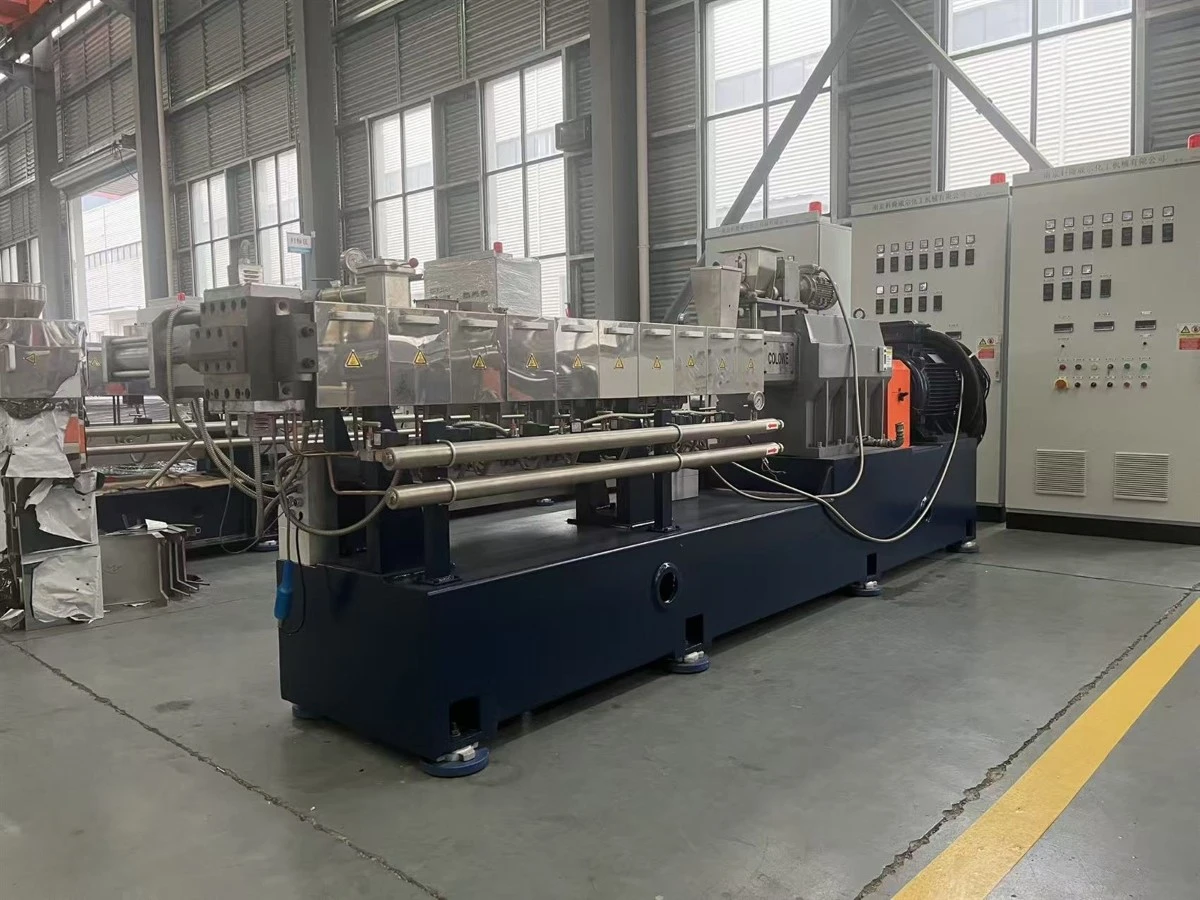
When the filling amount of calcium carbonate, talc powder, and fiberglass exceeds 40%, the viscosity of the melt sharply increases, and the extrusion torque remains high for a long time. At the same time, the abrasive effect of the filler accelerates the wear of the screw and barrel. The real risk of such working conditions lies not in occasional impacts, but in the combination of sustained overload and wear. At this point, the function of the torque protector is not to "prevent material jamming once", but to cooperate with the high specific torque gearbox to operate stably within the set torque limit, avoiding fatigue fracture of transmission components caused by long-term over torque. The industry consensus for selection is that co rotating twin-screw extruders with a specific torque of 8.7 Nm/cm ³ or more should be given priority when filling more than 40%. The high torque gearbox equipped on the cost-effective extruder from COLOWE can achieve a specific torque of up to 11 Nm/cm ³, leaving a scientific threshold window for torque protectors.
Type 3: thermosensitive new materials and biodegradation systems - the protection strategy shifts from "overload prevention" to "misoperation prevention".
PLA, PBAT, PBS and other materials are highly sensitive to thermal shear, and the process tends to adopt a "low-speed, high torque" plasticization path to compensate for the insufficient mixing energy caused by the decrease in rotational speed with torque. The biggest fear of this type of production line is not overload itself, but frequent false tripping caused by setting the torque protection value too low - every unplanned shutdown means that the thermal sensitive material is trapped, degraded, and even carbonized in the barrel. The data from the 2023 "Rubber and Plastic Technology and Equipment" industry report confirms this risk: about 42% of tripping problems are directly related to improper torque protection parameter settings. After a modified plastic company adjusted the protection value from 90% of the rated torque to 130%, the failure rate dropped sharply from 3-4 times per hour to less than 1 time per month. For customers who are trying to produce new materials, the value of torque protectors lies in their precise adjustability: the torque setting accuracy reaches ± 3%, which is necessary to maintain the safety bottom line of the equipment without accidentally damaging normal process fluctuations.
2, The "cost-effectiveness account" of torque protectors: an unknown account
Customers who purchase plastic extruders for the first time tend to view torque protectors as an "additional cost". But extending the timeline to the entire lifecycle of the device will completely flip the direction of this account.
The core transmission components of a co rotating twin-screw extruder - the screw, core shaft, and gearbox - are damaged due to overload impact, and the cost of repair and replacement is in the tens of thousands of yuan. The delay in orders caused by downtime is an implicit amplification factor. And the dedicated torque limiter has a simple reset after overload, can withstand countless disengagement actions, has low wear and long service life, and a temperature resistance range covering -40 ℃ to 80 ℃. In other words, torque protectors replace uncontrollable and amplified fault costs with controllable, one-time configuration costs.
In the product logic of high cost-effective extruders, COLOWE calculates this account more finely: modular platforms and lean supply chain management ensure that key components such as high torque gearboxes and Siemens PLCs are not downgraded, and torque protection is incorporated into the overall design of the transmission system, rather than being added as a "patch" afterwards. For customers who pursue environmental compliance, meeting the requirements of EN 1114-1 for setting the over torque alarm threshold is also one of the technical prerequisites for the equipment to enter regulatory markets such as the European Union.
3, Key Q&A: The four most concerned questions for first-time granulation customers
Q: I only make a stable new material with a fixed formula and clean raw materials. Can I not use a torque protector?
A: Technically, it can be evaluated, but strict prerequisites must be met: the raw materials undergo metal separation and pre screening, the process parameters are locked, and the operating team has the ability to quickly respond to abnormal torque. However, starting shock, abnormal temperature, or local failure of the heater may still cause instantaneous overload. For production lines that only produce one type of material, torque protectors are more like insurance - they cannot be seen when there is no accident, and decide whether to shut down for an hour or a week when there is an accident.
Q: Will the torque protector equipped with a cost-effective extruder be a "downgraded version"?
A: The true cost-effectiveness is not low quality and low price, but system optimization under the premise of uncompromising core configuration. Kelongwell's solution is to maintain high torque gearboxes, imported temperature control components, and Siemens PLC standards while controlling overall machine costs through modular design and supply chain efficiency. As a safety node of the transmission chain, the selection of torque protectors is based on the material torque profile and process window, rather than simply following price classification.
Q: What are the differences in the setting logic of torque protectors between regenerated material granulation and new material granulation?
A: The core difference lies in the threshold strategy. In the scenario of recycled materials, priority should be given to ensuring the certainty and speed of tripping. Millisecond level cutting is the first priority, and the protection value should leave sufficient recognition space for foreign object impact. New materials and thermosensitive new materials place greater emphasis on preventing false stops: the protection value should cover normal process fluctuations and start-up shocks (the torque at the moment of motor start-up can reach 2-3 times the rated value), and be appropriately adjusted according to the ambient temperature and material batch. COLOWE supports customers in sending materials for machine testing at the formula testing center, precisely to run this threshold accurately before mass production.
Q: What is the relationship between the torque protector and the specific torque of the co rotating twin-screw extruder?
A: The torque determines how much load the equipment can withstand, while the torque protector determines how to safely exit when the load exceeds the limit. The two are the relationship between carrying capacity and safety boundary. The higher the specific torque of the co rotating twin-screw extruder, the higher the filling capacity and viscosity upper limit that can be processed per unit volume. However, without matching torque protection, high load-bearing capacity may actually be converted into greater destructive energy under abnormal working conditions. The COLOWE plastic extruder integrates precise and adjustable torque protection on the 11 Nm/cm ³ torque platform, essentially allowing high torque capabilities to be released in a controlled manner.
4, Why does Kelongwell include torque protection in the definition of "high cost-effectiveness"
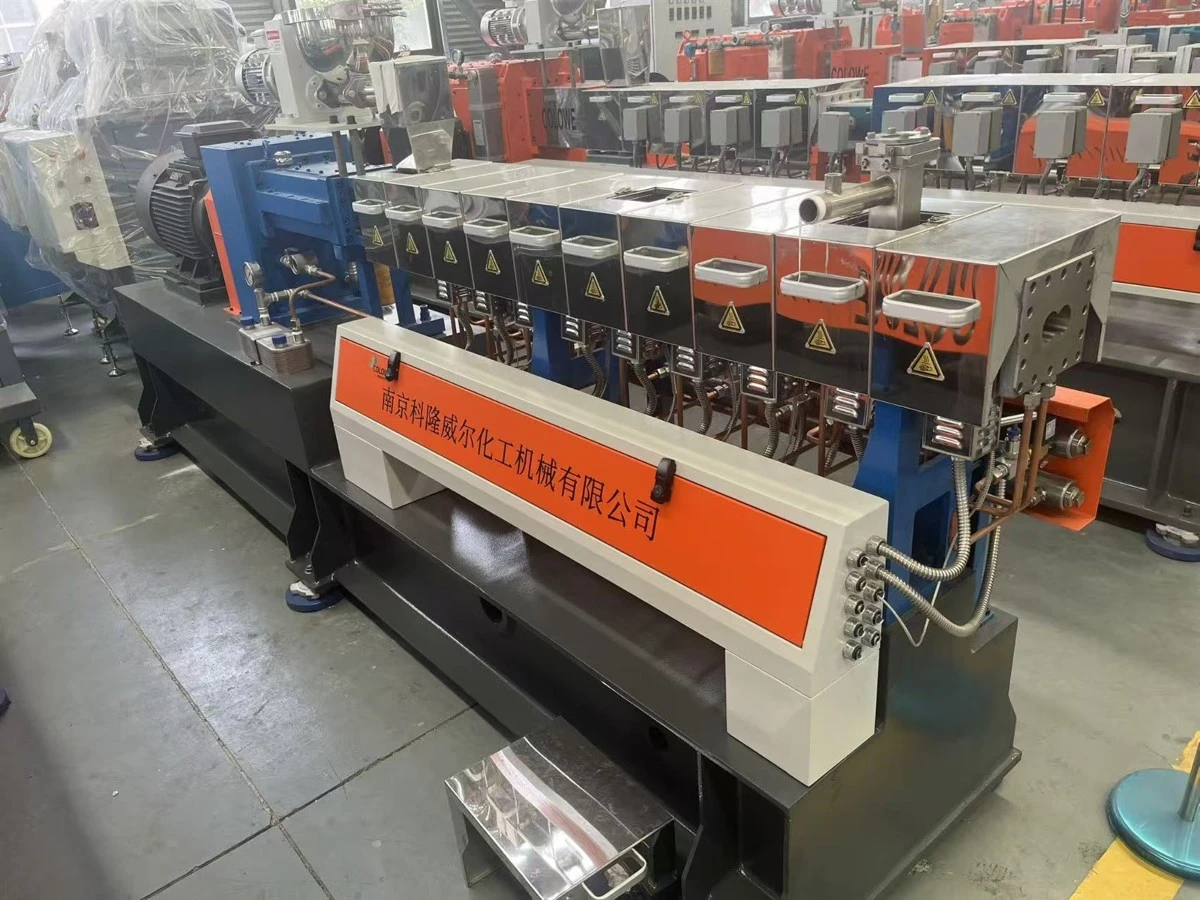
Nanjing Kelongwell Chemical Machinery Co., Ltd. has been dedicated to the research and development of co rotating twin-screw extruders for over 20 years, and has delivered over 2000 sets of plastic extruders to more than 60 countries worldwide. For international customers who are environmentally friendly, pursue high cost-effectiveness, try to produce new materials, and are new to granulation, the value of Kelongwell lies not in the highest value of individual parameters, but in the certainty of system matching: a 48:1 aspect ratio combination screw with a high torque gearbox provides adjustable torque windows for different materials; The modular threaded components and split barrel shorten the cleaning time for formula switching by about 40%; The power consumption per ton of PP+40% calcium carbonate filling granulation can be reduced to 0.25 kWh/kg, saving 15% -20% energy compared to the common industry level.
And the torque protector is the silent bottom line in this system - it does not produce particles, does not increase production, but determines whether a cost-effective extruder should stop and replace a protective component or a screw when one kilogram of metal foreign objects mix into rPE raw materials, when PLA suddenly increases torque due to temperature control in the barrel, or when a novice operator mistakenly sets parameters at the moment of start-up.
The competition for environmentally friendly granulation ultimately boils down to the competition for unplanned downtime. The selection of torque protector is an early answer to this number.
No Information


