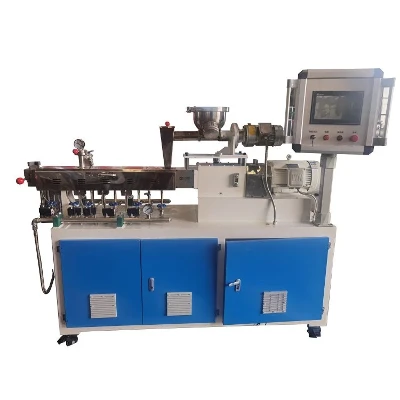
Why Does The Center Height Of The Base Of A Twin-screw Extruder Vary? An Underestimated Granulation Cost Variable
1. The size of the center height of the base is first and foremost an engineering question of "how to apply torque to the ground"
The two screws of the co rotating twin-screw extruder do not work symmetrically, and the torque allocated to the two output shafts is inherently inconsistent. The size of the center height of the base is essentially an external manifestation of the arrangement of the transmission system: models with lower center heights tend to compress the gearbox output shaft and the centerline of the barrel in a more compact vertical space, pursuing short transmission chains and low center of gravity; Models with higher center heights often leave structural allowances for larger thrust bearings, thicker output shafts, and higher specific torque. Taking a large extrusion granulation unit with a diameter of 320 mm as an example, its transmission device needs to transmit 10000 kW of power at a center distance of 26 mm, while bearing an axial load of approximately 270 t generated by a pressure of 35 MPa from the head. If the center height is not enough to accommodate the corresponding bearing and gear layout, the torque density cannot be increased, and the first loss of production stability in the granulation line under high filling and high viscosity conditions. On the contrary, a higher center distance is not necessarily better - increasing the center distance will compress the effective volume of the mixing chamber, decrease the volume of the meshing area, and reduce the ability to disperse and mix. The size of the center height of the base is a compromise between torque carrying capacity and mixing space, rather than a drawing that can be arbitrarily scaled.
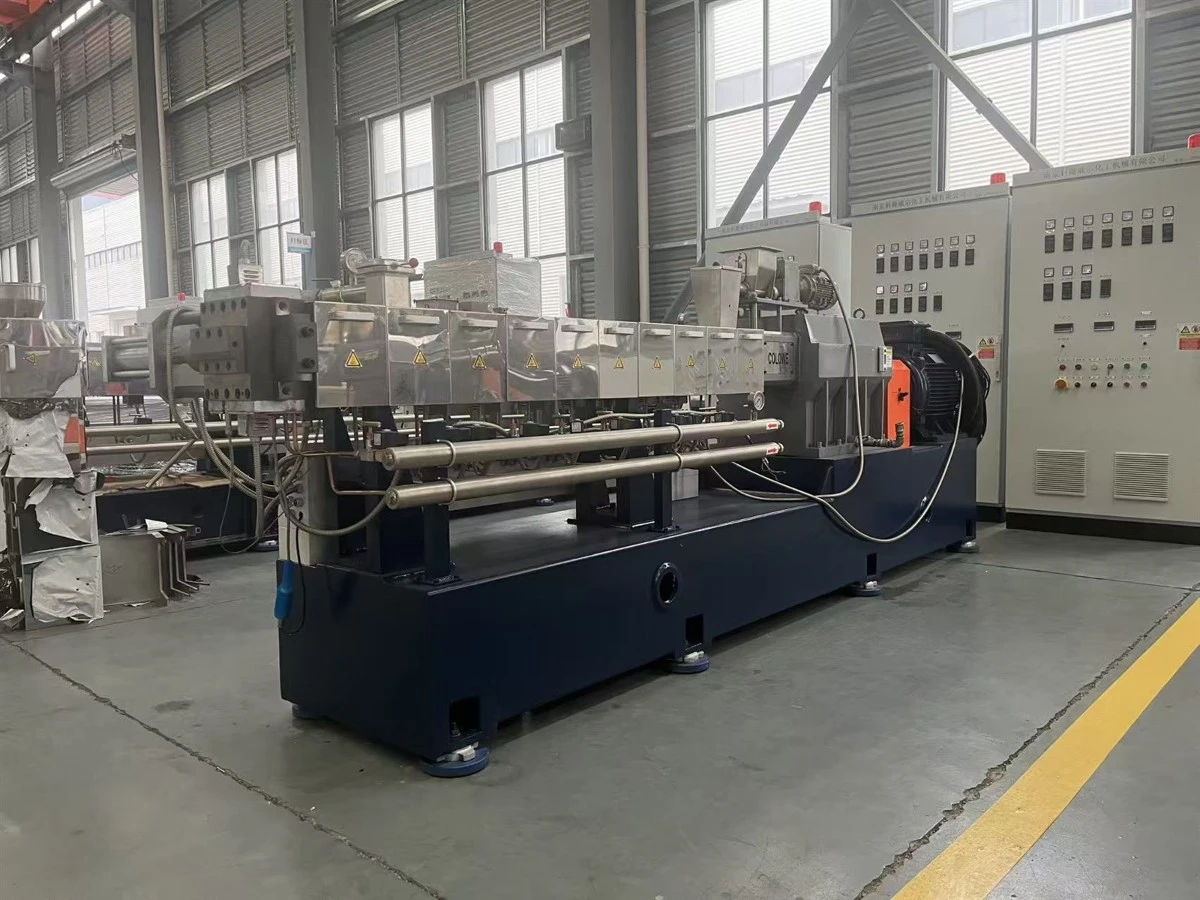
2. It does not directly "granulate", but it determines whether the physical starting point of granulation is clean
The center height of the base itself does not come into contact with the material, but it determines whether the barrel and screw can work on the correct spatial reference. The installation specifications released by SPE Extrusion Branch indicate that the primary goal of extruder installation is to maintain the alignment of the screw and the centerline of the barrel, and the levelness of the base needs to be controlled within strict requirements. The co rotating twin-screw extruder must also comply with the installation conditions specified in JB/T 5420. The center height design is unreasonable or the base rigidity is insufficient. During the installation phase, it can be "leveled" with gaskets, but the torque backlash and thermal expansion during operation will cause slight deformation of the barrel, and the gap between the screw and the barrel along the axial direction will no longer be uniform. This unevenness will not immediately manifest as equipment alarm, but will be transmitted downstream in the form of melt pressure pulsation.
Experimental data shows that after optimizing the flow channel structure, the dispersion coefficient of pressure pulsation in the twin-screw head can be reduced by 41.32% and 34.61%, respectively. The starting point of granulation is not the granulator, but the invisible centerline between the screw and the barrel. The task of raising the center of the base is to minimize the drift of this line throughout the entire production cycle.
3. For first-time buyers who pursue environmental protection and high cost-effectiveness, where is the high "implicit premium" in the center
For international customers who are trying to produce new materials and are on the granulation line for the first time, the impact of the high center of the base is often realized through three quantifiable paths. The first is energy consumption. According to statistics from the China Plastics Machinery Industry Association in 2025, the average specific energy consumption of twin-screw extruders of the same specifications and direction is 0.28-0.32 kWh/kg, while the KTE-65 cost-effective twin-screw extruder from Kelongwell has a measured specific energy consumption of only 0.23 kWh/kg when processing PP+40% talc powder at 800 rpm. The matching accuracy between the base and the transmission chain is directly related to whether this shear heat is effectively used for melting and dispersion, or whether it becomes an ineffective temperature rise and is carried away by the cooling water. The second is the success rate of startup. Among the 31 cost-effective extruder production lines delivered by COLOWE in the first half of 2026, 22 are the customer's first plastic extruder production lines, of which 19 produce qualified particles within 7 days of arrival at the factory, with a one-time start-up success rate of 93%. The consistency of the installation benchmark guaranteed by the center height of the base is one of the structural conditions behind this data. The third is the preservation of the value of recycled materials. The white paper on circular plastic processing technology released by Plastics Europe in 2025 states that the dispersion and mixing efficiency of the co rotating twin-screw extruder determines the degree of recovery of the mechanical properties of recycled materials. High quality equipment can increase the tensile strength retention rate of recycled PP from 72% to 89%. The high center of the base is not the "direct cause" of this performance, but it determines whether the screw combination can exert the expected dispersion ability under the designed clearance and centerline conditions.
4. Key Q&A: The most common questions to ask incorrectly when encountering granulation for the first time
Q1: Is it more stable and cost-effective to choose a lower center height for the base?
not always. A low center height may mean that the vertical distance between the gearbox output shaft and the barrel is compressed, leaving less space for thrust bearings and cooling structures. For high filling calcium carbonate, glass fiber reinforcement, or rPET thickening conditions, the torque requirement is higher, and forcibly lowering the center height will sacrifice the load-bearing capacity of the transmission system. The correct logic for a cost-effective extruder is "matching", not "low is economical".
Q2: Are the center height and screw center distance the same thing?
No. The center distance of the screw is the distance between the axes of two screws, which directly determines the meshing ratio and mixing chamber volume; The center height of the base is the vertical distance from the screw axis to the installation reference plane, which is a layout parameter of the entire machine. The two are related through the layout of the gearbox output shaft, but they solve problems at different levels.
Q3: I work on recycled materials and biodegradable new materials. Does the high center have a significant impact on me?
The impact is more direct than imagined. The processing window of recycled materials and PLA/PBAT thermosensitive system is narrow, and the slight deviation of the screw centerline will be transformed into local shear thermal accumulation. The EuPC White Paper on Extrusion Process and Recycled Plastic Quality in 2026 states that when the process parameters deviate from the optimal window, the fluctuation amplitude of the melt temperature can increase by 35% -40%, directly leading to inconsistent performance between batches of recycled particles. A co rotating twin-screw extruder with sufficient base rigidity and a well-designed center height is the first line of defense to compress such fluctuations with structural accuracy.

5. Kelongwell's choice: to make the center's height verifiable engineering data, rather than promotional rhetoric
Nanjing Kelongwell Chemical Machinery Co., Ltd. adopts a modular adaptation and core parameter retention approach in the design of the base and center height. The entire series of gearboxes of the cost-effective co rotating twin-screw extruder adopts carburizing quenching and gear grinding technology, and the cylinder liner is made of bimetallic centrifugal casting. The wear resistance is three times higher than that of nitride steel, which means that the bearing capacity of the base and transmission chain will not be compromised due to the positioning of the model. In the recycling and granulation scenario, the COLOWE rPET bottle pellet dedicated line can increase the intrinsic viscosity from 0.55 dL/g to 0.78 dL/g through the combination of dual stage co rotating twin-screw and vacuum devolatilization unit, without the need for crystallization drying, saving 35% energy compared to traditional routes. For customers who are trying new materials for the first time, modular design has reduced the price of entry-level environmentally friendly plastic extruders by 18%, while retaining configurations such as 12 temperature zone PLC control, melt pressure closed-loop feedback, and weight loss feeding linkage.
The center height of the base varies, and it is not a quality judgment in itself. What is truly worth questioning is: how much torque margin does the transmission system provide behind this size, whether the installation benchmark can still be maintained under hot and load conditions, and whether the same cost-effective co directional twin-screw extruder does not need to be overturned and restarted when customers switch from recycled materials to biodegradable new materials. At the point where the penetration rate of high-efficiency and energy-saving models is increasing from 35% in 2024 to 48% in 2026, treating the center height as a measurable and verifiable engineering variable is closer to the essence of granulation business than treating it as a number on an exterior drawing.
No Information