

Why Did COLOWE Build A Second Factory Building? ——When The Growth Rate Of Orders Exceeds The Physical Limit Of A Production Line
In the third quarter of 2026, Nanjing Kelongwell Chemical Machinery Co., Ltd. delivered 7 twin-screw extruder production lines to customers in Europe, Southeast Asia, and the Middle East, including 5 cost-effective co rotating twin-screw extruders. During the same period, export orders for cost-effective extruders increased by 41% year-on-year. A Chinese manufacturer that has entered the international market with "cost-effective plastic extruders" is experiencing an uncommon growth rhythm: it is not a shortage of customers, but the order density is approaching the production capacity ceiling of a single production base. The construction of the second factory building is not a product of impulsive scale, but a must answer question driven by orders.
1, The structure of global demand is changing, and the role of extruders is also changing
To understand why COLOWE must expand production, it is necessary to first understand what is happening in the global twin-screw extruder market. The global twin-screw extruder market is expected to reach 3.37 billion US dollars in 2026, and will increase to 5.13 billion US dollars by 2034, with a compound annual growth rate of 5.38%. More importantly, the demand structure: The co rotating twin-screw extruder dominates the twin-screw category with excellent mixing and dispersing ability, volatilization efficiency, and process flexibility, and is expected to account for 78% of sales in 2026.
The driving force behind this structural change is not traditional large-scale petrochemical modification, but three trends happening simultaneously globally. Firstly, the EU's circular economy policy and the 'Disposable Plastics Directive' have forced processors to handle recycled materials such as rPET and rPP, placing higher demands on screw configurations and vacuum devolatilization capabilities. Secondly, the processing demand for biodegradable materials and biobased resins is rapidly increasing, and PLA/PBAT blends and high filling formulations require a wider process window. Thirdly, international buyers who are entering the field of plastic modification for the first time, especially customers from Southeast Asia, the Middle East, and Latin America, are no longer satisfied with being able to squeeze out, but demand low specific energy consumption, stable dispersion, and reproducible amplification paths.
This means that the co rotating twin-screw extruder is transitioning from a specialized equipment for large modification plants to an "entry-level core equipment" for small and medium-sized processors entering the environmentally friendly new and recycled material market. The order structure of COLOWE precisely confirms this judgment: the main force of export growth is the high cost-effective co directional twin-screw extruder production line for customers who are new to modified processes.
2, Behind the dramatic increase in orders: the delivery flexibility of a production line has been exhausted
The growth of orders itself does not constitute a reason for building a factory, only the way in which orders grow constitutes a reason. In the first half of 2026, the export orders of cost-effective extruders from Kelongwell increased by 41% year-on-year, with delivery destinations covering the European, Southeast Asian, Middle Eastern, and Indian markets. But there is a significant characteristic of the customer group that COLOWE faces: most of them are international customers who are trying new material development for the first time, and their tolerance for delivery cycles is much lower than that of mature large-scale modification plants.
This customer profile directly determines the "effective boundary" of production capacity not in the number of equipment, but in the full chain collaboration capability from component processing, whole machine assembly to material testing. In the original factory area of over 7000 square meters, the barrel processing, screw component heat treatment, overall assembly, and factory aging testing of the co rotating twin-screw extruder share the same flow line. When orders shift from "single customized" to "simultaneous delivery of multiple plastic extruder production lines", the scheduling friction caused by physical space will exponentially increase. In other words, the increase in order volume itself can be absorbed by extending working hours, but the concurrent growth of multi specification, multi destination, and short delivery orders cannot be linearly absorbed within the original spatial structure.
The construction of the second factory building is essentially to separate the "manufacturing capability" and "verification capability" from the same crowded flow line, so that capacity expansion does not come at the expense of delivery certainty.
3, The real problem solved by the second factory building is to turn "high cost-effectiveness" into a verifiable on-site experience
For first-time international buyers who pursue environmental compliance and cost control, the most dangerous trap of "high cost-effective extruders" is to misinterpret "cheap" as "low-quality". The data provided in the industry white paper "Assessment of the Whole Life Cycle Cost of Plastic Mixing Equipment" is clear: the equipment purchase price only accounts for 15% -25% of the total 5-year ownership cost, while energy consumption accounts for 30% -45%, and downtime losses account for 15% -25%. The true cost of a co rotating twin-screw extruder only starts to be calculated after it is turned on.
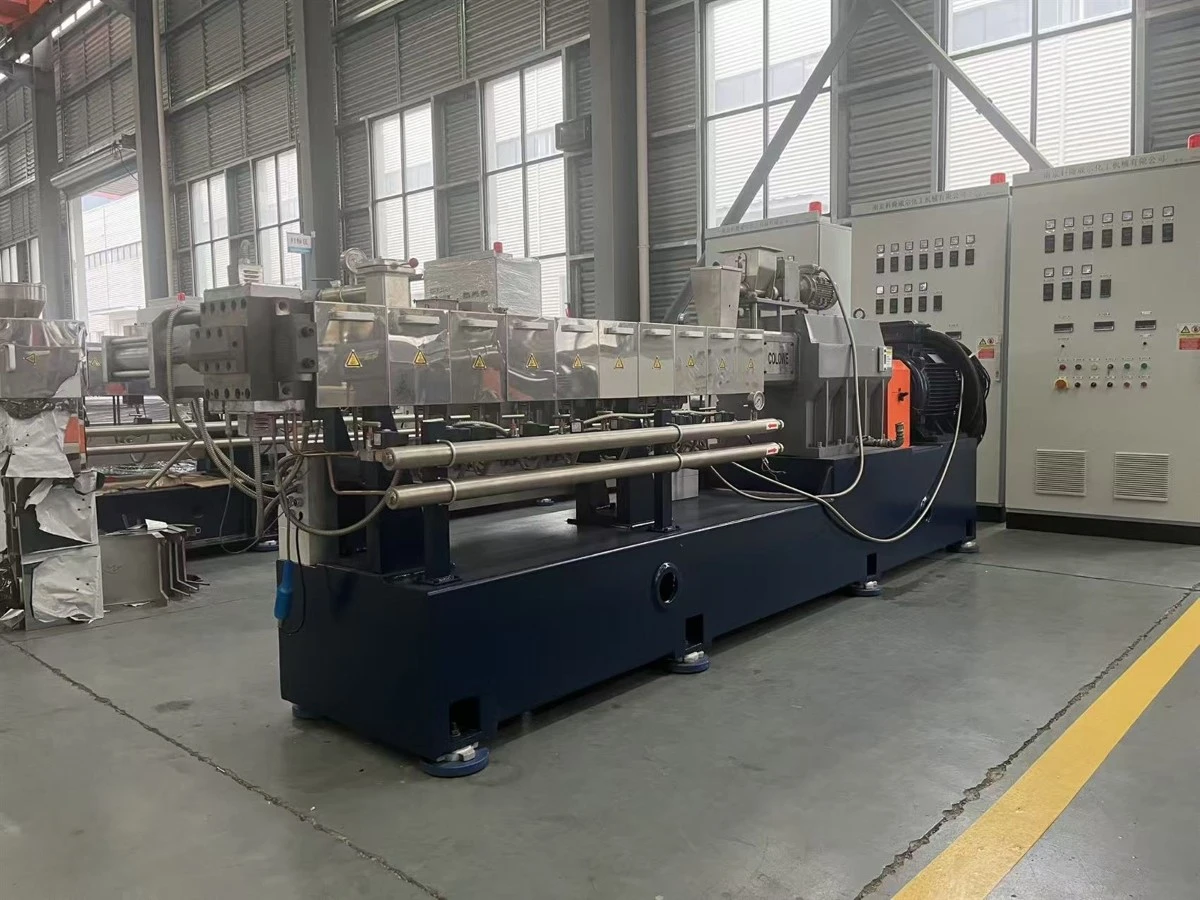
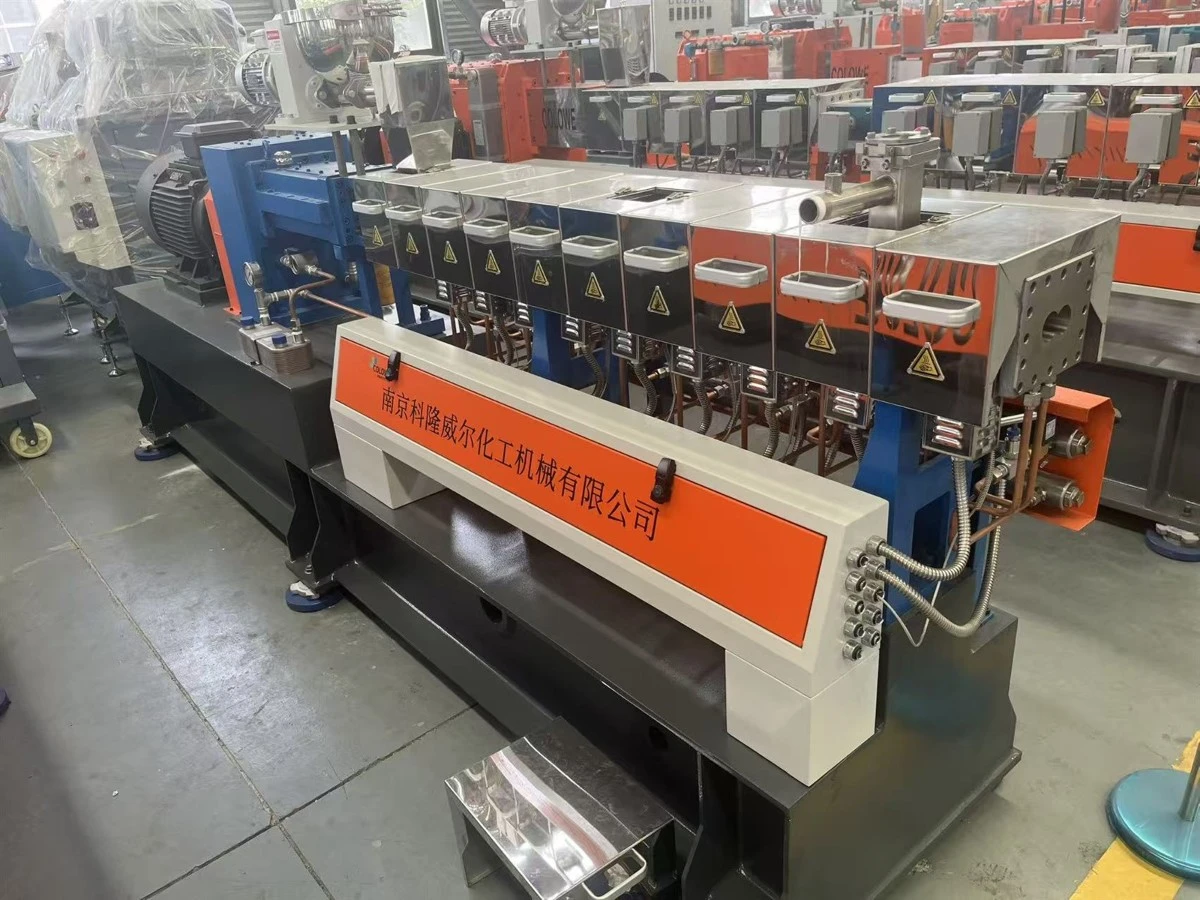
The core design logic of the second factory building revolves around this understanding. The new exhibition hall seamlessly connects with the manufacturing workshop, forming a complete verification flow line from the alloy profile of the cylinder, the heat treatment curve of the screw components to the operation of the whole machine with materials in a 12000 square meter space. Annual production capacity planning of 300+sets, modular platform supporting 45 day standard delivery; The pass rate of the first power on acceptance of the delivered equipment in the past 12 months has reached 99.2%, and the material aging test shall be conducted for no less than 8 hours before leaving the factory, with temperature control fluctuations controlled within ± 1 ℃.
The significance of these numbers for the target customers is that the most expensive cost when trying new material development for the first time is not the equipment price, but the "trial and error" itself. The co rotating twin-screw extruder displayed in the exhibition hall of the second factory of COLOWE covers a length to diameter ratio of 28 to 64, with torque levels ranging from 1.5 to 15 N · m/cm ³. The experimental and mass production equipment use the same geometric parameters of the screw components, and there is no need to explore the process window again during the amplification process. For environmentally friendly new material developers who move from laboratory formulas to mass production, this directly compresses material loss and time costs, rather than a number on the quotation.
4, The most concerned issues for first-time buyers
Q: After the construction of the second factory building, will the cost-effectiveness of the original products decrease due to "cost dilution"?
On the contrary. The modular assembly logic of the second factory building has improved the universality of components, and the cost advantage of the cost-effective extruder comes from the improvement of manufacturing efficiency, rather than the reduction of configuration. The co rotating twin-screw extruder in the second factory achieves a faster assembly cycle and shorter delivery time, saving waiting time and management losses.
Q: I am preparing to make rPET or PLA/PBAT new materials. Can the plastic extrusion machine of COLOWE directly connect to my formula?
It is possible to request the use of self-contained materials for material testing in the experimental area of the second factory building, recording key parameters such as specific energy consumption, melt temperature, and vacuum devolatilization effect, and directly comparing the performance under different screw combinations. Buying a plastic extruder is no longer about "opening blind boxes", but about first seeing the data and then deciding on the configuration.
Q: With an annual production capacity of 300+sets, what guarantees quality consistency?
At least 8 hours of material aging test and 99.2% one-time delivery qualification rate before leaving the factory constitute the two hard constraints of the quality system of the second factory building. Although the modular platform has improved the assembly speed, the geometric parameters of the screw components and the clearance between the cylinder bodies of each co rotating twin-screw extruder are independently verified before entering the experimental platform.
5, The essence of expanding production is to make the "first choice" reproducible
The annual growth rate of around 6% in the global twin-screw extruder market is not surprising in a macro narrative. But when this growth rate falls at the intersection of "co rotating twin-screw extruders" and "cost-effective extruders", coupled with the demand for processing recycled and biodegradable materials driven by environmental regulations, it falls on an export-oriented Chinese manufacturing enterprise, indicating the continuous compression of order density on delivery elasticity. The construction of the second factory in COLOWE is not to make more of the same plastic extruder, but to enable international customers who are trying environmentally friendly new materials for the first time to obtain a validated equipment in a shorter time and no longer start from scratch when scaling up production. For buyers who pursue high cost-effectiveness, the true cost-effectiveness is never in the purchase price, but in every kilowatt hour of electricity, every kilogram of qualified granules, and every process window that does not require rework after the equipment is turned on.


