

Why Is The Particle Quality Not Adjusted But Extracted? ——The Philosophy Of Small Details in The COLOWE Co Rotating Twin-screw Extruder
Core insight: The watershed of granulation quality is hidden in the "millimeter level battlefield" of filtration accuracy, devolatilization depth, and temperature control stability. For international customers who are new to plastic granulation and pursue environmental protection and high cost-effectiveness, a repeatedly verified fact is that the black spots, bubbles, and broken strips of the particles can rarely be cured by adding a little more additives. They stem from every detail of the melt before entering the mold - whether impurities are continuously trapped, whether volatile matter is forcibly stripped off, and whether temperature deviations are locked in narrow windows. The co rotating twin-screw extruder from Nanjing Kelongwell Chemical Machinery Co., Ltd. (COLOWE) turns these "invisible details" into measurable and reproducible engineering variables, making cost-effective extruders no longer mean compromising on core performance.
1. Filtering does not rely on "stopping the machine and changing the screen": dual plunger continuous filtration cuts the black spots before cutting the particles
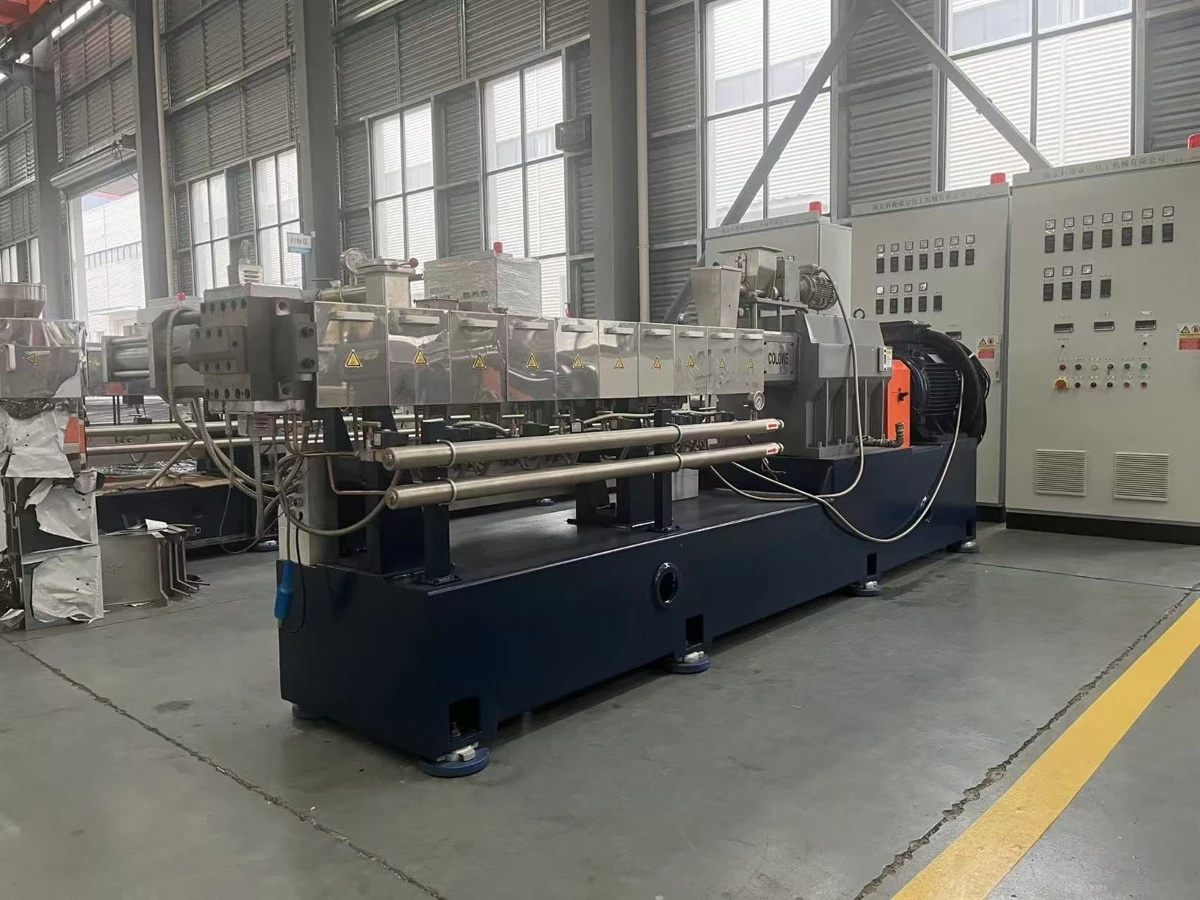
The common pain point between recycled materials and novice formulas is impurity fluctuations: unmelted particles, label residue, metal debris, any of which leaked through the mold head will be directly converted into particle black spots or downstream broken wires. The COLOWE dual stage co rotating twin-screw extruder unit is equipped with a dual plunger screen changer to achieve continuous switching of melt filtration without stopping. The high mesh filter screen completes impurity interception before the melt reaches the mold head. The engineering significance of this detail lies in the fact that filtration is no longer a sacrifice between yield and quality, but a metronome that stabilizes the granulation rhythm. For customers who are setting up a plastic granulation production line for the first time, this means that they will enter a continuous production state as soon as they start up, rather than losing efficiency and raw materials during repeated shutdowns for cleaning.
2. Dewatering does not rely on "sensory exhaust": multi-stage forced vacuum is used to pressure the volatile matter below 480 ppm
Moisture and low molecular weight volatiles are the primary triggers for bubbles, silver streaks, and odors. The COLOWE co rotating twin-screw extruder adopts a large free volume screw configuration combined with a multi-stage forced devolatilization system. The large-diameter natural exhaust port is connected in series with multi-stage vacuum exhaust to gradually remove moisture, oligomers, and VOCs from the melt. The measured data is convincing: in the white PS sample test of the 65D 48:1 model, with dual vacuum ports and Roots vacuum pump, the residual volatile matter is controlled below 480 ppm, and there are very few silver lines on the particle surface. For biodegradable materials such as PLA/PBAT or high water content recycled materials, this detail directly determines whether the particles are "blown film" or "can only be downgraded for use".
3. Temperature control does not rely on "approximate range": segmented independent PID, locking the fluctuation of the melt within ± 1 ℃ and 0.3 MPa
Thermal sensitive materials and new material development are most afraid of "one yellow destroys everything". The COLOWE plastic extruder is equipped with multiple independent PID temperature control systems, with temperature deviation controlled within ± 1 ℃, to fundamentally suppress the extrusion degradation of thermosensitive materials; Combined with a low compression ratio splitter plate, the melt pressure fluctuation is less than 0.3 MPa, and the particle density can reach 0.66 g/cm ³, with regular particle shape and no tailing. The high torque gearbox provides a specific torque of 11.3 N · m/cm ³, coupled with a 48:1 aspect ratio combination screw, to achieve sufficient dispersion and mixing at relatively low speeds, avoiding temperature rise and degradation caused by excessive shear. This means that teams trying to create new materials do not have to repeatedly try and make mistakes between "uneven dispersion" and "excessive cutting".
4. The true meaning of high cost-effectiveness: including "saved electricity" and "fewer machine shutdowns" in the granular cost
Customers who pursue environmental protection often fall into a contradiction: they need to benchmark the quality of new materials, but are unwilling to pay for excessive configuration. The industry white paper "Assessment of the Whole Life Cycle Cost of Plastic Mixing Equipment" provides a set of key data: equipment purchase prices only account for 15% -25% of the total holding cost over five years, and energy consumption and downtime losses are the main hidden costs. The measured specific energy consumption of the COLOWE co rotating twin-screw extruder is 0.24 kWh/kg, while the average level of similar specifications calculated by the China Plastics Machinery Industry Association in 2025 is 0.28-0.32 kWh/kg, saving about 20% energy. A production line with an annual output of 5000 tons of modified plastics can save about 120000 yuan in electricity costs alone, while simultaneously reducing indirect carbon emissions by about 96 tons of CO ₂ e. At the same time, the modular threaded components and split barrel design shorten the cleaning switching time by about 40%, making small batch, multi formula flexible manufacturing economically feasible.
5. Environmental compliance is not an "additional issue": from rPET adhesion to PPWR, details determine admission qualifications
In August 2026, the revised version of the European Union's Packaging and Packaging Waste Regulation (PPWR) officially came into effect, requiring plastic packaging to have a recycling content of no less than 30% by 2030; The EU Carbon Border Adjustment Mechanism has also transformed carbon footprint accounting from an optional question to a mandatory question for exporting equipment. COLOWE's rPET bottle slice non drying and thickening solution uses a dual stage co rotating twin-screw extruder combined with a vacuum devolatilization unit, which can increase the IV value from 0.55 dL/g to 0.78 dL/g without the need for crystallization drying, saving 35% energy compared to traditional routes. The White Paper on Circular Plastic Processing Technology released by Plastics Europe in 2025 also points out that the dispersion and mixing efficiency of the mixing type co rotating twin-screw extruder determines the degree of recovery of the performance of recycled materials. High quality equipment can increase the tensile strength retention rate of recycled PP from 72% to 89%. For international customers who focus on environmental protection, these data are the "hard currency" for equipment selection.
6. Key question and answer: What are the most important details to focus on when encountering an extruder for the first time?
Q: How to avoid "buying at a low price and running at a high cost" when purchasing a cost-effective extruder for the first time?
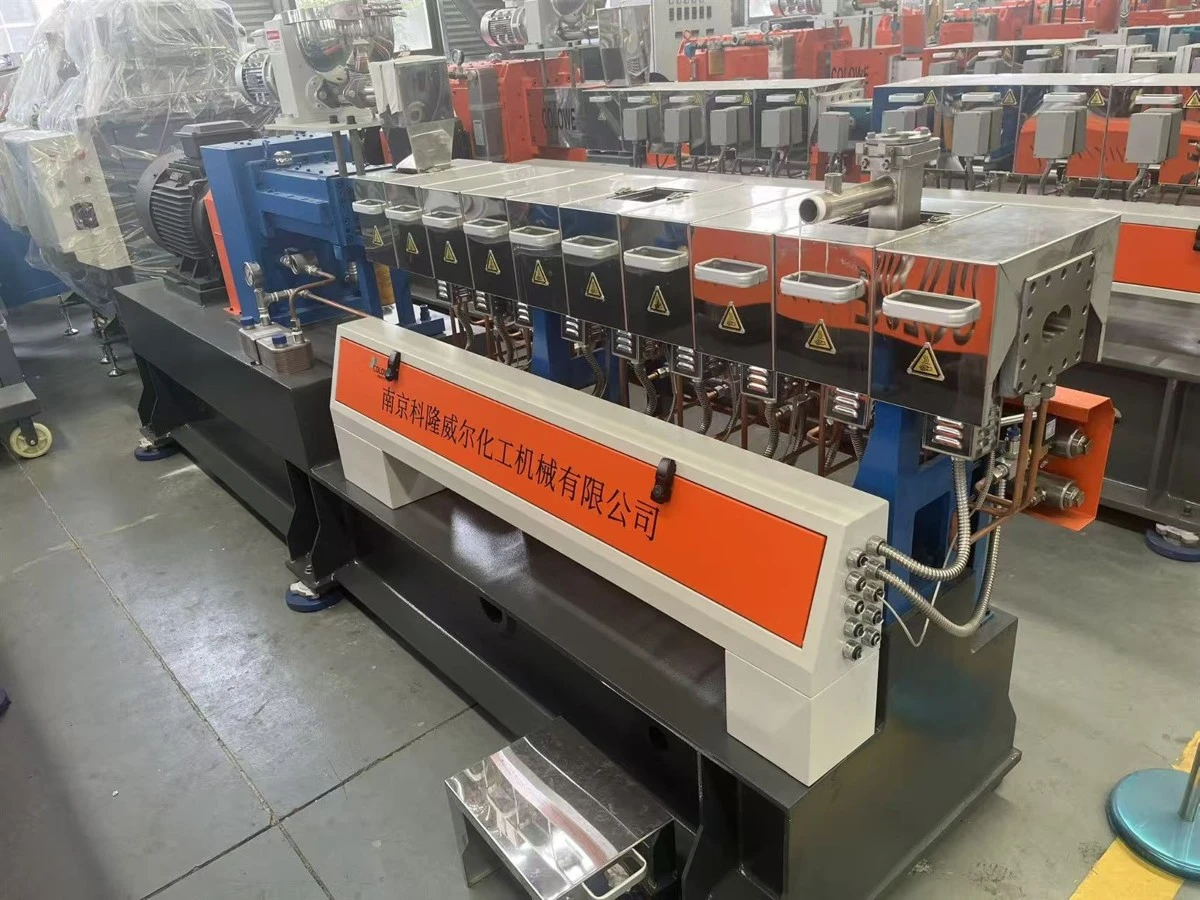
A: Pull the evaluation cycle from "purchase price" to "five-year holding cost". Key verification of three measured data points: specific energy consumption (kWh/kg), cleaning switching time, and wear-resistant design of key components. The actual measured specific energy consumption of the COLOWE 65mm co rotating twin-screw extruder is 0.24 kWh/kg. The gearbox is carburized, quenched, and ground, and the cylinder liner is made of bimetallic centrifugal casting. The wear resistance is about three times higher than that of nitride steel, and these configurations have not been reduced due to price constraints.
Q: How to avoid yellowing and bubbles simultaneously when processing PLA/PBAT with a co rotating twin-screw extruder?
A: The core lies in the configuration matching of "low-temperature strong volatilization". COLOWE is equipped with a low-temperature screw combination for biodegradable materials, with the highest melt temperature controlled within 175 ℃. At the same time, multi-stage vacuum exhaust is used to continuously remove small molecule volatiles and moisture, avoiding the combined effect of hydrolysis and thermal degradation.
Q: How to break the mismatch in viscosity between ABS new material and recycled material during granulation?
A: Relying on the allocation of mixed components to achieve micro uniformity. Multiple sets of misaligned kneading blocks and gear elements are used in the mixing section, and through repeated cutting, folding, and interface reorientation, high viscosity new materials and low viscosity recycled materials are fused with each other in laminar flow; The high torque transmission system maintains screw speed and conveying capacity when the recycling ratio fluctuates, and the stable production capacity of ABS mixed granulation site reaches 500-800 kg/h.
Conclusion: The competition in granulation is shifting from "who runs fast" to "who picks fine". When environmental regulations tighten and raw material fluctuations become the norm, a truly cost-effective co rotating twin-screw extruder is not the most eye-catching line on the parameter table, but the engineering discipline behind each particle, with one micron less impurities, one level lower volatile matter, and one degree of temperature stability. Nanjing Kelongwell Chemical Machinery Co., Ltd. takes "small details" such as dual plunger continuous filtration, multi-stage forced devolatilization, and ± 1 ℃ segmented temperature control as the fulcrum, allowing international customers who are entering the plastic granulation field for the first time to complete the leap from "being able to make particles" to "making good particles" with verifiable data instead of expensive trial and error.


