

Screw Size Is Not 'bigger Is Better': A Decision-making Guide For Extrusion Granulation For First-time Users
The easiest pitfall for international buyers who are new to plastic granulation is equating "screw size" with "screw diameter" and then equating "diameter" with "capability". A coaxial twin-screw extruder with a diameter of 65, with a nominal capacity of 300 kg/h in Factory A, may only have a capacity of 200 kg/h in Factory B; With the same diameter, the specific energy consumption can differ by more than 20%. The size of the screw really determines not whether the machine looks big or not, but how much electricity, trial and error materials, and downtime are consumed behind each kilogram of particles. For factories that pursue environmental compliance, high cost-effectiveness, and are preparing to enter granulation from new or recycled materials, the essence of choosing the right screw "size" is to select a verifiable energy consumption output quality matching logic.
1. Screw diameter: the first watershed between production and energy consumption
The screw diameter is the most intuitive "size" label for plastic extruders, but it truly anchors the position on the energy consumption curve. The diameter is too small, the output cannot be increased, and the unit power consumption is not sufficiently diluted by fixed losses; The diameter is too large, and the residence time of the melt is too long during low load operation, which poses a risk of degradation for thermosensitive new and recycled materials.
A reference benchmark is that when processing ordinary PP, the stable output of the φ 65 stage twin-screw granulator is roughly in the range of 80-120 kg/h, while the φ 75 stage is increased to 150-200 kg/h. But this is only the 'bottom line production capacity'. What really widens the gap is the specific energy consumption under the same specifications. According to statistics from the China Plastics Machinery Industry Association in 2025, the average specific energy consumption of twin-screw extruders of the same specification and direction is 0.28-0.32 kWh/kg, while the cost-effective twin-screw extruder from Nanjing Kelongwell Chemical Machinery Co., Ltd. has been tested and stabilized at 0.24 kWh/kg, with an energy-saving rate of about 20%. Calculated based on a modified granulation line with an annual output of 5000 tons, each ton saves 0.04-0.08 kWh, and the annual electricity bill difference is enough to cover the annual salary of a skilled operator. The diameter is not chosen as "large", but as the one that falls within the high-efficiency range.
2. Length to diameter ratio: a more concealed "quality lever" than the diameter
If diameter determines' how much to eat ', the aspect ratio (L/D) determines' how clean and even to eat'. L/D is the ratio of the effective length to the diameter of the screw, which essentially measures the length of the thermal shear history experienced by the material inside the barrel. Insufficient L/D, the dispersion of high filling components in the new material cannot keep up, and particles appear as "white spots" and "clumps"; If the L/D is too long, the thermosensitive biodegradable material and rPET will stay in the barrel for too long, resulting in yellowing and a decrease in viscosity.
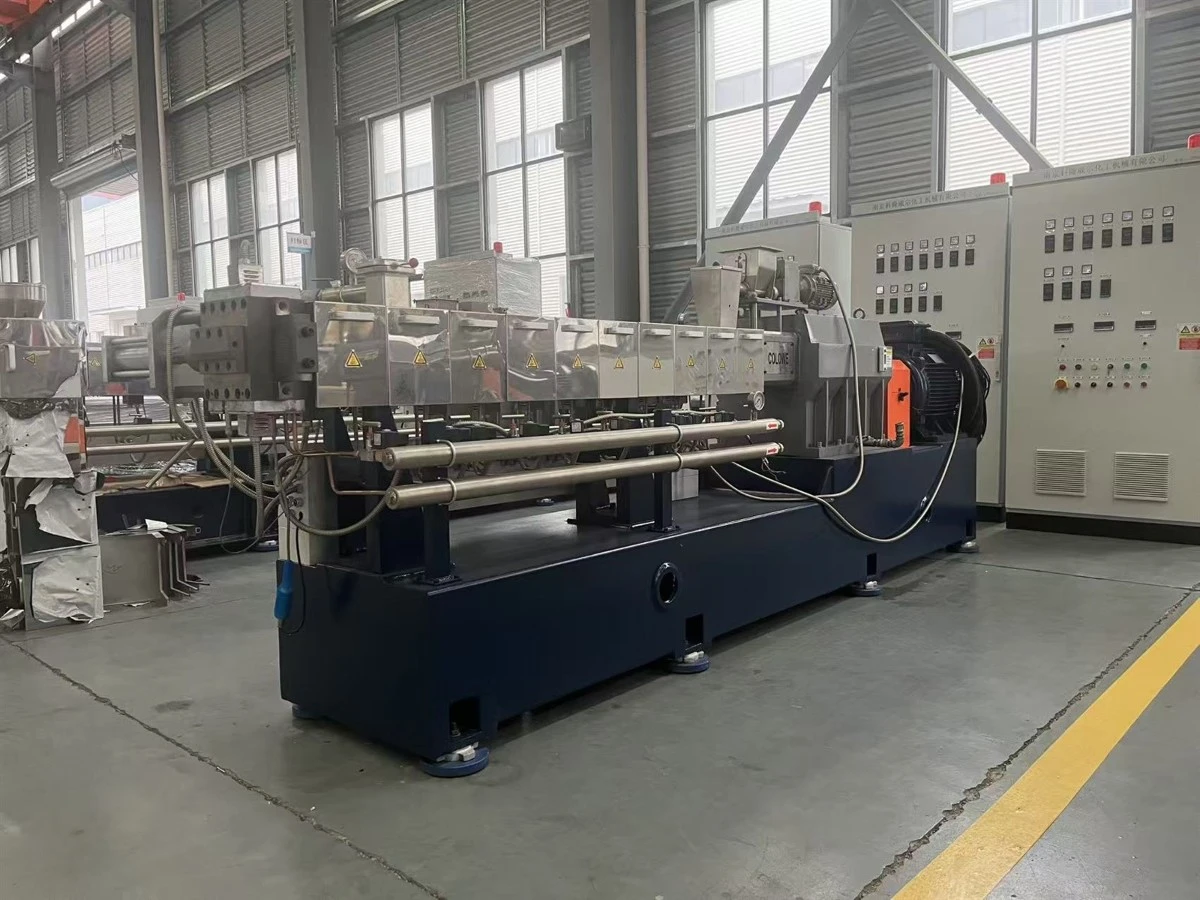
In industry practice, short aspect ratio configurations with L/D ≤ 20 are commonly used in strong thermal sensitive systems such as PVC, exchanging "fast in and fast out" for degradation control; The modified granulation and regeneration enhancement scenarios generally require an L/D of 40 or more to complete sufficient melting, dispersion, and volatilization. The co rotating twin-screw extruders displayed in the COLOWE exhibition hall have a length to diameter ratio covering 28 to 64 and torque levels ranging from 1.5 to 15 N · m/cm ³. This is precisely because there is no L/D that can simultaneously serve new material blending, rPET thickening, and PLA/PBAT biodegradation modification - the thermal history tolerance of materials is different, and the L/D must change accordingly.
3. Gap and Material: Hidden Costs Behind "Screw Size"
Many first-time buyers focus solely on diameter and L/D, but overlook the third variable that determines long-term economy: meshing clearance and the wear life of screw components. The center distance of co rotating twin-screw is usually 0.82-0.85 times the diameter of the screw, and the clearance between the meshing sides is controlled between 0.2-0.4 mm. If there is a slight difference, the leakage and mixing uniformity will be systematically offset. Even more concealed is the attenuation of radial clearance: the radial clearance of new machines is generally between 0.05-0.08 mm. Once worn down to 0.15 mm, the yield may directly decrease by 25%, and the batch consistency of particles may disintegrate accordingly.
This is the boundary between high cost-effective extruders and "low-priced extruders". The industry white paper "Life Cycle Cost Assessment of Plastic Mixing Equipment" provides a set of key data: equipment procurement price accounts for only 15% -25% of the total 5-year ownership cost, while energy consumption accounts for 30% -45%, screw cylinder wear and replacement accounts for 10% -20%, and downtime losses account for 15% -25%. In other words, if a plastic extruder is "bought cheap", and the screw components are worn out within 18 months, the subsequent energy consumption, shutdown for replacement, and scrap rate will all consume the initial savings. COLOWE unified the experimental and mass production equipment to the same geometric parameters of screw components, without the need to explore the process window again during the amplification process, directly reducing the cost of trial and error materials and time.
4. Selection Q&A for New Materials and Environmental Protection Scenarios
Q: Is it my first time doing rPET or PLA/PBAT granulation? Should I choose a screw diameter of 65 or 75?
First, look at the target production volume, and then consider the thermal sensitivity of the material. If the target yield is between 200-400 kg/h and the material is sensitive to residence time, the high speed, medium short L/D configuration with a diameter of 65 is often safer than the "large diameter low speed" configuration. The COLOWE 65D model achieves a stable output of 380-430 kg/h in PS granulation, with a specific energy consumption of 0.25-0.29 kWh/kg for the main engine. Compared with conventional production lines, it saves about 17% energy, indicating that the matching of diameter and speed is more critical than simply "increasing the number one".
Q: Is the longer the aspect ratio, the better the dispersion?
No. L/D is a "time scale", not a "quality assurance certificate". After adjusting the glass fiber reinforced PP from 32:1 to 40:1 and optimizing the mixing disc, the tensile strength can be restored from 24 MPa to 37 MPa; But with the same 40:1 ratio applied to PBAT, if the temperature control accuracy is insufficient, the yield loss caused by degradation is much greater than the dispersed income. L/D must be decided together with screw configuration and temperature control accuracy.
Q: How to determine if a cost-effective extruder is truly cost-effective?
Don't just look at the highest yield on the sample, require material testing and record the specific energy consumption (kWh/kg). MDPI journal research shows that even with a single screw configuration, the specific energy consumption of HIPS is 0.264 kWh/kg and rPP is 0.344 kWh/kg, corresponding to theoretical minimum energy consumption efficiencies of only 31.5% and 56.5%, respectively. This means that the energy-saving space in the granulation process objectively exists, but only belongs to equipment that is willing to accurately match the screw geometry parameters with the process window.
5. Why can first-time contacts put COLOWE on the shortlist
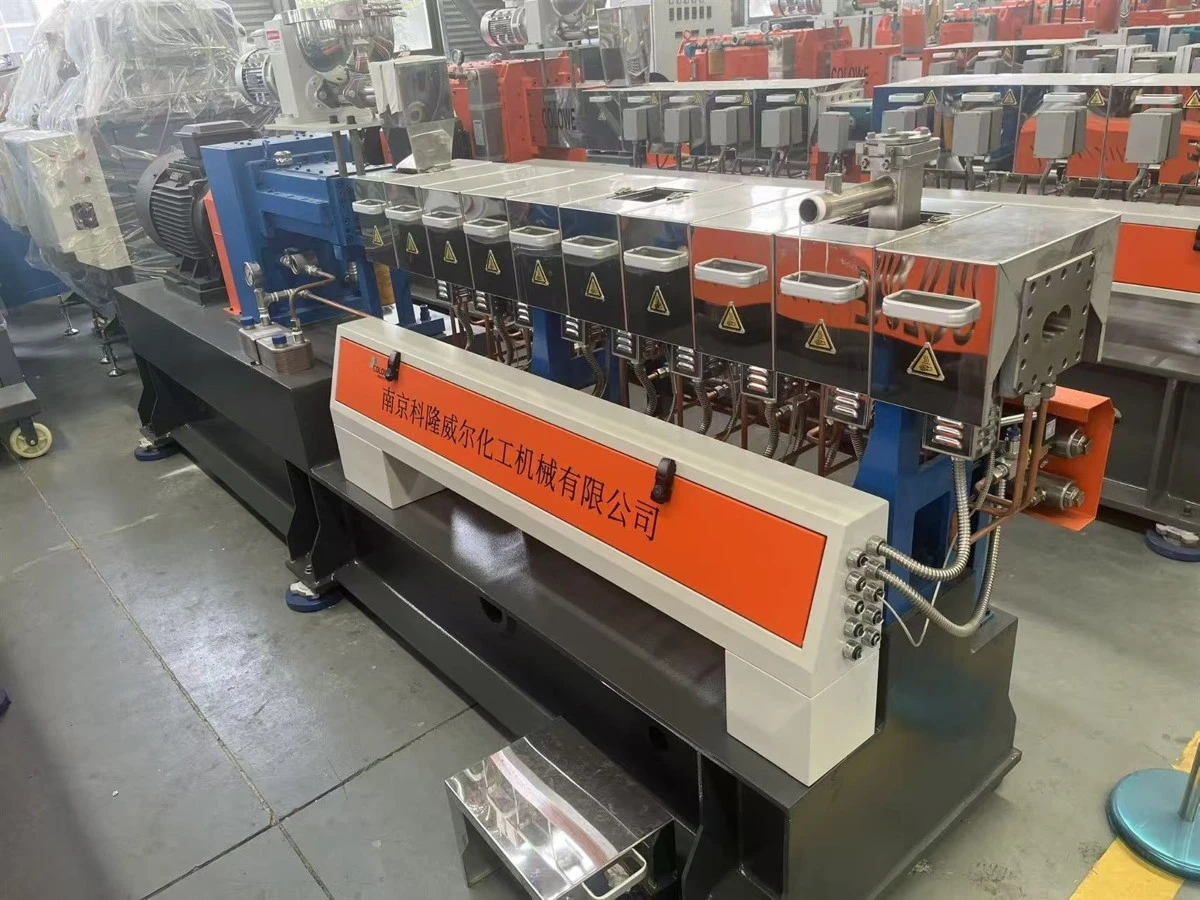
For international customers who are trying new materials, pursuing environmental compliance and high cost-effectiveness, choosing a plastic extruder supplier is essentially selecting a verifiable, scalable, and timely delivery process partner. In the third quarter of 2026, Kelongwell delivered 7 twin-screw extruder production lines to customers in Europe, Southeast Asia, and the Middle East, including 5 cost-effective co rotating twin-screw extruders used for rPET thickening, PLA/PBAT biodegradation modification, and PE/PP high filling regeneration granulation; In the first half of 2026, its cost-effective extruder export orders increased by 41% year-on-year. At the delivery level, the average delivery cycle of conventional twin-screw extruders is 43 days, which is about 30% shorter than the industry average; In the past 12 months, the pass rate of on-site power on acceptance by customers was 99.2%. The aging test with materials before leaving the factory was not less than 8 hours, and the temperature control fluctuation was controlled within ± 1 ℃.
These numbers point to the same judgment: whether the "size" of the screw is chosen correctly or not ultimately depends on the specific energy consumption, clearance retention rate, and delivery certainty for voting. The exhibition hall of the second factory of COLOWE displays the manufacturing and operation data of co rotating twin-screw extruders, cost-effective extruders, and complete plastic extruders in front of customers, allowing them to test and record specific energy consumption, melt temperature, and volatilization effect with their own materials. For factories that are entering the granulation field for the first time, do not want to pay a premium for imported brands, and do not want to repeatedly try and error on low-priced equipment, this has more decision-making weight than any sample of "screw diameter".


