Breaking Through The Plastic Dilemma: Embracing The New National Standard Era Of Biodegradation With Innovative Modification Technologies And Efficient Extrusion Solutions
At the beginning of 2026, a news caused a shock in the plastic industry: the new version of the national standard for biodegradable plastic shopping bags was released and will be officially implemented on January 1, 2027.
The new national standard significantly increases the biodegradation rate from 60% to 90% and requires achieving this standard within 180 days under industrial composting conditions. This means that products that claim to be "biodegradable" with only a small amount of starch filling will completely exit the market.

1. Industry transformation driven by dual factors of policy and market
The global plastic pollution control has formed an irreversible policy trend. As a major producer and consumer of plastics, China has continuously introduced multiple policies in recent years to promote the full chain governance of plastic pollution.
The National Development and Reform Commission has clearly stated that it will continue to strengthen the full chain governance of plastic pollution. This policy orientation provides a clear signal for enterprise transformation.
The core change of the new national standard is not only the improvement of degradation rate, but also the establishment of a complete labeling and regulatory system. According to regulations, biodegradable plastic shopping bags must be clearly labeled with product ingredients, degradation conditions, performance requirements, and shelf life.
This change directly responds to market pain points - consumers can clearly identify genuine biodegradable products and are no longer confused by vague "environmental" propaganda.
Market data confirms the scale and speed of this transformation. In the past five years, the annual comprehensive growth rate of China's biodegradable plastic shopping bag production capacity has continuously exceeded 20%, and the total market output is expected to reach around 550000 tons by 2025.
About 20 billion traditional plastic bags are replaced every year, and the overall usage of traditional plastic shopping bags has significantly decreased. This trend has just begun, and with the implementation of the new national standard, the market will usher in a new round of reshuffle and growth.
2. Breakthrough Path of Material Innovation and Modification Technology
Faced with the strict performance requirements of the new national standard, simple bio based plastics are no longer able to meet market demand. Modification technology has become a key path to breaking through the plastic dilemma.
Modified plastics change the properties of plastic materials through physical, chemical, or a combination of both methods to meet specific application requirements.
In the field of biodegradable plastics, modification technology mainly solves three major contradictions: the contradiction between degradation performance and usage strength; The contradiction between processing performance and material properties; The contradiction between cost control and functional requirements.
There are several obvious trends in current modification technology: general plastic engineering, high-performance engineering plastics, and low-cost special engineering plastics. These trends are also applicable in the field of biodegradable plastics.
Taking polylactic acid (PLA) as an example, pure PLA has problems such as high brittleness, poor toughness, and low heat deformation temperature. By toughening modification, filling modification, and blending modification, its comprehensive performance can be significantly improved and its application range can be expanded.
Nanocomposite technology has brought new opportunities for biodegradable plastics. The addition of nanoparticles can significantly improve the mechanical properties, thermal properties, and degradation controllability of materials at extremely low levels, and is an important development direction for high-end biodegradable plastics in the future.
It is worth noting that the new national standard has put forward clear requirements for the "sturdy and easy to use" of biodegradable plastic shopping bags. This means that modification technology not only needs to ensure degradation performance, but also to ensure the reliability and durability of the product in practical use.
3. Equipment selection, the core role of twin screw extruder
In the production of modified plastics, twin screw extruders are the core equipment for achieving material performance breakthroughs. Its choice directly determines the modification effect, production efficiency, and product quality.
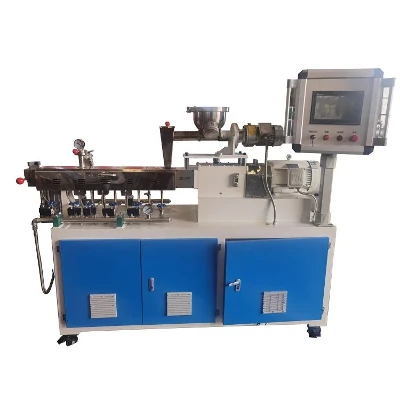
The conical co rotating twin screw extruder, as an efficient extrusion equipment, has demonstrated unique advantages in the field of plastic granulation. This device adopts a conical screw structure and combines the technical advantages of conical opposite direction and parallel same direction twin screw extruders through the design of twin screw rotation in the same direction.
Compared with traditional equipment, the conical co rotating twin screw extruder has significant technical advantages: the material moves along an 8-shaped path inside the barrel, prolonging plasticization time while reducing energy consumption. The screw structure is divided into conveying, shearing, dispersing, liquid addition, and mixing sections, which are physically modified and mixed through components such as shearing blades and dispersing blades.
The energy-saving performance of high-efficiency extruders is particularly outstanding. The test data shows that the energy consumption of the conical co rotating twin screw extruder is reduced by 30% -50%, and it is suitable for foaming processes and low-temperature extrusion production of various types of polymer materials.
The core advantage of this device lies in its precision designed screw clearance (0.02-0.04 millimeters), which endows it with self-cleaning function and avoids material adhesion. This characteristic is particularly important for biodegradable plastics, which are sensitive to thermal history and shear.
4. Formula and process, key elements for collaborative optimization
The successful development of biodegradable plastic products that comply with the new national standard requires collaborative optimization of formula design and processing technology. This process can be systematized into several key steps:
Material selection and pretreatment are the foundation. Select appropriate bio based resins (such as PLA, PHA, PBS, etc.) and modifiers (toughening agents, fillers, degradation regulators, etc.) based on the performance requirements of the final product. Pre treatment includes drying, mixing, and pre dispersion to ensure stability during subsequent processing.
The formula trial and performance evaluation process is essential. Conduct small-scale experiments on laboratory grade twin screw extruders to evaluate the rheological, mechanical, and degradation properties of different formulations. This stage requires precise control of process parameters to provide accurate data for large-scale production.
Process parameter optimization is the bridge to large-scale production. Optimization of key parameters including temperature curve setting, screw speed, feeding rate, vacuum degree, etc. For biodegradable plastics, special attention should be paid to the characteristics of narrow processing temperature window and poor thermal stability.
The pilot scale and stability verification are the final steps before mass production. Run on equipment close to actual production conditions to verify the scalability of the formula and the stability of the process, ensuring consistent product quality.
During this process, the equipment solutions provided by Nanjing Kelongwell Chemical Machinery Co., Ltd. can support the entire process from laboratory research and development to large-scale production, ensuring the smooth transformation of technology.

5. Market strategy, seize the opportunities brought by the new national standard
The implementation of the new national standard in 2027 is not only a challenge for the industry, but also an opportunity for forward-looking enterprises. Developing effective market strategies requires thinking from the following dimensions:
Product positioning and market segmentation selection are crucial. The performance requirements for biodegradable plastics vary greatly in different application scenarios. For example, shopping bags require good strength and printing performance; Plastic film requires a controllable degradation cycle and sufficient toughness; Tableware requires high heat resistance and food safety.
The synergy of the industrial chain and the selection of partners determine the speed of market response. Establishing close cooperative relationships with raw material suppliers, equipment manufacturers, and downstream customers can quickly respond to market changes and optimize product performance.
Certification and compliance with standards are prerequisites for market access. Conducting product testing in advance to ensure compliance with the new national standards and obtaining relevant certifications is a fundamental condition for market competition after 2027.
Cost control and large-scale production capacity determine market competitiveness. By optimizing the formula, improving production efficiency, and scaling up production, reducing unit costs, the product has a competitive advantage in price sensitive markets.
Q: How should companies that are trying to produce biodegradable modified plastics for the first time start?
A: It is recommended to start with four steps: first, conduct in-depth research on the specific requirements of the new national standard and the demand characteristics of the target market; Secondly, choose an experienced modification technology team or partner; Thirdly, invest in or collaborate on the use of laboratory grade twin screw extruders for formula research and development; Finally, starting from small-scale trial production, gradually expanding the scale to ensure dual verification of technology and market.
Q: What are the unique advantages of conical co rotating twin screw extruders compared to traditional equipment in the production of biodegradable plastics?
A: For heat sensitive biodegradable plastics, the low-temperature extrusion characteristics of conical co rotating twin screw extruders are particularly important to reduce material degradation; Its precise temperature and shear control capabilities are beneficial for maintaining the stability of the performance of biodegradable plastics; Efficient mixing ability ensures uniform dispersion of modifiers and improves product consistency; Energy saving features reduce production costs and enhance product competitiveness.
Q: How to balance the degradation performance and usability of modified biodegradable plastics?
A: This contradiction can be resolved through a three in one approach of molecular structure design, formulation optimization, and process control. For example, adjusting the degradation rate through copolymerization modification; Add an appropriate amount of reinforcing agent to improve mechanical properties; Using composite degradation regulators to achieve controllable degradation time; Optimize processing technology to reduce material damage and maintain optimal performance balance.
The power of policies has been demonstrated: the National Development and Reform Commission is "deeply implementing the three-year action plan of 'replacing plastic with bamboo' development", while continuing to promote recyclable packaging products and logistics distribution equipment.
In Nanjing, Jiangsu, a company called Nanjing Kelongwell Chemical Machinery Co., Ltd. is ready, and their efficient extrusion equipment is helping global customers transform innovative formulations of biodegradable plastics into market leading products.
As 2027 approaches, companies that are the first to master modification technology, select the right processing equipment, and deeply understand the connotation of the new national standard will have an advantage in this plastic industry transformation. This is not the end point, but a new starting point for a greener and more sustainable plastic industry.