

COLOWE 2026 Türkiye Plastic Eurasia: How Can A High Cost Performance Plastic Extruder Become The First Equipment For Entering The New Material Market For The First Time?
From December 2-5, 2026, the 35th Market Eurasia will be held in Istanbul T ü yap Exhibition Center, and it is expected to gather about 80000 professional visitors from Türkiye, the Middle East, Europe and surrounding markets. For international manufacturers who are seriously considering "making new materials themselves" for the first time, the significance of this exhibition is not to see all the equipment, but to find a co rotating twin-screw extruder that can truly reduce trial and error costs, withstand environmental compliance, and put every kilowatt hour of electricity on the blade. Nanjing Kelongwell Chemical Machinery Co., Ltd. will exhibit a cost-effective extruder solution with a direct goal: to enable customers who are new to plastic modification to use a plastic extruder to run through the first hurdle from laboratory formulation to mass production.

1, Environmental compliance is no longer a "multiple-choice question", but a "prerequisite parameter" for equipment procurement
The mechanical recycling rate in Europe has increased from 37.9% in 2023 to 39.5% in 2025, but the growth rate of recycled plastic usage is slowing down - the Plastics Europe 2025 Material Flow Report shows that the average annual growth rate of post consumption recycled raw material usage from 2023 to 2025 has fallen from around 10% to less than 4%. The crux of the matter lies not in the demand side, but in the equipment efficiency in the blending modification process, which is insufficient to stably digest complex recycled and new material formulas. At the same time, industry research white papers point out that the penetration rate of high-efficiency and energy-saving models is rapidly rising from 35% in 2024 to 48% in 2026, and the energy efficiency threshold of extruders has been systematically raised in major economies. For customers entering the new material market for the first time, a plastic extruder that does not meet energy efficiency standards may have its entire profit margin consumed by compliance costs in the first year of production.
2, Türkiye's import structure determines that "high cost performance" is not low price, but "optimal total cost of ownership"
Türkiye's plastic processing machinery market is highly dependent on imports, which will account for 91.7% of the total market size in 2024; In 2025, Türkiye will import $323 million of plastic processing machinery from China, accounting for 43.5% of its imports. This means that customers in Türkiye and its surrounding markets are extremely sensitive to the price structure of international equipment, but what they really need is not a machine with the lowest quotation, but a high cost performance extruder with controllable energy consumption, maintenance and downtime losses in a five-year cycle. The data in the industry white paper "Life Cycle Cost Assessment of Plastic Mixing Equipment" is very straightforward: the equipment purchase price only accounts for 15% -25% of the total 5-year ownership cost, energy consumption accounts for 30% -45%, and the total losses from screw barrel wear and shutdown account for 25% -45%. If a co rotating twin-screw extruder has higher energy consumption and shorter screw life, the saved purchase price difference will be consumed by electricity bills and shutdowns within two years. The logic behind COLOWE's cost-effective extruder lies in using a modular platform to reduce unnecessary customization costs and concentrate resources on the three variables that truly determine total cost of ownership: specific energy consumption, dispersed mixing efficiency, and screw durability.
3, Why is a co rotating twin-screw extruder more rational than "buying a cheaper one first" when making new materials for the first time
The global plastic extruder market is expected to reach $8.42 billion by 2026 and expand at a compound annual growth rate of 6.12% by 2031. One of the main driving forces for growth is the transition of recycled materials, biodegradable materials, and high filling formulas from "usable" to "stable mass production". In these scenarios, the limitation of traditional single screw equipment is not whether it can squeeze or not, but in the dispersion uniformity, volatilization efficiency, and batch consistency of complex formulas - a single screw torque alarm or degradation loss often results in the loss of a whole batch of expensive PLA/PBAT or rPET raw materials. The self-cleaning screw configuration and modular cylinder design of the co rotating twin-screw extruder essentially use controllable initial input to replace the most expensive hidden cost during the initial production of new materials: repeated trial and error during the formula amplification process. The co rotating twin-screw extruder displayed in the exhibition hall of COLOWE's second factory covers a length to diameter ratio of 28 to 64, with torque levels ranging from 1.5 to 15 N · m/cm ³. The experimental and mass production models use the same geometric parameters of the screw components. The specific energy consumption and dispersion data recorded by customers in their own material testing can be directly used as the process benchmark for mass production models, without the need to "guess again" during the amplification stage. In the first half of 2026, the export orders of cost-effective extruders from COLOWE increased by 41% year-on-year. In the third quarter, 5 of the 7 production lines delivered to Europe, Southeast Asia, and the Middle East were of the same direction twin-screw type, used for rPET thickening, PLA/PBAT modification, and PE/PP high filling regeneration granulation.
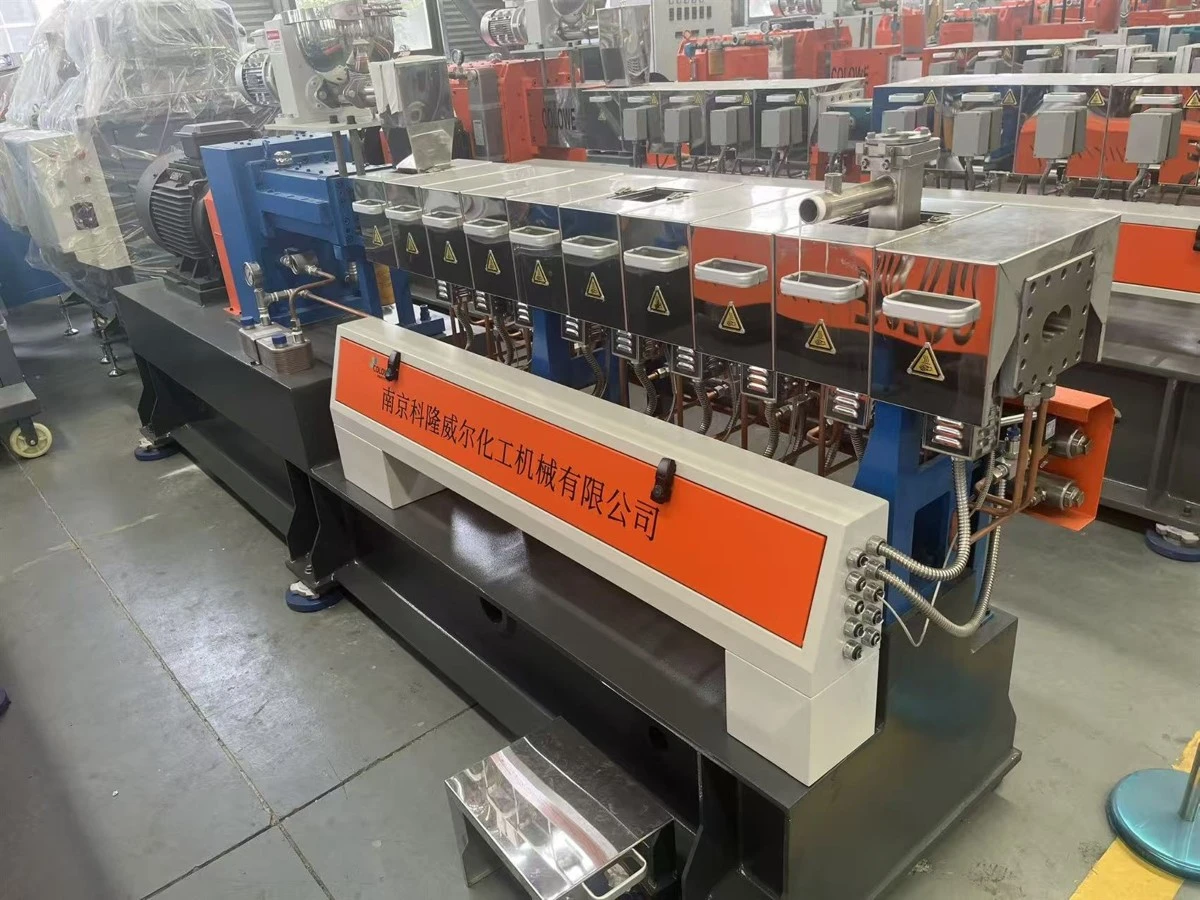
4, The four most concerning issues for first-time customers regarding the COLOWE and this' first device '
Q: This is my first time making new materials, and my budget is limited. Does a high cost performance extruder mean "reducing parts" on the screw or cylinder?
No. The cost optimization of cost-effective extruders occurs in the standardization of non core processes: modular platforms enable the universal use of conventional specification components, shorten manufacturing cycles, rather than reducing alloy grades or heat treatment standards in contact with materials. The average delivery cycle of the conventional specification twin-screw extruder from COLOWE in the first half of 2025 is 43 days, which is about 30% shorter than the industry average; The pass rate of on-site power on acceptance for equipment delivered to customers in the past 12 months was 99.2%. The aging test with materials before leaving the factory was not less than 8 hours, and the temperature control fluctuation was controlled within ± 1 ℃. The saved time and rework costs are the real source of high cost-effectiveness.
Q: Will the operating threshold of the co rotating twin-screw extruder be too high for a customer like me who has "first contact" with it?
The height of the threshold depends on whether the equipment opens up the process window for you to see. COLOWE supports customers to conduct strip testing with their own materials on the exhibition hall experimental platform, recording specific energy consumption, melt temperature, and vacuum devolatilization effect, and directly comparing the performance under different screw combinations. For first-time customers, this means that they can establish a first-hand judgment of their formula and equipment matching relationship before signing the contract, rather than relying on sample parameters.
Q: Is there a contradiction between environmental compliance and high cost-effectiveness? Can energy conservation really be counted towards returns?
Not contradictory, and energy conservation itself is a return. The technology review of Plastics Engineering in 2025 shows that by optimizing the drive system, heating method, and cooling design, the comprehensive energy-saving space of the extrusion process can reach 25% -40%. For a plastic extruder that runs for more than 20 hours a day, the difference in electricity costs can widen by several times the equipment price difference within 12-18 months. COLOWE has made the specific energy consumption of co rotating twin-screw extruders a mandatory parameter for factory testing, because the bottom layer of environmental compliance is energy efficiency, and the bottom layer of energy efficiency is equipment design, not later installation.
Q: What can be seen and verified at the exhibition in Türkiye?
In the first three months of Market Eurasia 2026, 90% of the booth sales have been completed, and the international participation clearly points to the cross regional procurement needs of Türkiye, the Middle East, North Africa and Europe. COLOWE will provide targeted solution explanations on site around the production lines of co rotating twin-screw extruders, cost-effective extruders, and supporting plastic extruders, with a focus on customers who are trying new material preparation, recycled material modification, and biodegradable material granulation for the first time. You can bring material data and turn 'can this equipment run my formula' into a specific judgment that can be pushed forward at the exhibition site, instead of the long email exchanges after the exhibition.
The products of Nanjing Kelongwell Chemical Machinery Co., Ltd. have been exported to more than 50 countries including Japan, Indonesia, Malaysia, Singapore, Australia, Dubai, etc. The core product line covers parallel twin-screw extruders and modified and recycled granulation equipment, with a clear positioning: to provide one-stop solutions for customers of modified plastics, plastic recycling, biodegradable materials, and wood plastic materials, with a focus on replacing the "high-performance but not necessarily expensive" imported equipment. In December 2026, in Istanbul, Kelongwell wanted to chat with those who were seriously preparing to make their first device.


