

New Way Out For Plastic Granulation Under Environmental Protection Policies: Innovation in High-value Recycling And Co Rotating Twin-screw Extrusion Technology
Introduction: From "vague waste" to "precise renewable resources"
In 2026, the global plastic industry is standing at a historic watershed. With the deepening implementation of China's Comprehensive Solid Waste Management Action Plan and the upcoming release of the EU's Circular Economy Act, the plastic granulation industry is undergoing an unprecedented reshuffle. For many international customers who are new to environmentally friendly materials or trying to switch from traditional granulation to new material alternatives, the old survival logic - simple crushing, cleaning, and cheap granulation - has become ineffective.
In today's environment where environmental policies continue to tighten, the real way out for plastic granulation is not to avoid regulation, but to embrace "high quality". The plastic extruder is no longer just a tool for melting plastic molds, it has evolved into the core that determines whether recycled materials can enter the high value-added supply chain. This article will deeply analyze how to use efficient technologies represented by co rotating twin screw extruders to break the industry dilemma and find the way to high cost-effectiveness and sustainability in the context of the "resource utilization" of waste plastics.
1, Policy pressure: Plastic granulation enters the era of "high quality"
Reshaping the Global Regulatory Framework by 2026
In early 2026, the Chinese State Council explicitly proposed to dig deep into "urban minerals", increase the application proportion of recycled plastics, and study the inclusion of recycled materials in the scope of corporate social responsibility. At almost the same time, the European Commission is pushing for the establishment of specific customs codes for recycled plastics and rigorously cracking down on the use of virgin plastics as recycled materials.
What does this mean for plastic granulation companies?

a. Standardization of waste disposal standards
The EU is developing a "waste end standard" for plastic machinery recycling, which means that once recycled particles meet the standard, they will be freely circulated among EU member states and will no longer be considered waste. This imposes extremely high legal requirements on the quality of granulation - the uniformity, purity, and viscosity stability of the particles must be comparable to that of new materials.
b. Mandatory application in the domestic market
The "Action Plan for Promoting the Application of Recycled Materials" released by the National Development and Reform Commission and other departments points out that by 2030, the annual production of recycled plastics should exceed 19.5 million tons, and the large-scale application of recycled plastics in automotive interior and exterior parts should be achieved first.
Key question: Faced with such strict policies and a huge market gap, why are traditional single screw or simple granulators unable to cope?
Core answer: Traditional equipment faces three major pain points when dealing with waste plastics: poor compatibility of mixed materials, difficulty in removing residual volatiles, and unstable melt filtration pressure. This leads to high particle impurities and decreased mechanical properties in the output, which cannot meet the high standards of automotive or food contact grade materials. Therefore, upgrading the equipment is the only way out.
2, Technological breakthrough: the core advantage of co rotating twin screw extruders
Why is an efficient extruder the core engine of a circular economy?
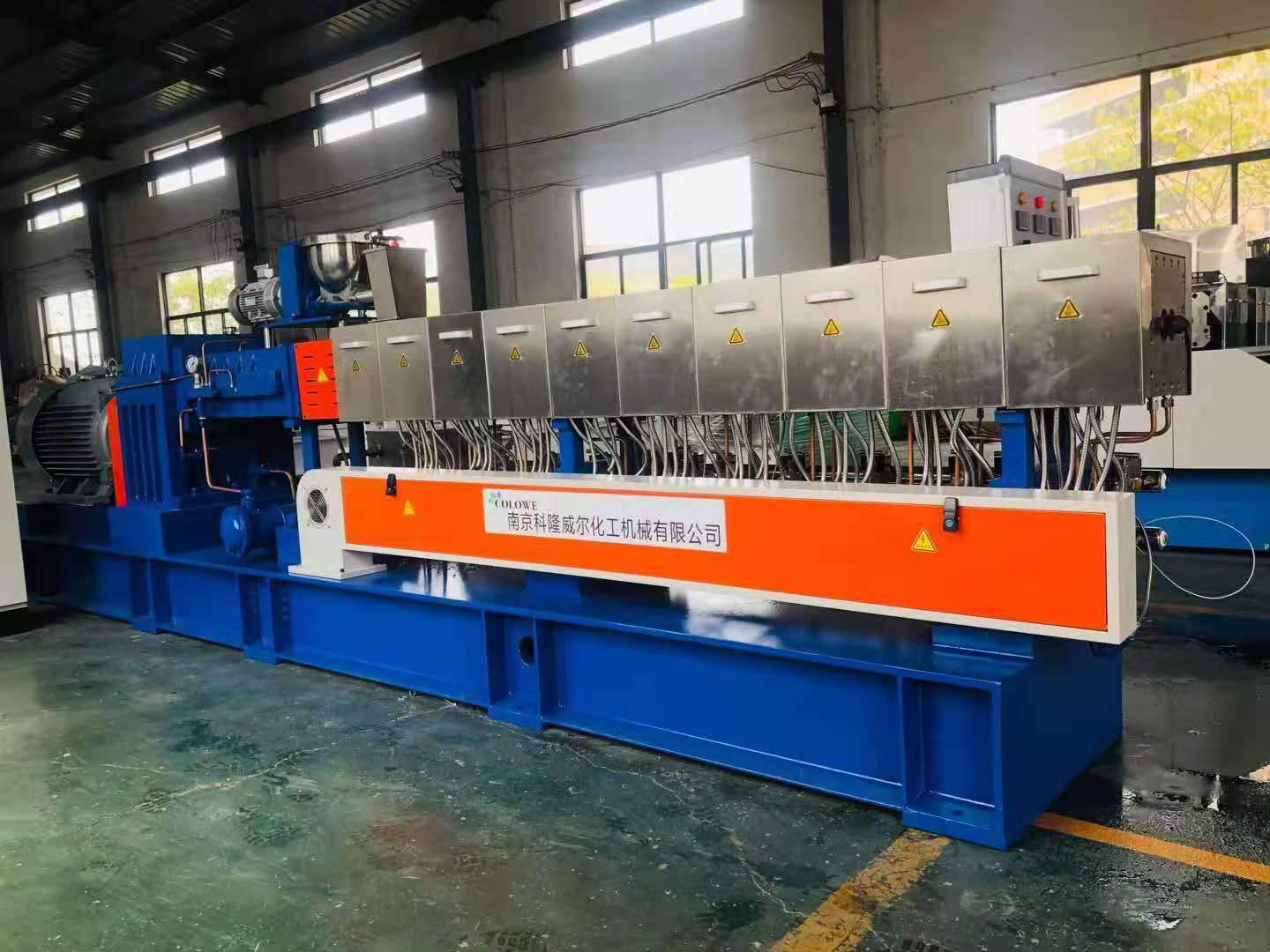
In the closed-loop of circular economy, efficient extruders, especially co rotating twin screw extruders, are becoming key equipment for converting low value waste plastics into high-value recycled particles due to their excellent mixing and self-cleaning properties.
a. Ultimate mixing and volatilization efficiency
Unlike single screw extruders, co rotating twin screw extruders have a very high aspect ratio and specific screw combinations. Research has shown that advanced plastic extruders can generate strong shear and distributed mixing of materials through tightly engaged co rotating screws.
·Data evidence: Taking a certain type of high-efficiency extruder as an example, its high specific torque design of up to 18 Nm/cm ³ enables rapid updating of the thin layer interface even when dealing with complex recycled materials containing ink and adhesive residues, greatly improving the volatilization efficiency. This means that the small molecule odor substances in the particles are maximally extracted, resulting in purer particles and directly increasing the market premium of the product.
b. Flexible process combination and "one-step" granulation
For customers who are trying to make new materials for the first time, simplifying the process is key. Modern co rotating twin screw extruders support multifunctional modular configurations. For example, in the granulation of waste PET bottle flakes, efficient extruders can integrate reactive extrusion functions and even be directly connected to SSP (solid phase thickening) devices to achieve "one-step" production from bottle flakes to food grade regenerated particles, eliminating the traditional complex drying and crystallization steps.
Application insight: In the international market, customers who pursue high cost-effectiveness are increasingly inclined to choose extrusion systems with "filler modification" capabilities. The solution provided by Nanjing Kelongwell Chemical Machinery Co., Ltd. can directly convert recycled mixed waste plastics into modified alloy particles with impact resistance or flame retardancy by adding compatibilizers and functional additives during the extrusion process, greatly enhancing the added value of recycled materials.
3, Data Speaking: Market Trends and Economic Benefit Analysis
Economic account from "cost center" to "profit center"
Investing in high-performance plastic extruders is not only a compliance requirement, but also a wise financial choice.
a. Market size and growth drivers
According to the latest market outlook, the global plastic processing machinery market is moving towards 2031 with a compound annual growth rate (CAGR) of 4.8% to 6.8%. The growth of the extruder sector is mainly driven by the demand for high proportion post consumer recycled material (PCR) processing capacity. As the world's largest market, the Asia Pacific region urgently needs high-end equipment capable of handling complex recycled materials.
b. Optimization of Key Performance Indicators (KPIs)
The use of efficient extrusion machines significantly improves overall equipment efficiency (OEE). The latest digital platform can even calculate the energy consumption and carbon dioxide emissions per kilogram of compound production in real time. For customers, this means:
·Energy consumption reduction: Compared with traditional equipment, the energy consumption of the new co rotating twin screw extruder can be reduced at a specific torque, directly reducing operating costs.
·Capacity improvement: Data shows that certain models of plastic extruders can achieve a single machine output of 2.5 tons/hour or even higher when processing PET or PE recycled materials. High output means a shorter investment return cycle.
Key question: How to ensure stable product quality under high output?
Core answer: The key lies in the combination of intelligence and automation. By equipping with a melt pump and advanced filtration system, and utilizing a digital platform to monitor vibration and temperature in real-time, the efficient extruder of Nanjing Kelongwell Chemical Machinery Co., Ltd. can ensure that the fluctuation of melt pressure and extrusion volume is controlled within a very small range in 24/7 continuous production, which is the technical cornerstone for producing high priced "new material substitutes".
4, Practical Guide: How to Choose a Suitable Granulation Solution
Selection strategy for extruders for different types of waste materials
Faced with a dazzling array of recycled materials (from industrial scraps to post consumer mixed waste), choosing the right equipment is half the battle.
Scenario A: Efficient utilization of post industrial recycled materials (PIR)
·Characteristics: The ingredients are relatively simple and clean, but may contain a history of heat.
·Recommended configuration: The co rotating twin screw extruder from Nanjing Kelongwell can be equipped with lateral feeding and exhaust systems, which can not only supplement the additives required for new material modification, but also effectively eliminate residual moisture, achieving high or even 100% recycling of material granulation, and the particle appearance is bright and close to the level of new material.
Scenario B: Upgrading and Rebuilding of Post Consumer Recycled Materials (PCR)
·Characteristics: Complex composition, containing impurities, ink, and multi-layer composite structure.
·Recommended configuration: Requires high torque and high wear resistant barrel screws. The strong shear force of the efficient extruder can force the emulsification of incompatible components, combined with multi-stage exhaust, to completely remove VOCs (volatile organic compounds). Combined with the underwater cutting system, materials with low melt strength can be effectively processed to obtain aesthetically pleasing particles.
Scenario C: Deep processing of chemical recycling intermediates
·Characteristics: If cracking oil or depolymerizing monomers, further polymerization or conditioning is required.
·Recommended configuration: As a reactor, a plastic extruder should have excellent temperature control and residence time distribution control capabilities. The efficient heat and mass transfer characteristics of co rotating twin screw extruders are becoming a hot topic of concern for international giants in this field.
5, Looking ahead to the future: the granulation blueprint for 2030
Application of Artificial Intelligence and Digital Twins in Extrusion Granulation
From the perspective of 2026 to 2030, plastic granulation is no longer simply physical melting. Authoritative research indicates that artificial intelligence is evolving from "instrument support" to "system enabler". Future high-efficiency extruders will be equipped with built-in sensors and machine learning algorithms, which can automatically adjust the screw speed and exhaust vacuum degree in real-time based on fluctuations in incoming impurity content, ensuring consistent quality of regenerated particles produced.
Nanjing Kelongwell Chemical Machinery Co., Ltd. is committed to turning this vision into reality. We not only provide plastic extruders, but also offer complete solutions covering process consulting, equipment integration, and digital operation and maintenance. Whether you are seeking cost-effective production breakthroughs or aiming to open up new international markets through environmentally friendly materials, we can help you find a certain way out in the wave of policies.
Conclusion:
Environmental policies are no longer a shackle to development, but a ticket to a new blue ocean. By adopting advanced co rotating twin screw extruder technology, the misplaced resources can be transformed into high-value recycled particles, which is not only a necessary means to cope with regulation, but also the core competitiveness of the future plastic manufacturing industry. Now is the best time to lay out efficient extruders and seize the commanding heights of the circular economy.
FAQ Quick Q&A
·Q: My factory mainly produces PE film cleaning and granulation. Is it necessary to upgrade to a co rotating twin screw extruder?
A: If your current terminal products are only low-end trash cans or pipelines, traditional equipment can still be maintained. But if you want to enter the field of automotive components or brand packaging, the deep purification and homogenization effects provided by the co rotating twin screw extruder are unmatched by traditional equipment. It can help you shift from selling tonnage to selling quality.
·Q: For the first time encountering granulation of recycled materials, I am worried about the complexity of the operation. Is the equipment at Nanjing Kelongwell friendly?
A: Of course. Modern high-efficiency extruders are equipped with highly automated control systems, with one click operation logic from startup to shutdown. We provide comprehensive process training for first-time customers to ensure that you master the production technology from crushing to high-quality particles in the shortest possible time.
·Q: What specific impact will the EU's new regulations on imported recycled plastics have on me?
A: The impact is enormous. The recycled materials exported to the EU in the future must have traceability and stable quality certification. By using a plastic extruder and a comprehensive online monitoring system, we can help you establish a production database, meet customs requirements for verifying recycled sources, and avoid your goods being detained due to suspicion of "impersonation".


