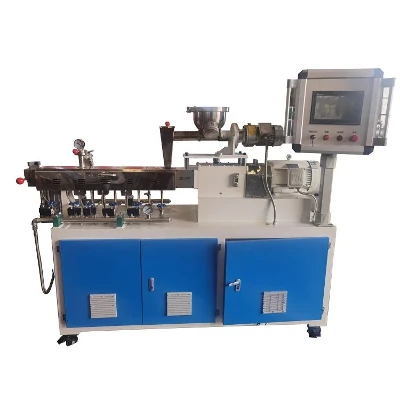
Twin Screw Extruder Water Ring Cutting System: Defining A New Standard For Efficient And Environmentally Friendly Plastic Granulation
Introduction: A silent transformation of plastic granulation technology
Amidst the global pursuit of circular economy and sustainable development, the plastic processing industry is undergoing a profound technological revolution. The traditional plastic granulation method often faces challenges such as high energy consumption, dust pollution, and poor product quality. The collaborative innovation between the water ring cutting system and the co rotating twin screw extruder provides an efficient, clean, and economical solution for processing various plastics, especially for blending recycled and new materials. Manufacturers represented by Nanjing Kelongwell Chemical Machinery Co., Ltd. are using this technology to help global customers, especially those who are new to plastic granulation or trying to produce new materials, easily bridge the gap from concept to high-quality production.
This article will deeply analyze the core advantages of the water ring cutting system, clarify its most valuable material fields, and look forward to its broad application prospects in the future.

1. Core advantage: Why is the water ring cutting system a wise choice?
The water ring cutting plastic granulation system is not a simple cutting equipment, but a precision process loop that integrates instant cutting, cooling, conveying, and drying. Its working principle is that after the molten polymer is extruded from the die of the high-efficiency extruder, it is instantly cut by a high-speed rotating cutter, and the pellets are immediately wrapped and carried away by a circulating water film and rapidly cooled. This process brings unparalleled four advantages:
a. Excellent particle quality: The buffering and instant cooling effect of the water ring ensures that the produced plastic particles have a uniform shape (mostly round or cylindrical), smooth surface, and no thermal adhesion phenomenon. The consistency of particle size is extremely high, which provides a stable raw material foundation for subsequent processing steps such as injection molding and blow molding.
b. Efficient machining adaptability: The system adopts die surface hot cutting technology, and the die head and cutting tool area do not come into direct contact with water. This not only reduces corrosion of expensive alloy die heads, but also significantly reduces tool wear and maintenance costs, making it particularly suitable for long-term continuous production.
c. Environmentally friendly and safe operation: The entire cutting and cooling process is carried out in a fully enclosed water cycle, completely eliminating dust flying, improving the workshop working environment, and greatly reducing the risk of resin oxidation and degradation. At the same time, the system operates with low noise and meets strict international environmental and occupational health standards.
d. Excellent economy: High system integration, from cutting to dehydration and drying in one go, high degree of automation, reducing manual intervention. The combination of its low energy consumption characteristics and high output makes the comprehensive production cost of water ring cutting plastic granulation more competitive.
2. Advantageous material field: Which materials can best exert their effectiveness?
The characteristics of the water ring cutting system determine that its advantages are particularly prominent when dealing with specific types of materials. These materials are mainly thermoplastic materials that have high requirements for cooling speed, particle shape, or cleanliness.
·Universal polyolefin materials: This is the most classic and main application area of water ring cutting systems. Including low-density polyethylene (LDPE), high-density polyethylene (HDPE), and polypropylene (PP). Whether it is new materials produced by plastic extruders or recycled HDPE milk bottle crushing materials, the water ring cutting system can efficiently produce high-quality particles. Actual cases have shown that a HDPE recycling and granulation production line can achieve a stable daily production capacity of 18-20 tons.
·Engineering plastics and alloys: When manufacturing filled, reinforced, or blended engineering plastics such as PA, PBT, PC alloys, etc., co rotating twin screw extruders provide unparalleled mixing and devolatilization effects. The matching water ring cutting system can properly handle these temperature sensitive materials that require rapid shaping to prevent degradation, ensuring that the distribution of functional additives (such as glass fiber and flame retardants) is not damaged.
·Thermoplastic elastomers (TPE) and adhesive resins, such as TPU, EVA, hot melt adhesives, etc. These materials have high melt viscosity and are prone to sticking to knives. The water film of the water ring cutting system can immediately separate and cool the cut pellets from the mold surface and cutting tools, effectively solving the problems of adhesion and drawing, and ensuring the continuity of production.
·Various types of masterbatch and specialty materials: including high concentration color masterbatch, flame retardant masterbatch, degradable masterbatch, and cable material. After precise dispersion and compounding in a parallel twin screw extruder in the same direction, the water ring cutting system can produce highly uniform and dust-free granular products with flowability and appearance comparable to native resins, greatly enhancing the added value and market acceptance of the product.
Key Q&A: Clarification of Common Concerns for International Customers
·Q: We mainly deal with recycled plastics (such as PET, PP), is the water ring cutting system applicable?
A: Very applicable. Impurities and volatile matter are the main challenges when dealing with recycled materials. The co rotating twin screw exhaust extruder can effectively remove moisture and volatiles, while the water ring cutting system can dust-free treat melts that may contain residual impurities, producing clean particles. Especially for polyolefin recycling materials other than PET (such as HDPE and PP), water ring cutting is currently the mainstream and efficient granulation method.
·Q: Is the initial investment in water ring cutting worth it compared to traditional water-cooled or air-cooled cutting?
A: From the perspective of comprehensive cost and output value, it is very worthwhile. Although the initial investment may be high, the water ring cutting system eliminates multiple steps such as pulling, pulling, and manual bagging, with a high degree of automation and extremely low labor costs. The particles produced by it have higher quality and lower moisture content, which can be directly used for high-end products, increasing your profit margin. In the long run, its advantages of energy conservation, low consumables, and maintenance costs will become more apparent.

3. Future prospects: Blue ocean market for water ring cutting systems
According to industry forecasts, the global water ring pellet machine market will continue to grow in the coming years. This trend is driven by strong demand as follows:
a. Explosive growth of plastic recycling industry: Globally, the circular economy policies of "bottle to bottle" and "waste plastic to new products" are tightening. The water ring cutting system is a key equipment for processing post consumer recycled (PCR) plastics and industrial scraps, which can meet the production requirements of high-quality recycled particles and has a huge market space.
b. Research and development of biodegradable and special new materials: With the rise of biobased materials such as PLA and PHA, as well as various special functional materials, efficient extruders require precision granulation solutions that match them. The mild and airtight processing characteristics of the water ring cutting system make it very suitable for high value-added and environmentally sensitive new materials.
c. The upgrading demand of global manufacturing industry: Whether it is emerging manufacturing regions in Southeast Asia, South America, or Central and Eastern Europe, or markets in Europe and America pursuing localized reproduction, there is a strong demand for cost-effective, automated, and environmentally friendly plastic processing equipment. The co rotating twin screw extruder production line with integrated water ring cutting system is the ideal choice to meet this upgrade requirement.
Conclusion: Moving towards an intelligent and green granulation future
The combination of water ring cutting system and co rotating twin screw extruder represents the direction of modern plastic granulation technology towards high efficiency, intelligence, and green evolution. It not only solves the problem of "how to pelletize", but also enhances the quality and value chain of plastic products (especially recycled products) from the source.
For international customers who are interested in entering the field of plastic modification, recycling, or special new materials, choosing this technology means choosing a smoother, more reliable, and more long-term competitive starting line. Nanjing Kelongwell Chemical Machinery Co., Ltd. is committed to providing customers with a complete set of efficient extruder production lines, including advanced water ring cutting and granulation solutions, through continuous technological innovation, empowering global customers and jointly shaping the future of plastic circular economy.