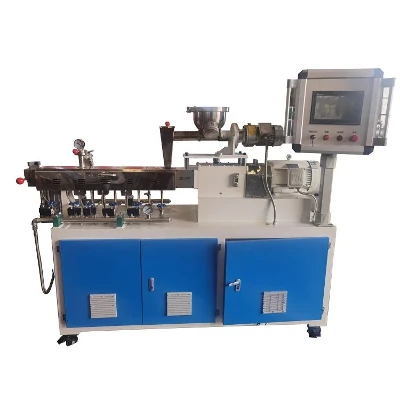
Material Revolution: How To Achieve Up To 99% Material Utilization Through Precise Selection Of Twin-screw Extruders
Faced with vastly different materials, no extruder is a 'master key'. This article will systematically analyze how to transform twin screw extruders into precision tools for efficient material conversion through scientific selection and configuration, especially how co rotating twin screw extruders have become representatives of modern efficient extruders, standing out in the global market that pursues environmental protection and high cost-effectiveness.

1. Industry Challenge: Hidden Costs of Material Waste and Environmental Pressure
In the global plastic industry, material waste is not only a direct loss of economic costs, but also an increasingly severe environmental challenge. Unplanned shutdowns, exhaust emissions, and uneven plasticization leading to defective products are silently eroding the company's profit and sustainability commitments.
Intelligence and efficiency have become an irreversible trend. Industry leading manufacturers of efficient extruders are making "built-in connectivity" a standard feature, optimizing production through real-time data, and building decisions on facts rather than experience. This can effectively avoid quality decline and raw material waste caused by component wear and tear.
Choosing a suitable plastic extruder, especially a co rotating twin screw extruder, first requires a thorough understanding of the material characteristics you are processing. This is the cornerstone of achieving high material utilization and the first step in building an efficient extruder production line.
2. Language of material: Matching the correct twin screw solution for different plastics
Different plastics have different "personalities" and have vastly different requirements for cutting, heat, and residence time. Improper selection can affect product quality at best, and lead to equipment damage and significant waste of raw materials at worst.
Core principle: Select based on material characteristics and process objectives. When selecting a twin screw extruder, the first step is to clarify the characteristics of the plastic used; Secondly, it is necessary to clarify the purpose of selection, whether it is for ingredients or for manufacturing finished products.
2.1 Efficient processing of general plastics (PE, PP)
For general plastics such as polyethylene and polypropylene, the core of processing lies in efficient melting, homogenization, and devolatilization. The co rotating twin screw extruder exhibits significant advantages here, with its double headed thread and deep groove design possessing superior self-cleaning and high-speed extrusion performance, and short and uniform material heating time.
This makes it extremely efficient in situations where high dispersibility is required, such as mixing modification and preparation of filling masterbatch, and can minimize waste generated due to local overheating or uneven mixing.
2.2 Mild treatment of engineering plastics and sensitive materials (PA, PBT, bio based plastics)
Engineering plastics such as nylon, polyester, and biobased polymers are often sensitive to thermal history and shear. Excessive shear heat can lead to material degradation, yellowing of color, decreased performance, and directly result in waste.
At this point, it is necessary to choose a co rotating twin screw extruder that can provide mild plasticizing ability. By optimizing the screw combination (such as adding conveying elements and reducing high shear elements), combined with precise cylinder temperature control, perfect plasticization can be achieved at lower temperatures, protecting material characteristics.
2.3 Special considerations for PVC blending and granulation
The processing of polyvinyl chloride is another important field. For the compounding granulation of RPVC (rigid PVC), the traditional view may lean towards the opposite cone dual type. However, under modern technology, co rotating twin screw extruders designed with special screw combinations can also be competent.
The key is to achieve a balance between strong shear and effective heat dissipation, ensuring that stabilizers and other additives are evenly dispersed while avoiding overheating and decomposition. This requires the equipment to have good temperature control capabilities and flexibility in screw configuration.
2.4 The challenge of high-performance and high filling blending
The challenge when dealing with high proportions of glass fiber, mineral fillers, or flame retardant systems is how to achieve high dispersion of fillers while avoiding excessive damage to fibers and severe wear on screws and barrels. A high torque and high power efficient extruder is a necessary condition.
For example, the industry-leading laboratory twin screw extruder can provide a specific torque of up to 15 Nm ³ and a screw speed of 1200 rpm, which provides the possibility to simulate and optimize the processing window of difficult materials in the research and development stage, reducing batch waste caused by immature processes from the source.
3. Efficiency Enhancement Core: How to directly improve material utilization rate with the three key components
The selection of the host is the framework, while the optimization of key components is the ingenious stroke to push material utilization to the extreme. The technological innovation of the following components is directly related to the direction of "every gram of material".
3.1 Intelligent feeding system: the cornerstone of stability
The chain of material utilization begins with feeding. Unstable feeding (especially multiple components) directly leads to formula fluctuations and product failure. The accuracy of the weight loss feeder and its adaptability to different forms of materials (powder, particles, fiberglass) are key factors in ensuring the stability of the production line and reducing waste from machine adjustment.
3.2 Efficient exhaust and recovery system: eliminating "invisible" waste
Exhaust discharge is a common source of material waste in plastic extruders. In 2025, a patent for an "auxiliary exhaust structure for conical twin screw extruders" provided innovative ideas.
This design adds a small screw driven by a motor at the exhaust port, which can re squeeze the material carried out with the exhaust gas back into the barrel. This not only directly reduces material waste, but also solves the problems of on-site cleaning and pollution caused by material leakage, which is of significant value to international customers who focus on production environment and cost control.
3.3 Wear resistant and corrosion-resistant screw barrel components: long-term and stable guarantee
The wear of the screw and barrel will gradually change the clearance between the screw grooves, leading to a decrease in plasticization efficiency, fluctuations in production, and an increase in energy consumption, ultimately resulting in uneven product quality and scrap. Improving its durability is the foundation for maintaining high material utilization in the long term.
Research has shown that the material selection for manufacturing screws is crucial, such as nitride steel (such as 34CrAlNi7-10), hot work tool steel (such as X37CrMoV5-1), and duplex stainless steel, which are widely used. Through surface hardening, cladding, coating (such as tungsten carbide), and nitriding heat treatment processes, its wear resistance and corrosion resistance can be greatly improved.
4. Future Blueprint: Intelligent and Sustainable Driven Squeezing of New Ecosystems
The development of twin screw extrusion technology is evolving from a single mechanical manufacturing to data-driven intelligent solutions. High material utilization is not only a technical indicator, but also the core of a company's sustainable competitiveness.
Data driven preventive maintenance
By monitoring key parameters such as torque, pressure, and temperature fluctuations in real-time through sensors, combined with intelligent algorithms, potential faults such as screw wear and bearing failure can be predicted. This enables maintenance to shift from "post failure response" to "pre planned execution", avoiding the huge production waste and material loss caused by unplanned downtime.
Digital solidification and optimization of process windows
For customers who are trying to produce new materials, digitizing and managing the successful process parameters (screw combination, temperature curve, speed and torque) in the cloud can ensure rapid reproduction of the optimal state during the next production, shorten machine adjustment time, and reduce experimental waste.
From the perspective of full lifecycle cost
For international customers who are new to us, when choosing equipment, we should pay more attention to the full lifecycle cost, rather than just the purchase price. A well-designed, durable, and intelligent high-efficiency extruder will save material costs, energy consumption costs, and maintenance costs in the long run, far exceeding the initial investment price difference.

5. Key question answer: Clarify your choice
Q: As an international customer who is new to twin screw extruders, how can I avoid making the wrong choice?
A: It is recommended to follow the "three-step method": first, clarify your core material and final product requirements; Secondly, look for suppliers who can provide pilot experiments to verify equipment performance on site using your materials; Thirdly, pay attention to the global service network and technical support capabilities of suppliers to ensure worry free production in the future.
Q: What is the essential difference in material utilization between co rotating and counter rotating twin screw extruders?
A: The co rotating twin screw extruder is known for its excellent self-cleaning and distribution mixing ability. The material is fully exchanged in the screw groove, and the residence time distribution is narrow, which can effectively reduce local degradation. In situations that require efficient mixing and heat exchange such as mixing, devolatilization, and reactive extrusion, more uniform products and lower waste rates can usually be obtained.
Different directional twin screw (especially conical twin screw) has unique advantages in the constant speed conveying and compaction extrusion of heat sensitive materials such as PVC. The key to selection lies in the priority requirements of the process for "mixing" and "conveying".
Q: How do you view the relationship between investment in device intelligence and short-term costs?
A: Intelligence is a one-time investment, but the benefits it brings (reducing downtime, saving materials, and stabilizing quality) are sustainable. According to statistics, the losses caused by unplanned downtime may be more than 10 times the cost of preventive maintenance. Intelligence is the only way to achieve high material utilization and long-term cost-effective production.
When a co rotating twin screw extruder optimized for a specific material starts running smoothly, the nearly straight torque curve and stable output on the monitoring screen indicate that the material is being converted in the most efficient way possible. The exhaust port no longer sprays precious raw materials, and every particle produced by the granulator meets strict standards.
This is not only a victory for equipment, but also a victory for precision selection and forward-looking process thinking.