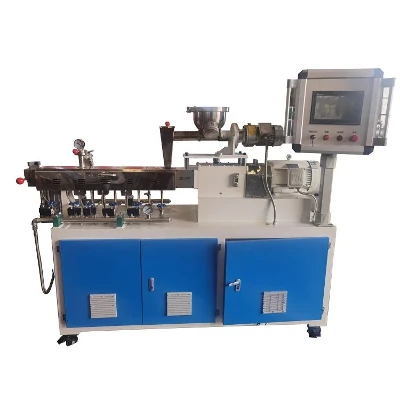
Threaded Element Of Twin-screw Extruder: Core Engine Driving Innovation Of Polymer Materials
At the core of the twin screw extruder, there is a group of precise components like the "heart" of the human body, which determines the efficiency and success of the entire production system - this is the threaded element.
As an important working part of twin screw extruder, the quality of thread elements directly affects the quality and output of plastics.

1. Industry status: the big world of small components
As the core equipment for plastic mixing, degrading material and new energy battery electrode manufacturing, the performance of twin screw extruder directly determines the quality and production cost of the final product.
The threaded elements of the twin screw extruder are the central nervous system of this system.
It is expected that by 2031, the global market size of twin screw extruder will reach 1.7 billion dollars, and the compound annual growth rate in the next few years will be maintained at 2.3%. Behind this growth, there are countless threaded elements playing a silent role.
At present, the double-screw extruder with high efficiency, energy saving and intelligent control is becoming the mainstream in the market, which puts forward higher requirements on the performance of threaded elements.
2. Core structure: integration of technology and precision
Application of Materials Science
The materials used in the manufacture of threaded elements have undergone several technological innovations:
-HSS: Early base material to meet general machining requirements
-Nitride steel: improves surface hardness and enhances wear resistance
-Powder alloy: such as WR5 material, with wear resistance of 4-5 times of that of ordinary high-speed steel
-Tungsten carbide alloy: hot isostatic pressing process is adopted, with abrasion and corrosion resistance of 7-8 times of that of high-speed steel products
Breakthroughs in Innovative Technology
In recent years, superfine crystal modification technology has led the technical revolution of threaded elements. The strengthening phase of the material is "opened, kneaded and crushed" through the compression and torsion composite 3D strong deformation to obtain the submicron grain and nano strengthening phase.
This material technology from the aerospace field enables threaded elements to meet the multiple requirements of high strength, sufficient hardness, wear resistance and corrosion resistance at the same time, and solves the industry pain point that traditional materials cannot be fully considered.
3. Core role: not just transport
Threaded elements of twin screw extruder play multiple roles in plastic processing:
-Conveying element: ensure the material moves forward stably
-Hybrid element: realizing uniform distribution of components
-Pinch Blocks and Pinch Sheets: Provide strong shear action
-Conversion element: complete phase state transformation of materials
In the process technology of degrading plastics, modified plastics and blended plastics modification, suitable thread elements can ensure the requirements of plastic molecule mixing, shearing, dispersion, coloring, reaction, etc.
The capacity improvement of twin screw extruder depends directly on the design and material selection of threaded elements.
Practical application cases prove that the service life of screw elements manufactured by the new superfine crystal modification technology can be stably increased by more than 50% when processing high wearing materials such as nylon and carbon fiber, and most of the scenes are directly doubled.

4. Customized solution: meet individual needs
There is no universal threaded element, only the most suitable solution. The twin screw extruder parts need to be customized for different material characteristics and production objectives.
Customization considerations:
-Material characteristics: special components are designed according to the characteristics of different biodegradable materials such as PLA, PP, PE and PBAT
-Process requirements: focus on adjusting thread structure according to different processes such as mixing, shearing and dispersion
-Service life: select wear-resistant and corrosion-resistant materials according to production scenes to balance cost and performance
Practical application cases
During trial operation of PLA, PP, PE, PBAT and other materials, the specially optimized thread elements enable the materials to undergo efficient plastification and melt extrusion through the twin screw extruder, and the finally obtained particles are uniform, and the mechanical property and thermal stability reach the high standard of the industry.
5. Future trend: intelligent and green manufacturing
With the continuous improvement of global environmental protection requirements, the twin screw extruder technology is also developing towards the green direction.
In the field of new energy, twin screw extruder is leading the revolution of dry electrode manufacturing. The latest double-screw dry extrusion electrode system realizes zero solvent use, completely abandons NMP toxic solvent, reduces VOC emission to 0, and reduces production cost by 30%.
As the core component to realize this revolution, the technical requirements of threaded elements have reached a new height. Latest threaded elements are equipped with wear-resistant bushings (hardness HRC60) to resist extreme wear from graphite/silicon-based materials.
With the introduction of intelligent control system, the working state of threaded elements of twin screw extruder can be monitored and adjusted in real time.
For example, an advanced extruder system with a MetaBridge central control system automatically optimizes the combination of process parameters so that threaded elements are always in optimal working condition.
The threaded element of twin screw extruder is only one part of a huge production system, but it directly affects the performance and output of the entire production line. Selecting the appropriate threaded element is not only a technical decision but also a strategic decision.
frequently asked questions
Q: How do I tell if a threaded element needs to be replaced?
A: In the case of reduced yield, unstable melt temperature, decreased uniformity of mixing, or fluctuating product quality, it may mean that the threaded element has been worn and needs to be replaced. Regular inspection of the outside diameter is a direct method, for example, when customers report a significant decrease in productivity when the outside diameter of the kneading block wears from 62.4 mm to 58.5 mm.
Q: What is the general process for custom threaded elements?
A: Customized process includes: analysis of processing material characteristics → determination of process objectives → selection of component types → design of specific structures → recommendation of suitable materials → manufacturing → test and optimization. Regular manufacturers will design special components with strong self-cleaning, wear resistance and corrosion resistance according to the use conditions of customers.
Q: How is the return on investment calculated for new material threaded elements?
A: Take WR5 powder alloy threaded element as an example. Although the initial investment is high, its wear resistance is 4-5 times of that of ordinary high-speed steel, which can greatly reduce the downtime for replacement and improve the production continuity. Generally, the additional investment cost can be recovered within half a year to one year.
Q: How do the threaded elements of the twin screw extruder affect the final product quality?
A: Threaded elements directly determine the molecular structure, dispersion quality and performance stability of the final product by affecting the shear history, thermal history and mixing uniformity of the material. Suitable threaded elements ensure more uniform material plasticisation and more stable production.